

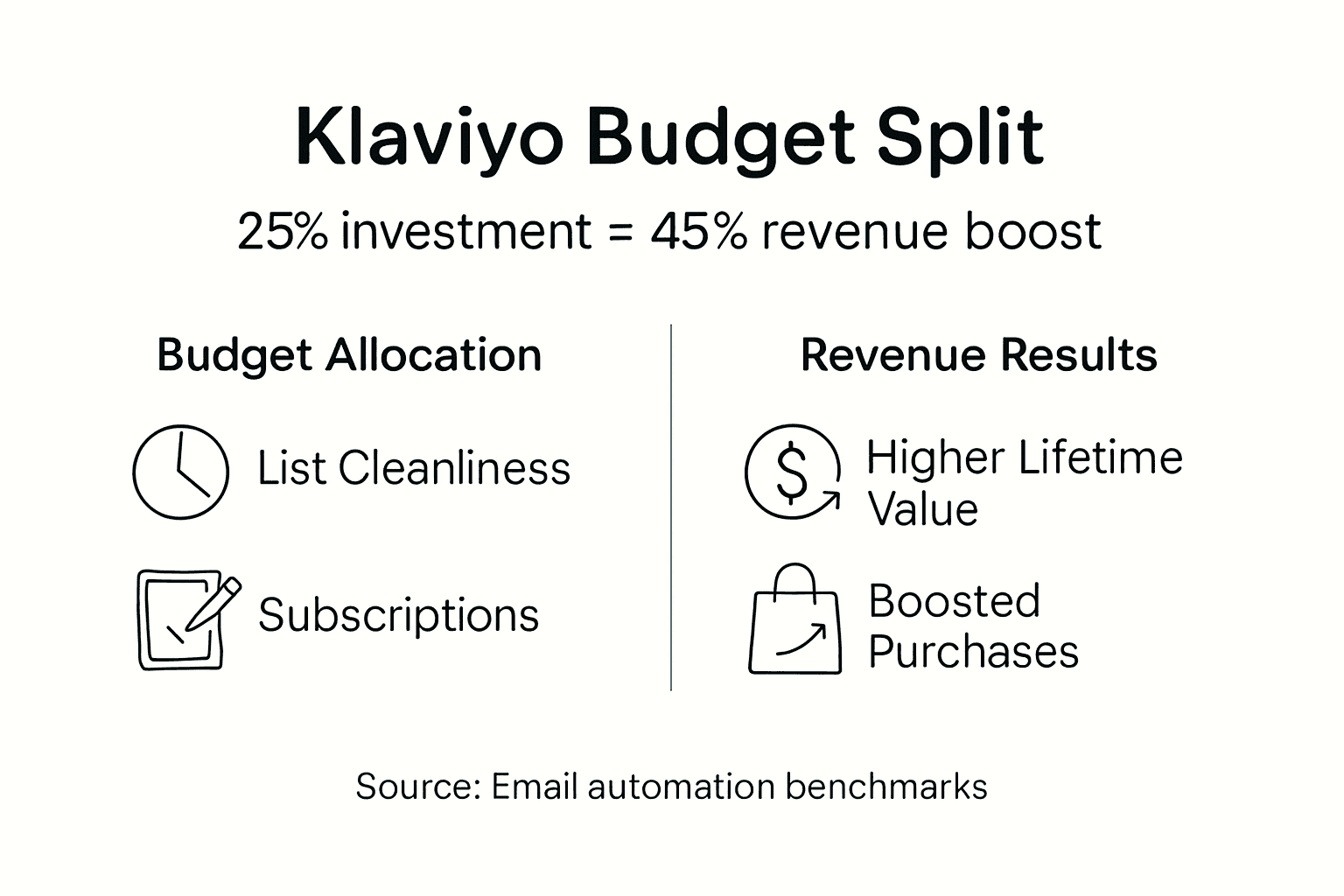
Marketing Budget: 25% to Klaviyo = 45% Revenue Boost
Every ecommerce brand faces a tough question: how much should we invest in customer acquisition versus retention? Most brands pour budgets into chasing new customers while automated retention sits underfunded. Yet allocating 20-30% of marketing spend to email and SMS automation through platforms like Klaviyo can unlock sustainable revenue growth. This guide shows you exactly how to optimize your marketing budget allocation to maximize ROI with Klaviyo automation.
Table of Contents
- Prerequisites And What You Need Before Allocating Your Marketing Budget
- Step-By-Step Marketing Budget Allocation Process For Klaviyo Automation
- Common Mistakes And Troubleshooting In Marketing Budget Allocation
- Alternative Approaches And Tradeoffs In Budget Allocation
- Expected Results And Outcomes Of Optimized Marketing Budget Allocation With Klaviyo
- Frequently Asked Questions About Marketing Budget Allocation With Klaviyo
Key Takeaways
| Point | Details |
|---|---|
| Optimal Budget Split | Allocate 20-30% of marketing budget to Klaviyo automation for maximum retention and revenue impact. |
| Prerequisites Matter | Clean email lists and clear retention goals are essential before effective budget allocation. |
| Strategic Priorities | Focus spending on segmentation, AI personalization, and core automated flows for best results. |
| Avoid Common Traps | Underfunding list hygiene and ignoring analytics will sabotage your budget efficiency. |
| Expected Outcomes | Brands see up to 45% revenue increase within six months of optimized allocation. |
Prerequisites and What You Need Before Allocating Your Marketing Budget
Before dividing your marketing dollars, you need solid foundations. Without proper setup, even generous budgets will underperform.
First, integrate your ecommerce platform with Klaviyo. Shopify, WooCommerce, and Magento all connect seamlessly, feeding customer data into your automation engine. This integration powers the personalization that drives retention.
Second, clean your email list. Bounced emails and invalid addresses drain budgets and hurt deliverability. Tools like no2bounce validate contacts, ensuring your messages reach real customers. Clean lists improve open rates and protect sender reputation.
Third, understand Klaviyo basics. You need working knowledge of flows, segments, and retention metrics. Learn how welcome series nurture new subscribers, abandoned cart flows recover lost sales, and post-purchase sequences build loyalty. Explore email segmentation strategies to understand how targeting increases relevance.
Fourth, establish flexible budgeting frameworks. Marketing isn’t static. Your budget must adapt as you test subject lines, optimize send times, and refine segments. Build in room for experimentation.
Finally, commit to the recommended allocation. Marketing budgets for ecommerce should dedicate roughly 20-30% to email and SMS automation for maximum retention and revenue growth. This range balances acquisition with lifecycle marketing, ensuring you don’t just find customers but keep them.
Consider these essential prerequisites:
- Active Klaviyo account integrated with your ecommerce platform
- Validated, segmented email list with reliable deliverability
- Basic understanding of automated flows and retention marketing goals
- Budget flexibility for testing and optimization cycles
- Commitment to list segmentation for ecommerce best practices
Pro Tip: Before allocating a single dollar, audit your current email performance. Identify which flows exist, which are missing, and where revenue leaks occur. This baseline guides smarter budget decisions.
Step-by-Step Marketing Budget Allocation Process for Klaviyo Automation
Allocating budgets strategically transforms email from a cost center into a revenue driver. Follow this proven sequence.
1. Define retention-focused marketing goals. Set clear targets for customer lifetime value, repeat purchase rate, and churn reduction. Goals anchor budget decisions in measurable outcomes.

2. Allocate 20-30% of total marketing budget to Klaviyo automation. This portion funds platform subscription, list management tools, content creation, and optimization labor. Larger brands may skew toward 20%, while growing brands benefit from the 30% range to accelerate retention.
3. Implement RFM segmentation. Divide customers by Recency, Frequency, and Monetary value. This creates targeted groups for personalized messaging. High-value segments deserve premium content and offers, while at-risk segments need win-back campaigns.
4. Fund essential automated flows first. Prioritize these revenue generators:
- Welcome series to onboard new subscribers
- Abandoned cart recovery to recapture lost revenue
- Post-purchase follow-up to encourage reviews and repeat orders
- Win-back campaigns to re-engage dormant customers
- Browse abandonment to capture interested shoppers
Each flow requires initial setup costs and ongoing optimization budget. Email marketing guides for beginners explain flow fundamentals in detail.
5. Reserve funds for AI-driven personalization. Klaviyo’s predictive analytics and product recommendations boost relevance. AI personalization increases email open rates by up to 50% compared to generic campaigns. Budget for advanced segmentation features and dynamic content.
6. Plan for ongoing optimization. Allocate 10-15% of your automation budget to testing and refinement. Use Klaviyo’s analytics to identify underperforming flows, then invest in improved copy, design, or targeting. Optimization compounds returns over time.
7. Set realistic timelines. Klaviyo implementation typically takes 3-6 months to fully deploy, with measurable revenue impact starting within the first quarter. Budget for this ramp-up period without expecting instant returns.
| Budget Component | Percentage of Automation Budget | Purpose |
|---|---|---|
| Platform & Tools | 25-30% | Klaviyo subscription, list hygiene, integrations |
| Core Flows Setup | 35-40% | Welcome, cart abandonment, post-purchase, win-back |
| AI Personalization | 15-20% | Predictive analytics, dynamic content, advanced segmentation |
| Optimization & Testing | 10-15% | A/B testing, flow refinement, performance analysis |
This allocation ensures comprehensive coverage while maintaining flexibility. Adjust percentages based on your brand’s maturity and specific gaps. For deeper strategies on maximizing value per customer, review customer lifetime value optimization techniques.
Pro Tip: Start with fewer, well-funded flows rather than spreading budgets thin across many mediocre automations. Three excellent flows outperform ten poorly executed ones.
Common Mistakes and Troubleshooting in Marketing Budget Allocation
Even with solid plans, brands stumble. Avoid these pitfalls to protect your investment.
Underfunding list hygiene destroys deliverability. Ignoring email validation tools like no2bounce seems like a budget saver. It’s not. Common failures include under-investing in list hygiene, leading to spam folder placement and damaged sender reputation. Invest in regular list cleaning to maintain inbox access.
Neglecting dynamic segmentation kills relevance. Sending identical messages to all subscribers wastes budget and alienates customers. Without proper segmentation, your campaigns lack personalization that drives conversions. Review email segmentation mistakes to avoid to sharpen targeting.
Over-investing in acquisition overshadows retention. New customer costs keep rising, yet many brands pour 70-80% of budgets into acquisition channels. This creates a leaky bucket where customers churn faster than you acquire them. Rebalance toward retention to improve unit economics.
Ignoring Klaviyo analytics stalls optimization. The platform provides detailed performance data on every flow and campaign. Brands that don’t review metrics miss opportunities to double down on winners and fix losers. Schedule monthly analytics reviews to guide budget shifts.
Skipping regular flow audits limits growth. Automated flows run continuously, but customer behavior evolves. Outdated messaging, broken links, or irrelevant offers reduce effectiveness over time. Audit flows quarterly to ensure they align with current customer needs and business goals.
Here’s how to fix these issues:
- Set aside 5-8% of automation budget for list hygiene tools and validation
- Use RFM segmentation to create at least 4-6 distinct customer groups
- Shift 10% of acquisition budget to retention flows every quarter until you reach the 20-30% target
- Block calendar time monthly to review Klaviyo dashboards and adjust underperformers
- Conduct flow audits every 90 days, updating copy and offers based on seasonal trends
Pro Tip: Create a troubleshooting checklist. When campaign performance drops, systematically check list health, segment accuracy, flow logic, and creative relevance before assuming the strategy failed. Often, small technical issues cause big performance swings.
For more guidance on avoiding pitfalls, explore common email marketing mistakes that drain budgets.
Alternative Approaches and Tradeoffs in Budget Allocation
No single budget model fits every brand. Understand your options and their consequences.
Balanced budgets optimize acquisition and retention equally. Allocating 25% to automation and 75% to acquisition drives steady growth without ignoring either channel. This works well for established brands with predictable customer behavior. The tradeoff: you won’t dominate retention as aggressively as specialists.
Retention-heavy budgets maximize customer lifetime value. Pushing 40-50% of marketing spend into Klaviyo automation reduces churn and increases repeat purchase rates dramatically. Ideal for subscription brands or high-ticket products where retention drives profitability. The risk: slower new customer growth may limit top-line expansion.
Acquisition-heavy budgets fuel rapid scaling. Keeping automation at 10-15% while pumping 85-90% into ads generates fast customer volume. This appeals to venture-backed brands prioritizing growth over immediate profitability. The danger: high churn rates and lower lifetime values erode margins over time.
Testing-heavy approaches enable data-driven refinement. Reserving 20% of automation budget for experimentation allows rapid iteration. You discover what works through controlled tests rather than assumptions. The requirement: patient leadership willing to accept short-term inefficiency for long-term optimization. Review email marketing budget approaches for implementation details.
Manual optimization lowers costs but limits scale. Handling segmentation, copywriting, and analysis in-house reduces agency fees. Effective for smaller brands with lean teams. The limitation: manual processes can’t match AI-driven efficiency as volume grows. Consider retention-focused budget benefits when deciding between manual and automated approaches.
| Approach | Acquisition % | Retention % | Best For | Main Tradeoff |
|---|---|---|---|---|
| Balanced | 70-75% | 25-30% | Established brands seeking steady growth | Moderate results in both channels |
| Retention-Heavy | 50-60% | 40-50% | Subscription or high-LTV businesses | Slower new customer acquisition |
| Acquisition-Heavy | 85-90% | 10-15% | Rapid-scaling, VC-backed startups | High churn, low lifetime value |
| Testing-Heavy | 65-70% | 30-35% (20% tests) | Data-driven brands optimizing performance | Short-term inefficiency |
| Manual Optimization | 75-80% | 20-25% | Small teams with tight budgets | Limited scalability |
Choose based on your business stage, goals, and resources. Early-stage brands often start acquisition-heavy, then shift toward balanced or retention-heavy as they mature. The key is intentional allocation aligned with strategic priorities, not default spending patterns.
Expected Results and Outcomes of Optimized Marketing Budget Allocation with Klaviyo
What returns should you expect from properly allocated budgets? Let’s set realistic benchmarks.
Automated Klaviyo flows generate 30 times more revenue per recipient than one-off campaigns. This multiplier effect explains why retention budgets punch above their weight. A modest flow investment delivers outsized returns compared to equivalent campaign spending.
Brands implementing optimized Klaviyo strategies see an average 45% increase in email marketing revenue within six months. This isn’t marginal improvement. It’s transformational growth from a single channel.
Improved segmentation and personalization drive higher engagement. Expect open rates to climb 15-25% as you target customers with relevant messages. Click-through rates typically improve 20-35% when content matches recipient interests and purchase history.
Timelines matter. Most brands need 3-6 months post-budget reallocation to see measurable revenue impact. The first 60 days focus on setup and testing. Months three through six deliver accelerating returns as optimizations compound.
Higher allocation to retention automation reduces churn by 10-20% for typical ecommerce brands. Fewer customers leaving means more revenue from existing relationships. This improved retention directly boosts customer lifetime value, making acquisition more profitable.
Revenue Impact Snapshot:
- 30x revenue per recipient from automated flows vs. campaigns
- 45% average revenue increase within six months
- 15-25% improvement in email open rates
- 20-35% increase in click-through rates
- 10-20% reduction in customer churn
These outcomes reflect proper execution, not just budget allocation. You need clean lists, strategic segmentation, compelling content, and ongoing optimization. But with those elements in place, the revenue lift is reliable and repeatable. Learn more about customer retention impact on long-term profitability.
Optimize Your Klaviyo Marketing Budget with Take Action
Allocating budgets strategically is one thing. Executing flawlessly is another.
Take Action specializes in maximizing Klaviyo ROI for ecommerce brands. We handle everything from email segmentation strategies to AI-powered personalization, ensuring every dollar drives measurable revenue. Our team builds automated flows that convert, segments that engage, and campaigns that scale.
Whether you need expert guidance on flow architecture, advanced segmentation, or comprehensive retention marketing services, we deliver results. Explore our blog for proven customer lifetime value strategies and service comparisons. Ready to transform your email channel into a growth engine? Contact Take Action for personalized support tailored to your brand’s goals and budget. Let’s turn your Klaviyo investment into sustainable revenue growth.
Frequently Asked Questions about Marketing Budget Allocation with Klaviyo
What percentage of my marketing budget should go to Klaviyo automation?
Allocate 20-30% of your total marketing budget to email and SMS automation through Klaviyo. This range balances acquisition with retention, funding essential flows and optimization while maintaining growth channels.
How long before I see ROI from Klaviyo budget allocation?
Most brands see measurable revenue impact within 3-6 months after optimizing budget allocation. Initial setup takes 60-90 days, with accelerating returns as flows mature and optimizations compound.
Why does list hygiene matter for budget efficiency?
Clean email lists improve deliverability, protecting your sender reputation and ensuring messages reach inboxes. Bounced emails and invalid addresses waste budget and reduce campaign effectiveness by 20-30%.
Should I prioritize segmentation or AI personalization first?
Prioritize segmentation. Basic RFM grouping unlocks immediate relevance gains with lower investment. Add AI personalization once segmentation is solid to amplify results through predictive analytics and dynamic content.
How do I balance acquisition and retention spending?
Start with 25% to retention if you’re established, 30% if you’re scaling. Monitor customer lifetime value and churn rates quarterly, shifting budget toward retention if churn exceeds 20% or LTV declines.
What are essential Klaviyo flows that need budget priority?
Fund welcome series, abandoned cart recovery, post-purchase follow-up, and win-back campaigns first. These four flows capture the entire customer lifecycle and deliver the highest returns per dollar invested.
Recommended
- Master Target Audience Research for Higher Email ROI | Take Action Blog | Take Action
- List Segmentation: Boosting Ecommerce Email Engagement | Take Action Blog | Take Action
- Email Segmentation Strategies for Ecommerce Growth | Take Action Blog | Take Action
- Social Content Strategy: Driving Email Engagement Growth | Take Action Blog | Take Action
- Fashion Shopping Workflow 2026: 25% Faster, 30% Fewer Returns – 16th Avenue
- Emotional Buying Causes 50% More Pollution: Eco Guide - STOMART.CO.UK