

Pinterest Traffic for Ecommerce Brands: Boost Email ROI
Every eCommerce owner who counts on Klaviyo for driving email sales knows how competitive customer acquisition has become. The real challenge is reaching shoppers who are ready to buy, not just browsing social feeds for entertainment. Pinterest stands out as a visual discovery platform where millions of users in the United States and Canada actively search for new products, inspiration, and solutions. This introduction breaks down how Pinterest traffic can transform your customer retention strategy, feed your email list, and fuel steady sales growth.
Table of Contents
- What Is Pinterest Traffic And Why It Matters
- Types Of Pinterest Content That Drive Traffic
- Integrating Pinterest With Email Marketing Efforts
- Common Pinterest Traffic Challenges For Brands
- Maximizing Pinterest To Diversify Revenue Streams
Key Takeaways
| Point | Details |
|---|---|
| Pinterest Traffic Is Valuable | It attracts over 460 million active users with high purchase intent, making it crucial for ecommerce brands. |
| Content Strategy Matters | Successful pins should be visually engaging and relevant, focusing on content types that drive traffic and conversions. |
| Integrate Pinterest With Email Marketing | Using Pinterest to capture email subscribers allows you to nurture them into repeat customers, creating a closed-loop revenue system. |
| Diversify Revenue Streams | Pinterest can generate multiple revenue events, including direct sales, email subscriptions, and repeat purchases, if strategically utilized. |
What Is Pinterest Traffic and Why It Matters
Pinterest is a visual discovery platform where users search for inspiration, ideas, and products to buy. Unlike Facebook or Instagram where people share personal updates, Pinterest users actively hunt for specific things they want—a new kitchen design, workout gear, or wedding ideas. This intent makes Pinterest traffic incredibly valuable for ecommerce brands.
Pinterest serves over 460 million active users worldwide who visit the platform specifically to discover and purchase products. These aren’t passive browsers scrolling for entertainment. They’re shoppers with purchasing intent searching for solutions.
Here’s what makes Pinterest traffic different from other social channels:
Here’s how Pinterest stands apart from other social platforms for ecommerce marketers:
| Platform Aspect | Pinterest Advantage | Key Marketing Result |
|---|---|---|
| User Intent | High purchase focus | More qualified site visitors |
| Content Longevity | Months to years | Steady, lasting traffic flow |
| Engagement Type | Active discovery | Higher conversion likelihood |
| Traffic Value | Warmer, niche audiences | Better email opt-in rates |
- High purchase intent: Users come to find products and ideas they actually want to buy
- Visual discovery: Pins with strong imagery drive clicks and engagement far better than text-based posts
- Evergreen content: Your pins continue driving traffic months or years after posting, unlike Instagram stories that disappear in 24 hours
- Qualified audience: Visitors landing on your site from Pinterest are already interested in your niche
For ecommerce brands using Klaviyo, Pinterest traffic becomes a second revenue stream beyond paid ads and organic search. When you drive new visitors to your site through Pinterest, you capture their email addresses through strategic lead magnets, welcome flows, and post-purchase automation. These email subscribers then generate repeat purchases through your nurture sequences.
The math works like this: More Pinterest traffic equals more site visitors. More visitors equals more email captures. More email subscribers equals higher lifetime customer value through retention campaigns.
Pinterest traffic feeds your email list with engaged, purchase-ready audiences—meaning higher revenue per new visitor compared to cold traffic sources.
Consider this scenario: A sustainable activewear brand drives 500 monthly visitors from Pinterest. If just 15% subscribe to their email list, that’s 75 new Klaviyo subscribers every month. Over a year, that’s 900 engaged subscribers who’ve already expressed interest in your products. Your abandoned cart flows, post-purchase upsells, and seasonal campaigns now reach an audience with proven engagement.
Without Pinterest traffic flowing into your email system, you’re relying entirely on paid ads to find customers. With it, you’re building an owned audience that drives consistent sales at a fraction of the cost.
The connection between Pinterest and email revenue is direct. Pinterest acts as a visual content platform that drives referral traffic, which means your email marketing has a larger subscriber base to work with. More subscribers mean more revenue from your email campaigns.
Pro tip: Start by identifying your 10 best-converting products and create 5 different pin designs for each. This gives Pinterest’s algorithm plenty of variations to test which designs resonate most with your target audience, sending the highest-quality traffic to your site.
Types of Pinterest Content That Drive Traffic
Not all pins perform equally on Pinterest. The platform rewards specific content types that users actually engage with and share. Understanding which formats drive traffic is essential for building your strategy.
Pinterest content includes pins with images, videos, and articles that drive discovery and traffic to ecommerce sites. The most successful pins combine strong visuals with relevant keywords so Pinterest’s algorithm surfaces them to the right audience.
Here are the content types that consistently drive traffic for ecommerce brands:
- How-to and tutorial pins: Step-by-step visual guides showing how to use or style your products
- Before-and-after pins: Transformation images that showcase product results or styling changes
- Lifestyle and inspiration pins: Images showing products in real-life settings or aspirational contexts
- Product collection pins: Flat-lay photography or styled shots of multiple complementary items
- Behind-the-scenes pins: Authentic photos from your studio, warehouse, or production process
- Quote and text overlay pins: Inspirational or motivational designs relevant to your niche
One often-overlooked content type is user-generated content (UGC) such as customer reviews and photos. When customers pin photos of themselves using your products, those pins gain authenticity that branded content can’t match. This UGC drives higher conversions because buyers trust peer recommendations more than brand claims.
Below is a summary of top Pinterest content types and their main benefits:
| Content Type | Drives Traffic By | Best For |
|---|---|---|
| How-to Tutorials | Solving user problems visually | Showcasing product usage |
| Before-and-After Images | Demonstrating real transformations | Proving product effectiveness |
| Lifestyle Inspiration | Creating aspiration and context | Building emotional product connections |
| User-Generated Content | Adding authenticity and trust | Leveraging peer recommendations |
| Video Pins | Showcasing products in action | Driving quick engagement and interest |
The most shareable Pinterest content solves a problem, inspires action, or shows real results—not generic promotional material.
Video pins deserve special attention. While static images dominate Pinterest, short videos (under 15 seconds) are gaining traction. Demonstration videos showing your product in action, quick styling tips, or customer unboxings drive significant engagement and click-through rates.
The key to all these formats is consistency with your brand aesthetic. Your pins should look cohesive across your entire profile. Use the same color palette, fonts, and photography style so users recognize your pins instantly as they scroll.

When you combine these content types with strategic social content planning, you create a steady stream of pins that feed traffic to your site. This traffic then flows into your Klaviyo welcome sequence, capturing emails from engaged, purchase-ready visitors.
Pro tip: Create pins in batches using a consistent template system—design 20-30 pins at once with the same layout and branding, then schedule them to post over several weeks. This approach saves time and ensures your profile maintains visual consistency across all content.
Integrating Pinterest With Email Marketing Efforts
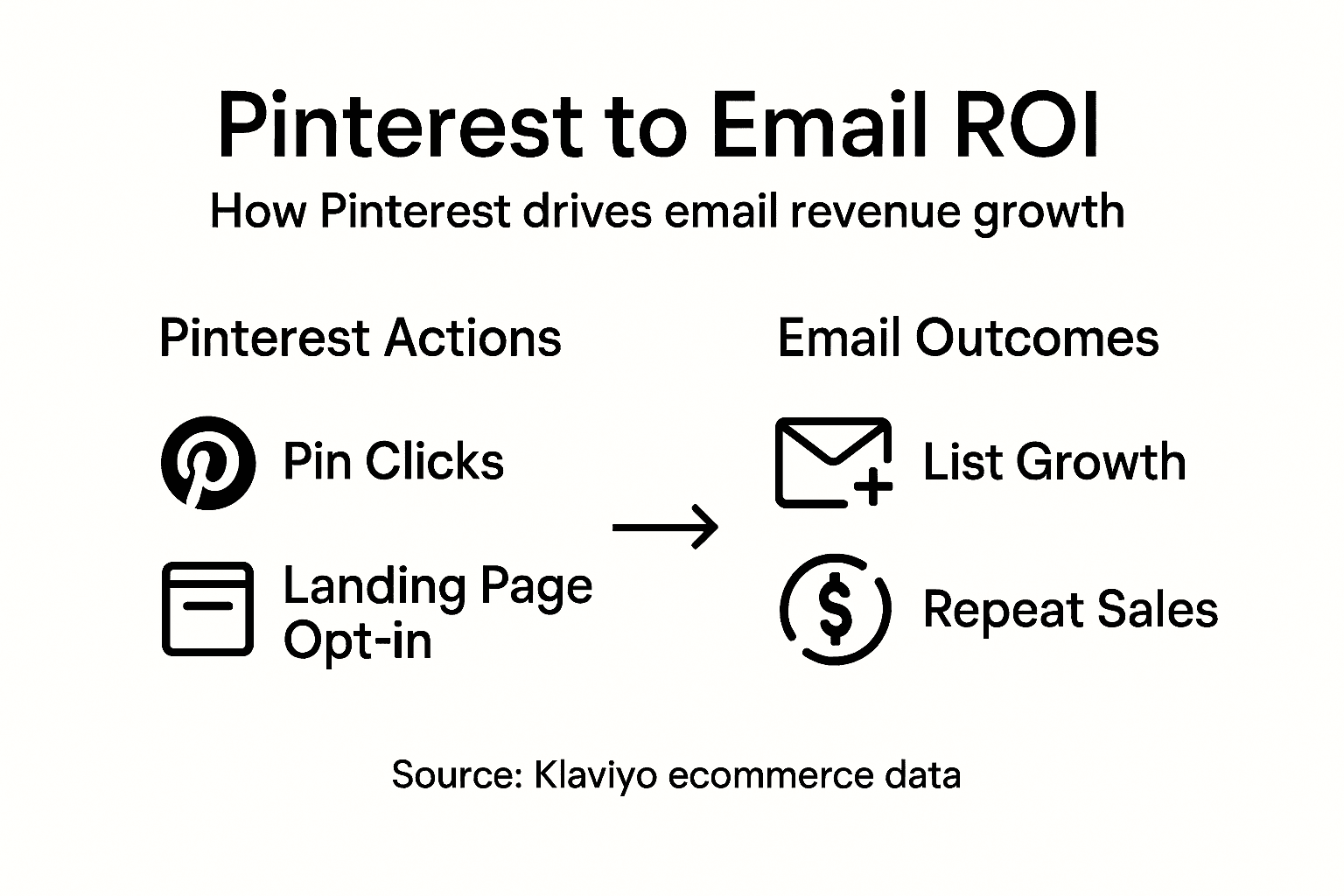
Pinterest and email marketing aren’t separate channels—they work together to drive revenue. Pinterest brings traffic to your site and captures new email subscribers. Email nurtures those subscribers into repeat customers. Connecting these two channels multiplies your results.
The integration starts with capturing Pinterest visitors into your email list. When someone clicks from Pinterest to your site, they land on a page with a strategic lead magnet or welcome offer. They exchange their email for a discount code, free guide, or exclusive product access. Now they’re in your Klaviyo database, ready for your nurture sequences.
You can also embed Pinterest content directly into email campaigns to keep visual inspiration front and center. Showcase your best-performing pins or seasonal collections within your emails. This visual enrichment increases engagement because subscribers see what’s trending on Pinterest without leaving their inbox.
Here’s how to structure this integration:
- Pinterest traffic → Landing page: Direct clicks from pins to a dedicated landing page with a clear conversion goal
- Landing page → Email capture: Offer something valuable in exchange for an email address
- Email → Klaviyo segmentation: Tag new subscribers based on which pin or product category brought them in
- Segmented campaigns: Send follow-up emails featuring similar products or content they engaged with on Pinterest
Segmentation is critical here. If someone clicked a pin about sustainable fashion, they shouldn’t receive emails about home decor. Segmentation allows you to send targeted emails that match each subscriber’s interests, driving higher open rates and conversions.
Email marketing delivers strong ROI when combined with targeted traffic sources like Pinterest. Your email campaigns can feature seasonal pins, new arrivals, or customer favorites—content your Pinterest audience already knows and loves.
The real power emerges when Pinterest feeds engaged visitors into email, and email converts them into loyal customers who buy repeatedly.
Track this integration by creating unique UTM parameters for each pin or board. In Klaviyo, use source tracking to identify which pins drive the most valuable subscribers. Double down on the content types and products that convert best.
This closed-loop system transforms Pinterest from a one-time traffic source into a sustainable customer acquisition channel feeding your email growth machine.
Pro tip: Create a dedicated landing page for your top 5 performing pins, each with a unique offer based on the pin’s content—this ensures message alignment and dramatically improves email capture rates from Pinterest traffic.
Common Pinterest Traffic Challenges for Brands
Pinterest looks simple on the surface, but driving consistent traffic requires navigating real obstacles. Most brands underestimate these challenges and abandon their Pinterest strategy when results don’t materialize quickly.
The first major hurdle is algorithm competition. Pinterest hosts billions of pins competing for visibility. Understanding Pinterest’s visual search algorithm and SEO tactics is essential because the platform prioritizes highly engaging and relevant pins. Your pins can be beautiful but still invisible if they don’t align with what users search for and what the algorithm favors.
Content relevance directly impacts your success. If your pin descriptions lack keywords your audience actually searches, the algorithm won’t surface them. This requires ongoing testing and optimization—something many brands don’t budget time for.
Here are the obstacles you’ll likely face:
- Low click-through rates: Pins that get impressions but fail to drive clicks waste your effort
- Ad saturation: Sponsored pins clutter user feeds, making organic pins harder to stand out
- Content filtering: Pinterest filters content for safety concerns and relevance, potentially limiting your reach if pins don’t meet guidelines
- Audience mismatch: Driving traffic that doesn’t convert because you’re reaching the wrong people
- Inconsistent posting: Algorithm favors active pinners, but many brands pin sporadically and lose momentum
Balancing promotional and authentic content trips up many brands. Users come to Pinterest for inspiration, not constant sales pitches. Too many promotional pins get buried, while purely inspirational pins drive traffic but don’t directly showcase your products.
The challenge isn’t getting pins in front of people—it’s getting the right pins in front of the right people who actually click and convert.
Scaling Pinterest traffic also requires strategic creativity. Generic product photos underperform dramatically compared to styled, aspirational imagery. This means investing in quality photography or design work that most brands aren’t prepared for.
Tracking which pins drive valuable email subscribers (not just any traffic) adds another layer of complexity. Many brands track traffic volume but miss the ROI picture—they don’t know if Pinterest visitors actually convert into email subscribers and paying customers.
Using creative brainstorming techniques can help you develop pin concepts that break through saturation and resonate with your audience.
Pro tip: Audit your top 20 performing pins and identify the common elements—color palette, composition style, messaging angle—then create variations using those proven patterns instead of experimenting randomly with every new pin.
Maximizing Pinterest to Diversify Revenue Streams
Most ecommerce brands treat Pinterest as a single traffic source. They pin, they get clicks, they call it done. But Pinterest can fuel multiple revenue channels simultaneously if you structure it strategically.
The key is viewing Pinterest as an audience funnel, not just a click generator. Leveraging audience engagement funnels converts Pinterest discovery into sales and subscriptions while building a loyal community that generates recurring revenue beyond one-time purchases.
Here’s the reality: One Pinterest visitor can generate revenue through multiple channels. They might click a pin, land on your site, buy a product, subscribe to your email list, and then purchase again three months later. That’s four revenue events from one traffic source.
Diversifying your Pinterest revenue streams means:
- Direct ecommerce sales: Pins driving product page clicks and immediate purchases
- Email subscriber acquisition: Pinterest traffic feeding your Klaviyo list with engaged prospects
- Repeat customer revenue: Email nurture sequences converting subscribers into repeat buyers
- Upsell opportunities: Abandoned cart flows and post-purchase campaigns reaching Pinterest-sourced customers
- Affiliate commissions: Pinning products from brands you partner with, earning commission on referred sales
Revenue optimization on Pinterest uses data analytics to improve targeting and optimize pricing. You’re not guessing which pins drive value—you’re measuring which traffic sources actually convert into high-lifetime-value customers.
Segmentation is critical here. If you’re driving Pinterest traffic into Klaviyo without segmentation, you’re missing revenue opportunities. Tag subscribers by the pins or product categories that brought them in. Then send them targeted follow-up campaigns featuring similar products or complementary items.
The brands dominating Pinterest revenue aren’t just getting traffic—they’re strategically routing that traffic into multiple monetization channels simultaneously.
Consider a sustainable fashion brand. A user clicks a pin about eco-friendly activewear, lands on the product page, and buys. They also join the email list. Now they’re in a nurture sequence receiving seasonal campaigns, product recommendations based on their purchase, and exclusive member-only offers. Over their lifetime, that single Pinterest click generates $200+ in revenue.
Without this funnel structure, that same click generates one $40 sale and nothing else.
Content repurposing across channels means your Pinterest pins can also feed blog content, email campaigns, and social media, multiplying the value of each creative asset you develop.
Track everything. Use UTM parameters to identify which pins drive the most valuable subscribers. In Klaviyo, segment by traffic source and measure the lifetime value of Pinterest-sourced customers versus other channels. Double down on what works.
Pro tip: Create a “Pinterest VIP” email segment for your highest-value customers sourced from Pinterest, then send them exclusive early-access offers and member-only products before promoting to your general list.
Unlock Your Pinterest Traffic Potential with Expert Email Marketing
Driving Pinterest traffic is only half the battle. The real challenge lies in converting those engaged, purchase-ready visitors into loyal customers who fuel your brand’s growth over time. If you are struggling with low email capture rates, segmentation hurdles, or maximizing the lifetime value of Pinterest audiences, Take Action is here to help you turn clicks into consistent revenue.
With our email marketing expertise, we specialize in crafting Klaviyo automations, strategic campaigns, and flow setups that capture Pinterest visitors at the perfect moment. We focus on automation, segmentation, and personalized nurture sequences that maximize repeat purchases from your Pinterest-sourced leads. From welcome flows triggered by unique Pinterest landing pages to abandoned cart recovery designed to rescue potential sales, our data-driven approach helps you diversify your revenue beyond paid ads.
Ready to transform your Pinterest strategy into a powerful email revenue engine?
Discover how our dedicated team combines human expertise with AI-driven insights to optimize your email list growth and campaign performance. Visit Take Action now to start building an owned audience that turns Pinterest traffic into lasting customer relationships and scalable growth.
Frequently Asked Questions
What is Pinterest traffic and why is it valuable for ecommerce brands?
Pinterest traffic refers to visits to a website driven by Pinterest users, who actively search for products and ideas. It is valuable for ecommerce brands because it consists of highly qualified visitors with purchasing intent, leading to higher conversion rates and more email subscriptions.
How can I create effective Pinterest content to drive traffic?
To create effective Pinterest content, focus on visually appealing pins that offer solutions, such as how-to guides, transformation images, or lifestyle inspirations. Use strong imagery, relevant keywords, and maintain consistency in your branding for better visibility and engagement.
How does Pinterest traffic integrate with email marketing?
Pinterest traffic can be integrated with email marketing by capturing emails from visitors who click through from Pinterest. Brands can offer lead magnets or special offers, adding new subscribers to their email lists, which can then be nurtured into repeat customers through targeted email campaigns.
What are some common challenges brands face with Pinterest traffic?
Common challenges include low click-through rates due to algorithm competition, ad saturation making organic reach difficult, and driving the wrong audience to the site. Brands must also maintain consistent posting and balance promotional content with authentic, engaging pins.
Recommended
- Blog - Email Marketing Insights | Take Action | Take Action
- How to Repurpose Content for Ecommerce Email Success | Take Action Blog | Take Action
- Digital Media Strategy: Unlocking Ecommerce Growth | Take Action Blog | Take Action
- Email Marketing Mistakes That Hurt Ecommerce Growth | Take Action Blog | Take Action
- Amazon Email Marketing: Driving Sales and Loyalty - Searchoneers