

Social Proof Influencer Marketing for Ecommerce Success
Every ecommerce marketing manager knows the challenge of earning genuine trust and driving repeat engagement in a crowded inbox. As DTC brands using Klaviyo aim for measurable growth, the power of social proof in influencer marketing stands out as a key advantage. Modern research reveals that customers rely on trusted influencer recommendations to guide purchase decisions, making the integration of authentic endorsements crucial for brand credibility and retention.
Table of Contents
- Defining Social Proof In Influencer Marketing
- Types Of Influencer-Driven Social Proof Campaigns
- Integrating Social Proof Into Klaviyo Email Flows
- Measuring Impact: Conversion And Engagement Metrics
- Risks, Legal Pitfalls, And Authenticity Challenges
Key Takeaways
| Point | Details |
|---|---|
| Influencer Trust | Consumers increasingly rely on influencers for purchasing decisions, highlighting the importance of authentic engagement over follower count. |
| Diverse Campaign Types | Different influencer campaigns, such as macro and micro-influencer initiatives, serve various marketing strategies and objectives, each with specific advantages. |
| Social Proof in Emails | Integrating social proof into Klaviyo email flows can enhance conversion rates and customer trust through testimonials and influencer content. |
| Risk Management | Brands must navigate disclosure compliance and authenticity challenges while ensuring influencers are genuinely aligned with their values to maintain consumer trust. |
Defining social proof in influencer marketing
Social proof in influencer marketing represents a powerful psychological phenomenon where consumers make purchasing decisions based on the recommendations, experiences, and behaviors of trusted online personalities. Empirical research on social media marketing reveals that consumers increasingly rely on influencers’ endorsements to validate their purchasing choices.
At its core, social proof operates through several key psychological mechanisms:
- Trust transfer from influencer to brand
- Credibility amplification through perceived expertise
- Social validation of consumer decisions
- Emotional connection with content creators
Influencers serve as modern-day product ambassadors, transforming traditional word-of-mouth marketing into a digitally scalable strategy. Their impact stems from cultivating authentic relationships with audiences who view them as relatable experts rather than distant corporate spokespersons.

Psychological foundations of social proof in influencer marketing emerge from fundamental human tendencies to seek guidance from perceived authority figures. Research on influencer marketing dynamics demonstrates that consumers are more likely to trust recommendations from individuals who demonstrate genuine expertise and personal connection.
Pro tip: Prioritize influencers who demonstrate authentic engagement and genuine product understanding over pure follower count to maximize social proof effectiveness.
Types of influencer-driven social proof campaigns
Comprehensive research on influencer marketing campaigns reveals multiple strategic approaches for generating social proof across digital platforms. These campaigns can be categorized based on influencer scale, content format, and engagement mechanisms, each delivering unique value to ecommerce brands.
Key types of influencer-driven social proof campaigns include:
- Macro-influencer endorsements: High-visibility campaigns featuring celebrity or large-scale personalities
- Micro-influencer collaborations: Targeted, niche-specific content with higher engagement rates
- User-generated content drives: Authentic consumer experiences shared through brand-sponsored challenges
- Product review campaigns: In-depth, honest assessments from trusted content creators
- Live demonstration series: Real-time product showcases demonstrating practical applications
Each campaign type leverages distinct psychological triggers to build consumer trust. Macro-influencer campaigns capitalize on brand recognition and aspirational positioning, while micro-influencer strategies focus on relatability and genuine personal connection.
Here’s a comparison of influencer campaign types and their typical brand benefits:
| Campaign Type | Primary Advantage | Ideal Use Case |
|---|---|---|
| Macro-influencer | Wide brand exposure | New product launches |
| Micro-influencer | High engagement rates | Niche targeting |
| User-generated content | Greater authenticity | Community building |
| Product reviews | In-depth trust building | Complex products |
| Live demonstrations | Real-time validation | Feature showcases |
Performance dynamics vary significantly across campaign types. Systematic analysis of marketing strategies indicates that engagement rates and conversion potential differ dramatically based on influencer selection, content authenticity, and audience alignment.
Pro tip: Design influencer campaigns that prioritize genuine product understanding and authentic storytelling over pure reach metrics.
Integrating social proof into Klaviyo email flows
Insights into email engagement strategies reveal that incorporating social proof directly into Klaviyo email campaigns can dramatically increase conversion rates and customer trust. By strategically embedding user experiences, testimonials, and influencer content, brands can transform standard email communications into powerful trust-building mechanisms.
Key methods for integrating social proof in Klaviyo email flows include:
- Customer review snippets: Highlight top customer testimonials within email templates
- Influencer endorsement blocks: Create dedicated sections featuring influencer product recommendations
- User-generated content galleries: Showcase authentic customer photos and experiences
- Social validation metrics: Display total number of satisfied customers or recent purchases
- Trust badge integrations: Include certifications, awards, and third-party endorsements
Successful integration requires careful segmentation and personalization. Brands must match social proof elements with specific customer journey stages, ensuring relevance and maximum psychological impact. Dynamic content blocks in Klaviyo allow for sophisticated, targeted social proof placement that feels organic and compelling.
Performance optimization involves continuous testing and refinement of social proof elements. Different customer segments respond uniquely to various trust signals, making A/B testing and granular analytics critical for maximizing email engagement and conversion potential.
Pro tip: Rotate social proof content regularly and segment testimonials based on specific customer personas to maintain authenticity and relevance.
Measuring impact: conversion and engagement metrics
Advanced measurement frameworks provide critical insights into evaluating the effectiveness of social proof strategies in influencer marketing. By establishing comprehensive tracking mechanisms, ecommerce brands can quantify the precise impact of influencer collaborations on customer behavior and revenue generation.
Key performance metrics for assessing social proof effectiveness include:
- Click-through rates (CTR): Measure direct audience engagement with influencer content
- Conversion rate: Track percentage of influenced viewers who complete purchases
- Audience sentiment analysis: Evaluate qualitative responses and emotional resonance
- Follower growth rate: Monitor influencer’s ability to expand brand reach
- Revenue attribution: Calculate direct sales generated through specific influencer campaigns
Successful measurement requires sophisticated analytics that go beyond surface-level engagement. Brands must implement multi-dimensional tracking strategies that capture both immediate and long-term impact of social proof initiatives. Comprehensive consumer engagement research emphasizes the importance of tracking nuanced performance indicators that reflect authentic audience connection.
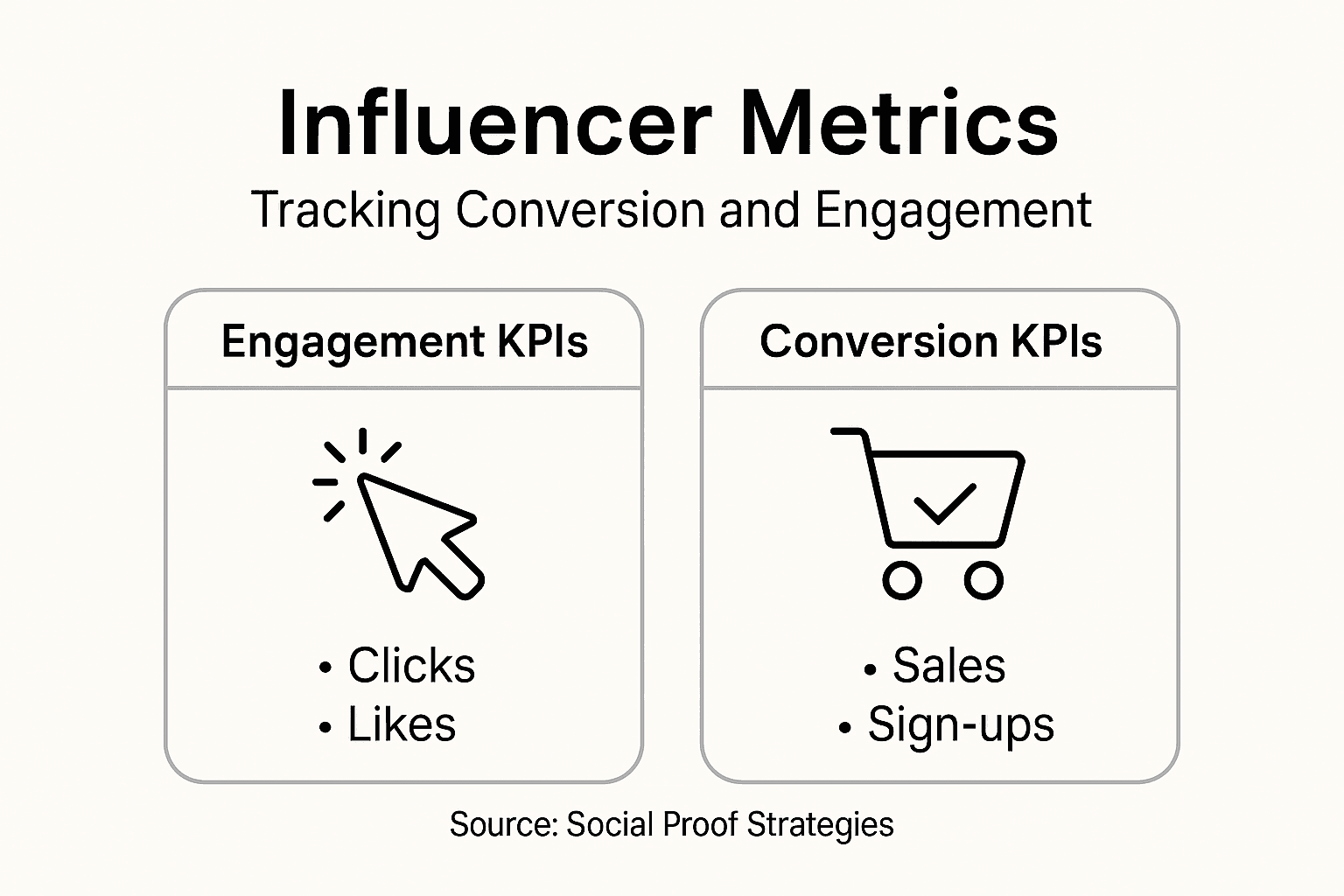
Key metrics offer distinct insights at different marketing funnel stages:
| Metric | Funnel Stage | Insight Provided |
|---|---|---|
| CTR | Awareness | Initial audience interest |
| Conversion rate | Decision | Actual purchase intent |
| Sentiment analysis | Consideration | Emotional audience response |
| Follower growth | Awareness | Long-term brand reach |
| Revenue attribution | Purchase | Direct financial impact |
Analytical depth separates high-performing influencer marketing programs from mediocre attempts. Advanced brands utilize granular segmentation, cross-platform tracking, and predictive modeling to understand the complex dynamics of social proof conversion.
Pro tip: Develop custom UTM parameters and unique tracking links for each influencer to enable precise performance measurement and eliminate attribution ambiguity.
Risks, legal pitfalls, and authenticity challenges
Comprehensive legal analysis of influencer marketing reveals a complex landscape of regulatory challenges that demand strategic navigation by ecommerce brands. Understanding these risks is crucial for maintaining brand integrity and avoiding potentially costly legal and reputational consequences.
Key risks and authenticity challenges include:
- Disclosure compliance: Mandatory transparent sponsorship notifications
- Intellectual property violations: Unauthorized content usage risks
- Fake follower detection: Identifying and mitigating fraudulent engagement
- Misleading advertising claims: Preventing exaggerated product representations
- Platform-specific regulatory variations: Navigating diverse international marketing regulations
Authenticity challenges represent a significant threat to influencer marketing effectiveness. Academic research on influencer perceptions demonstrates that consumers have increasingly sophisticated methods for detecting staged or inauthentic content, making genuine connection more critical than ever.
Successful brands implement rigorous vetting processes that go beyond follower count, focusing on demonstrated credibility, audience alignment, and consistent brand values. This approach mitigates risks while preserving the fundamental trust mechanism that makes social proof effective.
Pro tip: Develop a comprehensive influencer contract that explicitly outlines disclosure requirements, content guidelines, and potential penalties for misrepresentation.
Unlock Ecommerce Growth with Social Proof and Klaviyo Email Expertise
The article highlights the challenge ecommerce brands face in building authentic social proof through influencer marketing while effectively measuring its impact and maintaining legal compliance. You want to leverage trust transfer, credibility amplification, and genuine customer connections in your campaigns but also integrate these powerful social proof elements directly into your Klaviyo email flows. This is where strategy meets execution. At Take Action, we specialize in turning influencer-driven social proof into automated, conversion-focused email sequences. Our approach helps you segment your audience, feature genuine testimonials and influencer endorsements, and optimize every message for maximum engagement and revenue growth.
Incorporating social validation, user-generated content, and influencer reviews into your email marketing can dramatically increase open rates and sales recovery from abandoned carts. With our human expertise and AI-driven insights, we fine-tune your flows to build trust at every stage of the customer journey, ensuring your brand voice shines through. Don’t let social proof opportunities slip away because of unoptimized emails.
Explore how our Klaviyo automation services can help you scale your influencer marketing impact today.

Ready to transform social proof into your most powerful growth engine Use our proven email marketing solutions to automate retention, boost conversions, and build lasting customer relationships. Visit Take Action now and start turning authentic influencer connections into measurable revenue.
Frequently Asked Questions
What is social proof in influencer marketing?
Social proof in influencer marketing refers to the phenomenon where consumers make purchasing decisions based on the recommendations and experiences of trusted online personalities, or influencers, who they view as relatable experts.
How can influencer campaigns increase consumer trust?
Influencer campaigns can increase consumer trust by leveraging the emotional connection, perceived credibility, and authentic engagement influencers create with their audiences, making followers more likely to trust their recommendations.
What are the types of influencer-driven social proof campaigns?
Key types of influencer-driven social proof campaigns include macro-influencer endorsements, micro-influencer collaborations, user-generated content drives, product review campaigns, and live demonstration series, each with distinct advantages.
How can social proof be integrated into email marketing campaigns?
Social proof can be integrated into email marketing by embedding customer review snippets, influencer endorsement blocks, user-generated content galleries, social validation metrics, and trust badge integrations to build credibility and trust with recipients.
Recommended
- What Is Social Proof? Complete Guide for Ecommerce Brands | Take Action Blog | Take Action
- Complete Guide to the Importance of Social Proof | Take Action Blog | Take Action
- Influencer Marketing’s Impact on Ecommerce Growth | Take Action Blog | Take Action
- Importance of Customer Testimonials for Ecommerce Brands | Take Action Blog | Take Action
- Improve Post-Purchase Customer Experience | Order Tracking & WISMO Reduction