

Swipe Files: Unlocking Creative Wins in Ecommerce
Most American ecommerce marketers spend hours searching for inspiration before launching new campaigns. Creative blocks and slow idea generation can stall email automation and weaken customer retention. Swipe files offer a proven shortcut. By curating high-performing marketing assets from global brands, you can accelerate content development, spark innovative strategies, and sharpen Klaviyo automation for increased sales. Discover how American marketers use swipe files to stay ahead and unlock smarter email marketing techniques that actually convert.
Table of Contents
- What Are Swipe Files in Marketing?
- Popular Types of Swipe Files for Ecommerce
- How Swipe Files Impact Email Automation Strategy
- Best Practices for Building and Using Swipe Files
- Mistakes to Avoid With Swipe Files
Key Takeaways
| Point | Details |
|---|---|
| Definition of Swipe Files | Swipe files are curated collections of successful marketing materials that inspire creativity and accelerate content development. |
| Strategic Organization | Organize swipe files systematically by themes, campaigns, and channels for quick reference and inspiration. |
| Best Practices | Continuously maintain and update swipe files to ensure relevance and effectiveness while focusing on inspiration rather than direct copying. |
| Common Mistakes | Avoid pitfalls such as content hoarding, blind copying, and maintaining outdated examples to preserve creativity and originality. |
What Are Swipe Files in Marketing?
A swipe file is a curated collection of marketing materials designed to spark creativity and accelerate content development. Professionals across marketing, design, and creative industries maintain these dynamic reference libraries to capture, organize, and learn from successful campaign examples. Marketing inspiration archives serve as strategic repositories that help teams rapidly generate innovative ideas without starting from scratch.
These collections typically include a diverse range of high-performing marketing assets such as advertisements, email campaigns, social media posts, landing pages, and compelling visual content. By systematically organizing these materials by theme, industry, or campaign type, marketers can quickly reference proven strategies and design approaches. The goal is not to copy verbatim but to understand underlying patterns of successful communication and creative execution.
Marketing professionals build swipe files through multiple methods: screenshotting exceptional campaigns, saving PDFs, creating digital folders, or using specialized tools that help capture and categorize inspirational content. Multimedia marketing archives can include images, videos, written copy, design layouts, and interactive elements that demonstrate effective communication techniques across different channels.
Pro tip: Create a structured digital folder system with clear subcategories like “Email Design,” “Headline Formulas,” and “Social Media Hooks” to make your swipe file instantly searchable and maximally useful.
Here’s a quick comparison of swipe files and traditional brainstorming for marketing inspiration:
| Approach | Speed of Idea Generation | Organization Level | Risk of Copying |
|---|---|---|---|
| Swipe Files | Immediate references | Highly structured | Lower if curated |
| Traditional Brainstorming | Slower, unstructured | Often disorganized | Minimal risk |
Popular Types of Swipe Files for Ecommerce
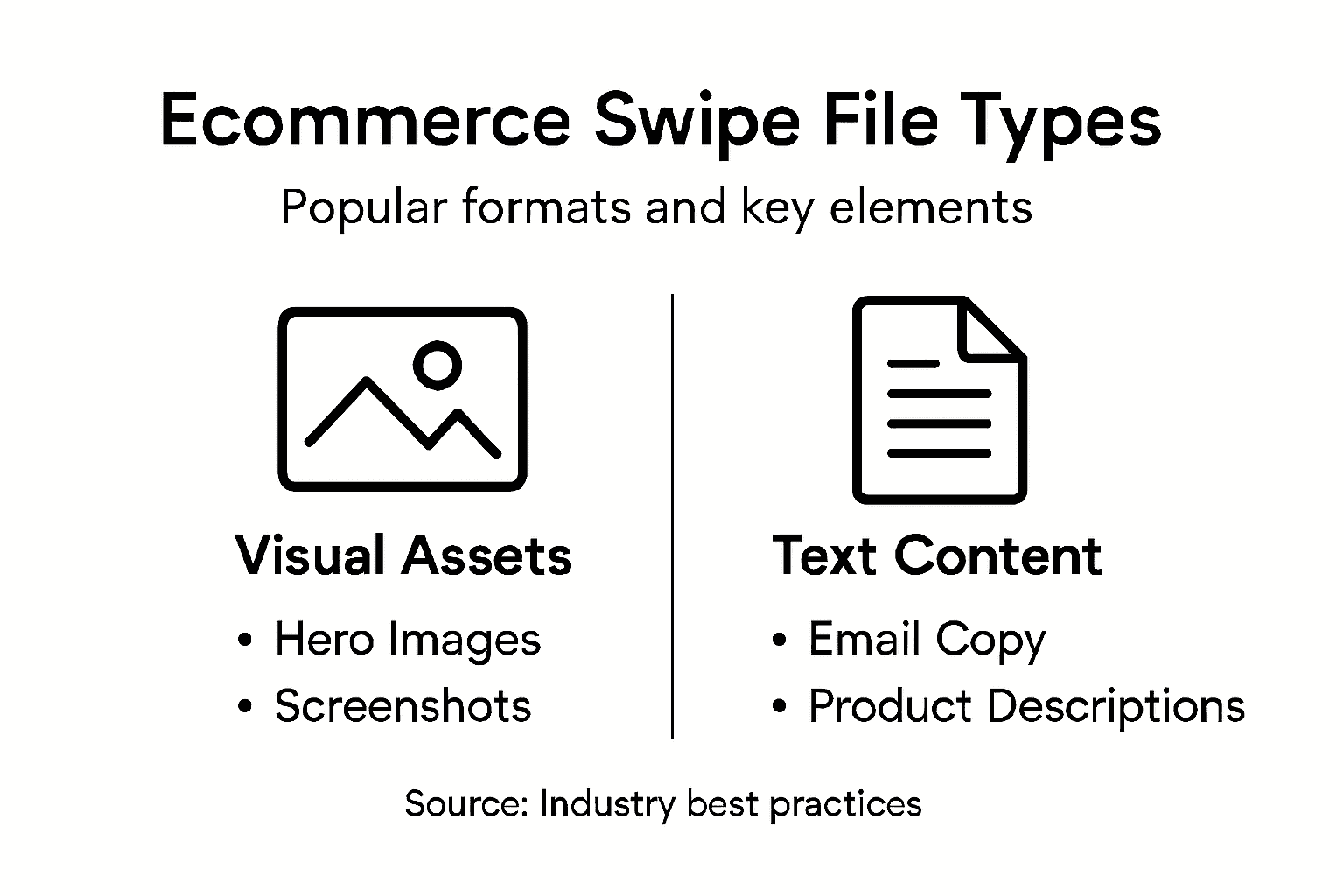
Ecommerce marketers leverage multiple types of swipe files to streamline their creative processes and gain strategic inspiration. Marketing content swipe files typically encompass diverse formats that capture successful campaign elements across different marketing channels, helping brands understand what resonates with their target audience.
These specialized collections often include key categories such as:
- Email Marketing Swipe Files: Screenshots of high-converting email designs, compelling subject lines, and effective promotional layouts
- Social Media Advertisement Swipe Files: Engaging Facebook, Instagram, and Pinterest ad creatives that demonstrate strong visual communication
- Landing Page Swipe Files: Optimized page designs that showcase persuasive copywriting, strategic element placement, and conversion-focused layouts
- Product Page Swipe Files: Examples of product descriptions, image compositions, and user experience design that drive customer engagement
Ecommerce content archives can contain multiple multimedia elements including images, videos, screenshots, and interactive design examples. These comprehensive collections help marketers rapidly analyze successful strategies across different platforms and industries, providing a rich source of inspiration for developing innovative marketing approaches.
Pro tip: Organize your swipe files with a consistent naming convention and include metadata like conversion rates, campaign dates, and target audience to make your reference library more actionable and insights-driven.
How Swipe Files Impact Email Automation Strategy
Email automation transforms marketing strategies by enabling personalized, scalable communication with customers. Marketing automation research reveals that swipe files play a crucial role in developing sophisticated email workflows that drive engagement and conversions.
Swipe files provide strategic advantages in email automation through several key mechanisms:
- Template Optimization: Offering pre-tested email designs that demonstrate proven conversion patterns
- Subject Line Inspiration: Showcasing compelling headline structures that improve open rates
- Workflow Design: Presenting successful customer journey mappings for abandoned cart, welcome series, and re-engagement campaigns
- Personalization Insights: Highlighting effective segmentation and targeting strategies that enhance message relevance
Marketing automation insights demonstrate that successful email strategies depend on high-quality data, strategic segmentation, and continuously refined messaging. Swipe files serve as a dynamic learning resource, allowing marketers to rapidly adapt and improve their automation strategies by studying successful campaign architectures and communication approaches.

Pro tip: Create a dedicated folder in your swipe file collection specifically for email automation examples, categorizing them by industry, campaign type, and measurable performance metrics to facilitate quick strategic reference.
Best Practices for Building and Using Swipe Files
Swipe file creation requires a strategic approach that balances systematic organization with creative inspiration. Effective content collection involves deliberate strategies that transform random marketing materials into a powerful creative resource.
Key best practices for building robust swipe files include:
- Immediate Collection: Start capturing inspiring content immediately, without overthinking
- Systematic Organization: Use digital tools like Google Drive, Notion, or specialized apps to categorize content
- Strategic Categorization: Group materials by:
- Campaign type
- Marketing channel
- Industry vertical
- Specific design or copywriting element
- Regular Maintenance: Review and update your swipe file collection monthly to ensure relevance
- Ethical Usage: Always treat swipe files as inspiration, not templates for direct copying
Swipe file management strategies emphasize the importance of continuous learning and adaptation. Successful marketers view their swipe files as dynamic resources that evolve with industry trends, helping them overcome creative blocks and develop more sophisticated marketing approaches. The goal is to internalize successful patterns and communication strategies, not to replicate them exactly.
Pro tip: Develop a quick tagging system for your swipe file entries, using keywords like “high-conversion”, “innovative design”, or “breakthrough copy” to make future searching and retrieval lightning fast.
Mistakes to Avoid With Swipe Files
Swipe file management requires careful strategic approach to prevent common pitfalls that undermine creative effectiveness. Dangerous swipe file practices can transform what should be an inspirational tool into a creativity roadblock.
The most critical mistakes marketers make with swipe files include:
- Blind Copying: Directly replicating content instead of using it as strategic inspiration
- Content Hoarding: Collecting excessive, irrelevant materials that create visual noise
- Stale Collections: Failing to regularly update and refresh swipe file contents
- Narrow Perspective: Limiting inspiration to a single industry or marketing channel
- Compliance Risks: Ignoring potential copyright or intellectual property concerns
Marketing swipe file strategies emphasize the importance of treating these resources as dynamic learning tools. Successful marketers view swipe files as frameworks for understanding communication patterns, not as shortcut templates. The goal is to internalize creative strategies, understand underlying psychological triggers, and develop unique approaches that resonate with your specific audience.
Summary of challenges and solutions for maintaining effective swipe files:
| Challenge | Potential Impact | Recommended Solution |
|---|---|---|
| Content Overload | Decreases quality, causes noise | Regular audits and culling |
| Blind Replication | Damages originality, legal risk | Focus on inspiration, not copying |
| Outdated Examples | Hinders creativity, loses value | Schedule routine updates |
| Narrow Source Pool | Limits perspectives | Diversify channels and industries |
Pro tip: Set a quarterly “swipe file audit” where you ruthlessly delete 30% of your existing collection, ensuring only the most inspiring and relevant examples remain.
Unlock Ecommerce Growth with Expert Email Automation and Swipe File Strategies
Swipe files are powerful tools to ignite creativity and streamline your marketing efforts but the real challenge lies in translating that inspiration into effective, automated email campaigns that convert. If your goal is to avoid blind copying and instead harness data-driven, personalized workflows that increase open rates, recover abandoned carts, and build long-term customer loyalty then you need a partner who understands how to turn swipe file insights into scalable action.
At Take Action, we specialize in transforming curated marketing inspiration into automated email flows that truly engage your audience. Our experts combine human creativity with AI-driven insights to create Klaviyo strategies that are fully aligned with your brand voice and designed for measurable revenue growth. Whether you want to optimize your welcome series, abandoned cart recovery, or post-purchase campaigns, we help you build a flexible email automation system that leverages the best examples from your swipe files while avoiding common pitfalls.
Ready to go beyond inspiration and put proven email marketing automation to work for your ecommerce brand Visit Take Action now to schedule a consultation and discover how we convert swipe file ideas into conversion-focused campaigns that grow your business today.
Frequently Asked Questions
What are swipe files in marketing?
Swipe files are curated collections of successful marketing materials that help spark creativity and enhance content development. They serve as reference libraries for marketers to quickly generate innovative ideas by learning from high-performing campaigns.
How can ecommerce marketers benefit from swipe files?
Ecommerce marketers can use swipe files to streamline their creative processes, gain inspiration from successful strategies, and optimize various elements like email campaigns, social media ads, and landing pages, ultimately improving their overall marketing effectiveness.
What are some best practices for building an effective swipe file?
Key best practices include collecting inspiring content immediately, systematically organizing materials by campaign type or channel, regularly updating the collection, and ensuring ethical use of the content as inspiration instead of direct copying.
What common mistakes should I avoid when using swipe files?
Common mistakes include blind copying of content, excessive hoarding of irrelevant materials, failing to keep the collection updated, limiting inspiration to a single industry, and overlooking copyright concerns. It’s important to treat swipe files as dynamic learning tools rather than templates for duplication.
Recommended
- 7 Creative Brainstorming Techniques for Ecommerce Success | Take Action Blog | Take Action
- 7 Best Blog Post Formats for Ecommerce Success | Take Action Blog | Take Action
- Complete Guide to Creativity in Business | Take Action Blog | Take Action
- 7 Must-Read Business Book Recommendations for Ecommerce Growth | Take Action Blog | Take Action