

Master Target Audience Research for Higher Email ROI
Most American ecommerce brands waste valuable resources sending generic emails to their lists, missing out on precise Klaviyo segmentation that can dramatically increase retention. In a crowded digital world, efficient automation and sharp targeting define success for DTC marketing managers striving to maximize conversion rates. This guide shows you how to set up clear research objectives, gather actionable data, and refine your audience segments for higher engagement and revenue—all while staying steps ahead of industry competition.
Table of Contents
- Step 1: Define Research Objectives For Klaviyo Segmentation
- Step 2: Collect Actionable Audience Data From Key Platforms
- Step 3: Analyze Customer Behaviors And Engagement Trends
- Step 4: Build Precise Audience Profiles For Email Marketing
- Step 5: Validate And Refine Segments Through Campaign Testing
Quick Summary
| Key Insight | Explanation |
|---|---|
| 1. Define Clear Research Objectives | Identify specific business questions to guide segmentation effectively. Use these to create actionable customer segments. |
| 2. Collect Comprehensive Audience Data | Integrate data from various platforms to gather in-depth insights about customer behavior and preferences for effective segmentation. |
| 3. Analyze Customer Behaviors | Utilize statistical methods to uncover meaningful behavioral patterns that inform targeted marketing strategies. |
| 4. Build Detailed Audience Profiles | Develop rich customer profiles that include behavioral data and emotional motivations to enhance email marketing efforts. |
| 5. Continuously Validate and Refine Segments | Implement A/B testing and ongoing performance reviews to optimize audience segments based on engagement and revenue data. |
Step 1: Define research objectives for Klaviyo segmentation
Defining clear research objectives is critical for transforming your email segmentation strategy from generic to highly targeted. Your goal is to create precise, actionable segments that drive meaningful engagement and revenue through your Klaviyo campaigns.
Start by identifying specific business questions you want your segmentation to answer. This means moving beyond basic demographic splits and developing comprehensive customer research objectives that reveal deeper insights about your audience. Ask yourself strategic questions like: What purchasing behaviors indicate high lifetime value? Which customer characteristics predict repeat purchases? What motivates different customer groups to convert?
Your research objectives should blend quantitative metrics and qualitative insights to build rich customer profiles. Look beyond surface level data to understand motivational patterns unique to your brand. Consider tracking metrics such as purchase frequency, average order value, product preferences, engagement levels with previous email campaigns, and customer lifecycle stages. The more nuanced your research objectives, the more precisely you can segment your Klaviyo audience.
Pro tip: Create a one-page research objective document that clearly outlines your key questions, hypotheses, and expected segmentation outcomes before diving into data collection.
Step 2: Collect actionable audience data from key platforms
Building a powerful email segmentation strategy begins with gathering comprehensive customer data from multiple platforms. Your mission is to collect rich, multidimensional insights that reveal the intricate behaviors and preferences of your target audience.
Start by integrating data sources that provide comprehensive market segmentation research across different touchpoints. This means pulling information from your e-commerce platform, customer relationship management system, social media analytics, website tracking tools, and point of sale systems. Focus on collecting key metrics such as purchase history, engagement rates, demographic information, browsing behaviors, and product interactions. The goal is to create a holistic view of your customers that goes beyond basic surface level information.
Each data source offers unique insights that can help you build more nuanced audience segments. Analyze transactional data to understand purchasing patterns, examine social media interactions to gauge brand sentiment, and review website analytics to track customer journey stages. By combining these diverse data streams, you can develop a sophisticated understanding of your audience that allows for highly targeted Klaviyo email campaigns.
Pro tip: Invest in a customer data platform or integration tool that can automatically consolidate data from multiple sources, saving you countless hours of manual data compilation and ensuring real time insights.
Here’s a concise comparison of popular data sources for Klaviyo segmentation and the unique insights each provides:
| Data Source | Key Insights Provided | Typical Metrics Collected |
|---|---|---|
| E-commerce Platform | Purchase history, preferences | Transaction value, frequency |
| CRM System | Customer lifecycle, loyalty | Contact info, last contact |
| Social Media | Sentiment, interests | Engagement, shares, likes |
| Website Analytics | Browsing behavior, conversion | Page views, time on site |
| POS System | Offline purchase trends | Item count, purchase dates |
Step 3: Analyze customer behaviors and engagement trends
Understanding your audience goes far beyond basic demographic information. Your goal is to dive deep into the intricate patterns of customer interactions that reveal the true motivations behind purchasing decisions.

Start by leveraging statistical and computational methods to uncover meaningful behavioral patterns. Examine metrics like purchase frequency, time between purchases, average order value, product categories explored, email engagement rates, and abandoned cart behavior. Look for nuanced signals that indicate customer intent such as repeated website visits, specific product page views, or interaction with particular email content. Pay special attention to how different customer segments respond to various marketing stimuli.
Advanced analysis requires sophisticated techniques that transform raw data into actionable insights. Use machine learning algorithms to identify complex relationship patterns between customer characteristics and purchasing behaviors. Cluster analysis can help you recognize distinct customer archetypes that go beyond traditional segmentation approaches. By understanding these intricate behavioral trends, you can create hyper targeted email campaigns that speak directly to each customer segment’s unique motivations and preferences.
Pro tip: Create visual dashboards that map customer behaviors across different touchpoints, allowing you to quickly identify emerging trends and potential opportunities for personalized marketing interventions.
Step 4: Build precise audience profiles for email marketing
Creating powerful audience profiles transforms generic marketing approaches into precision targeted strategies that speak directly to your customers unique needs and preferences.
Start by developing comprehensive customer segmentation profiles that go beyond basic demographic information. Your profiles should integrate multiple dimensions of customer understanding including behavioral patterns, purchasing motivations, lifestyle characteristics, and engagement preferences. Combine quantitative data points like purchase history and frequency with qualitative insights such as customer aspirations, pain points, and emotional triggers. This multidimensional approach allows you to construct rich narratives about each customer segment that inform more nuanced and resonant email marketing strategies.
Each audience profile should function as a detailed blueprint for personalization. Map out specific attributes like average order value, product preferences, communication channel preferences, time of day most likely to engage with emails, and typical customer journey stages. Pay close attention to the subtle differences between segments that can dramatically impact messaging effectiveness. By treating each profile as a living document that evolves with new data insights, you can continuously refine your understanding and create increasingly targeted email campaigns that feel individually crafted for each customer.
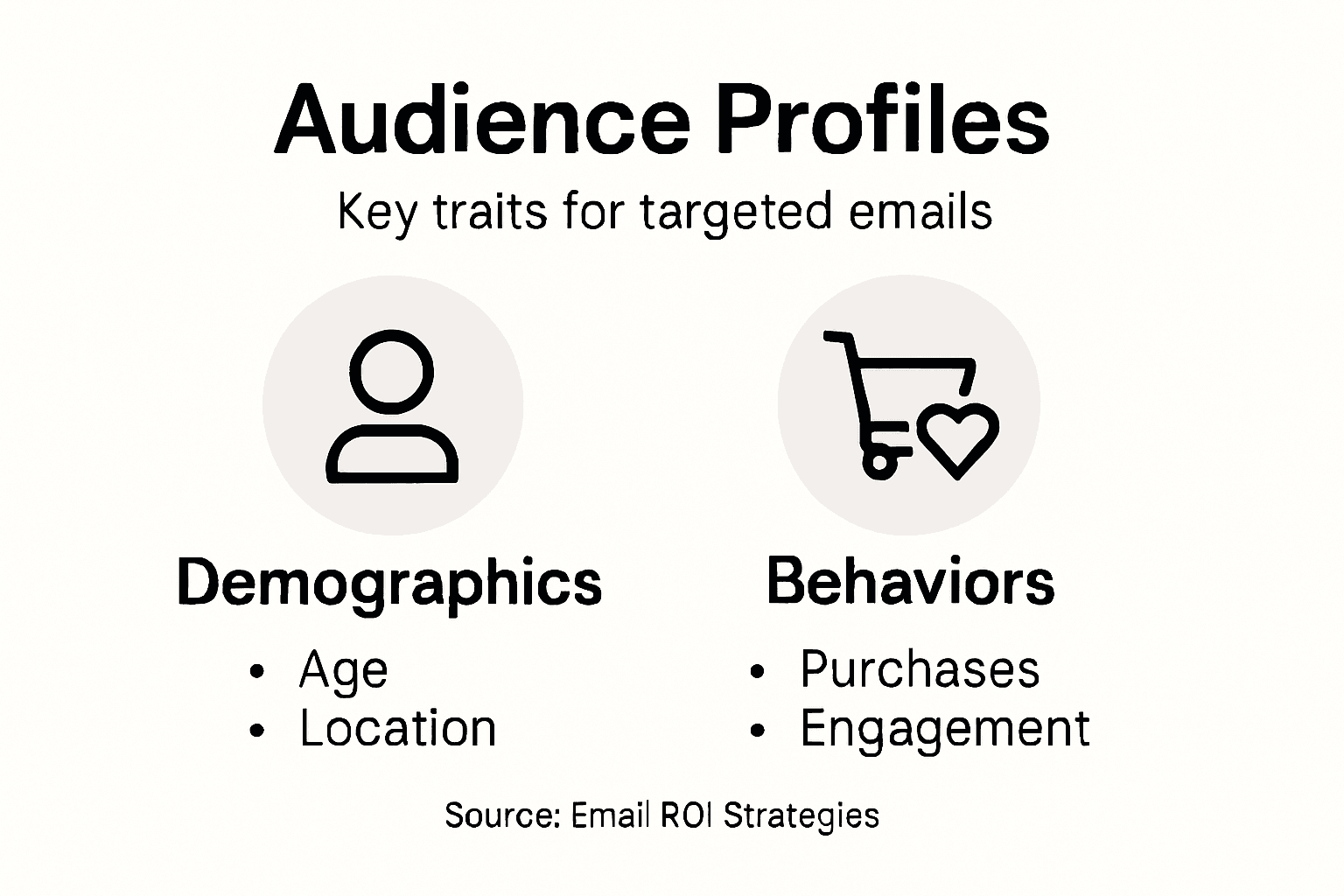
Pro tip: Develop a standardized profile template with consistent categories that allows for easy comparison and dynamic updating as new behavioral data emerges.
Step 5: Validate and refine segments through campaign testing
Effective segmentation is not a one-time task but an ongoing process of continuous refinement and optimization. Your goal is to transform initial audience segments into precision targeting mechanisms that consistently deliver higher engagement and revenue.
Begin by implementing systematic campaign validation techniques through rigorous A/B testing. Create multiple email campaign variants targeting different segments, carefully tracking performance metrics like open rates, click through rates, conversion rates, and revenue per recipient. Compare these results to identify which segments demonstrate the most promising engagement patterns. Look beyond surface level metrics to understand the underlying behaviors and motivations that distinguish high performing segments.
Treat your segmentation strategy as a dynamic, evolving framework that requires continuous learning and adjustment. Develop a systematic approach to segment refinement where you regularly challenge your existing assumptions. Analyze outliers, investigate unexpected performance variations, and be prepared to merge, split, or completely restructure segments based on empirical evidence. The most successful marketers view segmentation as an adaptive process where each campaign provides valuable insights that can be immediately leveraged to improve future targeting strategies.
Pro tip: Establish a quarterly segmentation review process where you comprehensively assess segment performance and make data-driven refinements to maintain marketing precision.
The following table summarizes key techniques for refining audience segments through campaign testing:
| Method | Purpose | Impact on Segmentation |
|---|---|---|
| A/B Testing | Compare segment campaign results | Reveals high-potential segments |
| Outlier Analysis | Identify unusual patterns | Helps refine or merge segments |
| Performance Review | Track engagement over time | Supports ongoing optimization |
Unlock Higher Email ROI with Precision Audience Research and Expert Klaviyo Segmentation
Mastering the art of targeted audience research is the key to skyrocketing your email marketing performance. This article highlights the challenge brands face when trying to transform raw data into meaningful, actionable segments within Klaviyo. If you struggle with defining clear customer profiles, analyzing deep engagement trends, or validating segments through testing, you are not alone. These pain points often block ecommerce brands from unlocking the full revenue potential of their email lists.
At Take Action, we specialize in turning those complex audience insights into high-impact, automated email campaigns. Our team combines hands-on Klaviyo expertise with AI-driven data analysis to build precise customer segments that boost open rates, recover abandoned carts, and increase repeat purchases. Whether you want to enhance your segmentation strategy or set up complete email flows like welcome sequences and post-purchase automations, our solutions are designed to align perfectly with your brand voice and growth goals.
Elevate your email marketing by partnering with experts who understand how to convert detailed customer research into measurable business results.
Drive smarter segmentation and automated campaigns today.
Take the first step to transform your email strategy.
Explore how we help ecommerce brands who want to unlock scalable growth through Klaviyo automation.
Ready to boost your email ROI by mastering audience research and segmentation? Visit Take Action now to get started with a tailored strategy that converts insights into revenue.
Frequently Asked Questions
What are the first steps to define research objectives for my Klaviyo segmentation?
To define research objectives, identify specific business questions your segmentation should address. Focus on aspects like customer purchasing behaviors and motivations. Create a one-page research objective document outlining your key questions before collecting data.
How can I collect actionable audience data for my email campaigns?
Gather customer data from multiple platforms, including your e-commerce system, CRM, and social media analytics. Look for metrics like purchase history and engagement rates to create a holistic view of your audience. Integrate these data sources to save time and ensure real-time insights.
What metrics should I analyze to understand customer behaviors for better segmentation?
Examine metrics such as purchase frequency, average order value, and email engagement rates. Focus on identifying signals that indicate customer intent, like specific product page views or repeat website visits. Use these insights to refine your email marketing strategies.
How do I create precise audience profiles for my email marketing campaigns?
Develop comprehensive customer segmentation profiles that integrate behavioral patterns, purchasing motivations, and engagement preferences. Include both quantitative data, like purchase history, and qualitative insights about customer motivations. Treat these profiles as dynamic documents that you update with new data regularly.
What steps should I take to validate and refine my audience segments?
Implement A/B testing to compare campaign results across different segments. Track performance metrics like open and conversion rates to identify high-potential segments. Regularly assess and refine your segments based on these insights to ensure ongoing optimization and engagement success.
Recommended
- Audience Targeting Strategies: Complete Expert Guide | Take Action Blog | Take Action
- Benefits of Segmentation: Unlocking Email Revenue Growth | Take Action Blog | Take Action
- Email Campaign Best Practices for 2025 Success | Take Action Blog | Take Action
- Email Frequency Best Practices for Maximum Engagement | Take Action Blog | Take Action