

What Comes Under Digital Marketing Today
Digital marketing is no longer limited to banners and blasts. For DTC founders and ecommerce brand managers, the scope now includes everything from personalized email flows to AI-driven automation. The transformation enabled by digitalization breaks old barriers, letting you engage with customers across borders and time zones. This article helps you understand how modern digital marketing creates value and why integrating email retention strategies with platforms like Klaviyo is essential for sustained growth and measurable customer engagement.
Table of Contents
- Defining Digital Marketing And Its Scope
- Main Channels In Digital Marketing Strategies
- Automation, Personalization, And AI Integration
- Common Pitfalls And Compliance Challenges
- Comparing Digital Marketing With Traditional Methods
Key Takeaways
| Point | Details |
|---|---|
| Embrace Digital Transformation | Digital marketing is a dynamic and ongoing process that integrates technology, customer focus, and sustainability to engage customers effectively. |
| Leverage Key Channels | Focus on core digital marketing channels like Email, Social Media, SEO, PPC, and Content Marketing to reach customers throughout their journey. |
| Utilize Automation and AI | Implement automation to enhance efficiency and employ AI for personalization, allowing real-time adjustments to customer interactions. |
| Prioritize Compliance | Stay compliant with data privacy laws and regulations by ensuring clear consent and transparent data usage to avoid legal pitfalls. |
Defining Digital Marketing and Its Scope
Digital marketing today extends far beyond ads and emails. It encompasses the transformation enabled by digitalization—converting information into formats machines can read, which removes old barriers and opens new marketing possibilities.
At its core, digital marketing is a value-driven process that benefits all interconnected actors—brands, customers, platforms, and partners. Unlike traditional marketing, it integrates technology, customer focus, and sustainability into one dynamic system.
Digital marketing isn’t a campaign you launch once. It’s a continued process that evolves with your customers and the platforms they use.
For DTC founders and ecommerce brand managers, this shift matters intensely. You’re no longer bound by geography or time zones. Your customer data flows across multiple channels, creating opportunities to engage at scale.
Here’s what modern digital marketing actually covers:
- Creating and distributing content across digital channels (websites, social media, email)
- Building customer relationships through personalized communications and touchpoints
- Using data and analytics to understand customer behavior and preferences
- Running automated campaigns that work while you sleep (think abandoned cart recovery)
- Measuring performance and optimizing in real time based on results
- Integrating multiple platforms and channels into one cohesive strategy
The scope keeps expanding. Digital marketing now goes beyond classic exchanges into interest groups, communities, and loyalty programs. It touches customer service, product recommendations, retention strategies, and even brand advocacy.
For your ecommerce business, this means email marketing isn’t separate from your digital strategy—it’s central to it. Your welcome flows, post-purchase communications, and re-engagement campaigns are all digital marketing. They’re all tools for building value with interconnected actors in your ecosystem.
The key difference: traditional marketing pushed messages out. Digital marketing pulls customers in through relevance, timing, and personalization.
Pro tip: Map out all the digital touchpoints where your customers interact with your brand (email, website, social, SMS, landing pages). You’ll realize how interconnected these channels are and where automation like Klaviyo can amplify your impact across the entire customer journey.
Main Channels in Digital Marketing Strategies
Digital marketing isn’t a single channel game. Your customers live across email, social platforms, search engines, and content spaces. You need to meet them everywhere.
The core channels that drive results for DTC brands include:
- Email marketing: Direct communication with owned audience, highest ROI for most ecommerce brands
- Social media: Platform-native content, community building, and customer engagement
- Search engine optimization (SEO): Organic visibility for high-intent customers searching for solutions
- Pay-per-click (PPC): Paid search ads and display advertising for immediate visibility
- Content marketing: Blog posts, guides, videos that attract and educate potential customers
Each channel serves a specific purpose in your customer journey. The key digital marketing channels aren’t equally important for every business—you pick based on where your audience actually spends time.
Integration across channels is what separates winners from everyone else. A customer seeing your ad on Facebook should recognize your email. Your landing page should match your social content. Consistency builds trust and drives conversions.
For ecommerce brands, email remains the workhorse. Unlike social platforms where algorithm changes destroy your reach overnight, email reaches customers you actually own. They opted in. They want to hear from you.

But email doesn’t work in isolation. Your welcome series starts after someone clicks from your paid ads. Your post-purchase flows reference content from your blog. Your abandoned cart reminders link to product pages optimized for search.
The integration matters more than any single channel. A customer might discover you through SEO, see your retargeting ad on social, receive your welcome email, then click your product recommendation in a follow-up message. Each touchpoint reinforces the previous one.
Metrics and analytics are crucial for assessing effectiveness across all channels. Track opens, clicks, conversions, and revenue by source. Know which channels actually move the needle for your business.
Start with what drives qualified traffic to your site. Then build email campaigns that convert those visitors into repeat customers. Layer in retargeting to recover people who visited but didn’t buy. That’s a real digital strategy.
Here’s a quick look at how core digital marketing channels support different customer journey stages:
| Channel | Best For | Sample Tactic | Customer Journey Stage |
|---|---|---|---|
| Email Marketing | Building retention | Post-purchase follow-up | Loyalty & Re-engagement |
| Social Media | Generating awareness | Instagram reels | Awareness & Engagement |
| Paid Search (PPC) | Driving quick sales | Google Smart Shopping | Consideration & Conversion |
| Content Marketing | Educating audiences | How-to blog series | Discovery & Nurturing |
| SEO | Capturing intent | Optimized product pages | Discovery & Acquisition |
Pro tip: Audit which channels your top customers discovered you through, not just which channel made the final sale. Then allocate your budget to the awareness channels that feed your email list, since email converts the best over time.
Automation, Personalization, and AI Integration
Automation is no longer optional for ecommerce brands. When you’re juggling hundreds or thousands of customers, manually managing every touchpoint becomes impossible. That’s where AI-powered solutions change the game.
AI integration transforms how you automate and personalize customer experiences at scale. Instead of building rigid workflows, AI learns from customer behavior and adapts in real time.
Here’s what modern automation does for your brand:
- Sends welcome emails the moment someone subscribes (triggered automatically)
- Recovers abandoned carts before customers forget why they added items
- Recommends products based on past purchases and browsing behavior
- Re-engages inactive customers with personalized offers
- Segments audiences automatically based on engagement patterns
- Scales your team’s output without hiring more people
Personalization at scale used to require a huge team manually crafting messages. AI handles that now—producing content tailored to individual preferences while you focus on strategy.
Personalization goes beyond inserting someone’s first name. Real personalization means your email content, product recommendations, and subject lines shift based on what that specific customer cares about.
A customer who bought winter gear gets different product suggestions than someone buying summer items. Their email frequency, content style, and offer timing adjust automatically. This drives measurable results: higher open rates, more clicks, better revenue.
But here’s the reality: AI-powered personalization requires ethical oversight and human judgment. Algorithmic bias can creep in. Privacy concerns matter. You need transparency in how your automation works.
For DTC brands using Klaviyo or similar platforms, AI features help with:
- Predictive analytics: Forecasting which customers will buy next
- Smart sending: Timing emails when each person is most likely to engage
- Content optimization: Testing subject lines and copy automatically
- Churn prediction: Identifying customers about to leave before it happens
The key is starting with automation fundamentals first. Get your welcome series running smoothly. Perfect your abandoned cart flow. Then layer in AI personalization.
Don’t let AI complexity paralyze you. Begin with simple automations—welcome sequences, post-purchase flows, re-engagement campaigns. These alone boost revenue significantly. Add AI intelligence once your foundation is solid.
Pro tip: Start with one automated workflow (like abandoned cart recovery) and optimize it completely before building the next. Measure the revenue impact, refine based on data, then scale. Quality automation beats scattered half-built flows every time.
Common Pitfalls and Compliance Challenges
Digital marketing operates in a minefield of regulations. One wrong move—a misleading claim, a missing consent checkbox, data misuse—and you’re facing fines, lost trust, and legal headaches.
The stakes are real. Brands have paid millions in penalties for compliance failures. Your customers expect you to protect their data. Regulators expect you to follow the rules. Both are non-negotiable.
Digital marketing strategies face complex legal challenges including data privacy laws, consumer protection regulations, and intellectual property rights. These laws vary by region and evolve constantly.
Common compliance pitfalls for ecommerce brands include:
- Collecting emails without explicit consent (violates CAN-SPAM, GDPR, CASL)
- Sending emails without clear unsubscribe options
- Making misleading claims about products or offers
- Failing to honor data deletion requests
- Using customer data for purposes they didn’t authorize
- Not disclosing affiliate relationships or sponsored content
- Ignoring age restrictions for certain product categories
Transparency isn’t optional anymore. Tell customers exactly how you’ll use their data, what they’re signing up for, and how they can opt out. This builds trust and keeps you legal.
Data privacy laws like GDPR (Europe) and CCPA (California) are spreading globally. CASL in Canada is strict. LGPD in Brazil is expanding. Each has different requirements for consent, data handling, and customer rights.
For email specifically, you need:
- Clear opt-in consent before sending marketing emails
- An obvious unsubscribe link in every message
- Accurate sender information
- A physical mailing address
- Compliance with frequency caps (don’t spam)
AI and personalization add complexity. When algorithms make decisions about what customers see, ethical concerns around data usage and algorithmic fairness become critical. You need transparency about how your automation works.
Many brands assume compliance is someone else’s job. It’s not. Your marketing team needs to understand basic requirements. Partner with legal counsel before launching major campaigns. Document your consent processes. Audit your practices regularly.
The good news: building compliance into your workflows from the start costs far less than fixing problems later. Klaviyo and similar platforms have built-in compliance features. Use them.
Pro tip: Create a simple compliance checklist before launching any campaign: Do we have explicit consent? Is our unsubscribe option obvious? Are our claims accurate? Does our privacy policy match our practices? Run through this every time, and you’ll avoid 90% of common pitfalls.
The table below highlights key risks and compliance solutions for digital marketing:
| Pitfall | Impact on Business | Preventive Solution |
|---|---|---|
| Missing explicit consent | Fines, lost trust | Use double opt-in forms |
| Misleading product claims | Legal action, refunds | Verify marketing accuracy |
| Ignoring unsubscribe requests | Spam complaints | Automated unsubscribe management |
| Unprotected customer data | Data breaches, lawsuits | Encrypt and audit all data flows |
| Undisclosed sponsorships | Regulatory penalties | Add mandatory content disclosures |
Comparing Digital Marketing With Traditional Methods
Traditional marketing—print ads, billboards, TV commercials, direct mail—still exists. But it’s not where ecommerce brands win anymore. The differences are stark and worth understanding.
Digital marketing moves fast. Traditional marketing crawls. With digital, you launch a campaign today and see results tomorrow. With traditional, you plan months ahead, spend a fortune, and hope it works.
Digital marketing enables speed, cost flexibility, and real-time adjustments that traditional methods simply cannot match. You can pause underperforming campaigns instantly. Adjust your messaging based on data. Scale what works within hours.
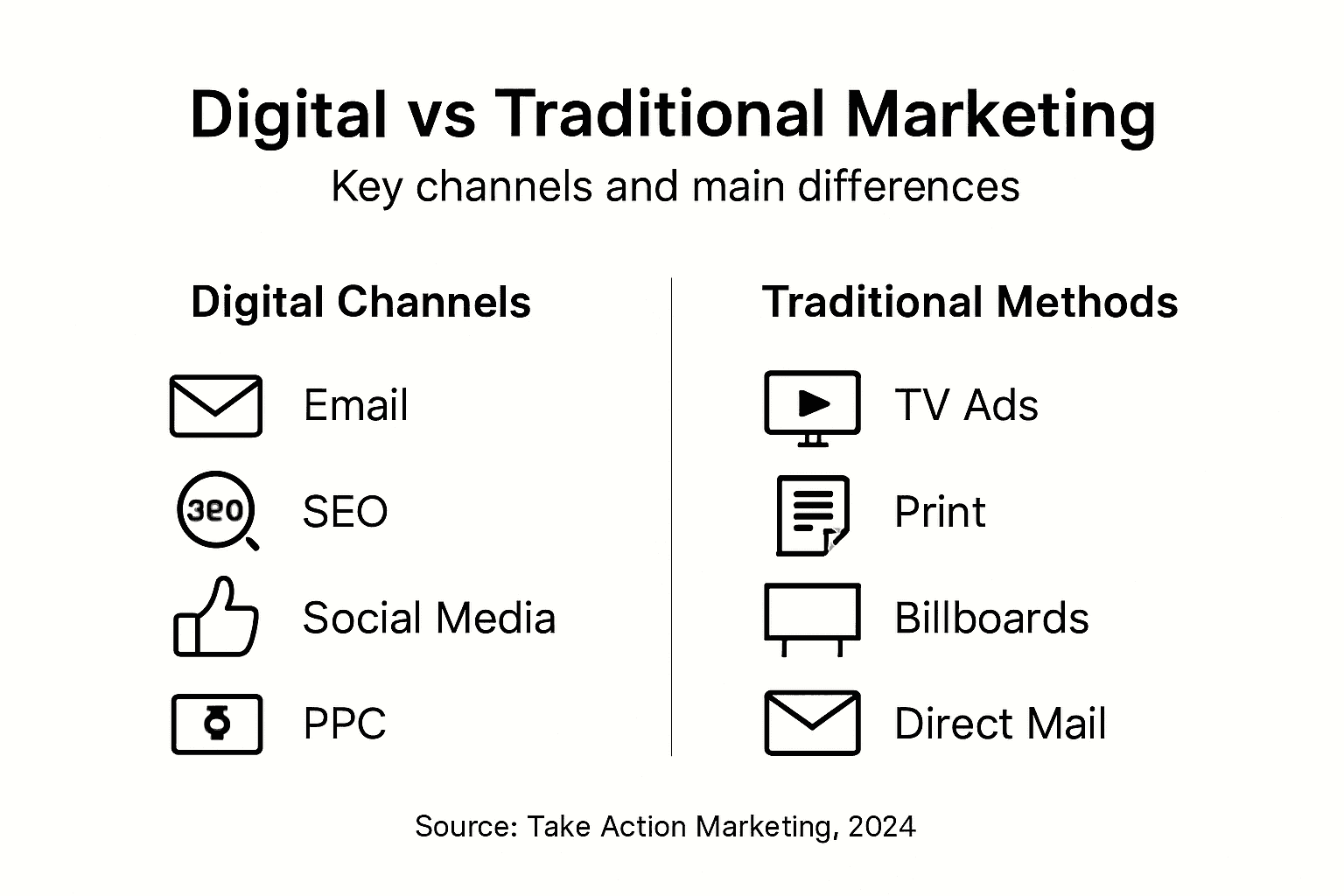
Here’s the practical difference:
Cost and Budget Control
- Digital: Start with $100 and scale up. Stop anytime. Pay only for results.
- Traditional: Minimum spend of thousands. Locked-in contracts. No pause button.
Measurement and Data
- Digital: Know exactly who clicked, opened, purchased, and when. Track every dollar.
- Traditional: Estimate reach. Hope people saw it. Guess at ROI.
Targeting and Personalization
- Digital: Show your winter coat ad only to people in cold climates who browsed similar items.
- Traditional: Show your ad to everyone in the newspaper, regardless of interest.
Speed to Market
- Digital: Launch email campaign in hours. Test subject lines. Optimize based on data.
- Traditional: Design, print, distribute. Takes weeks or months.
Digital enables two-way conversation with customers. Traditional is one-way broadcasting. Your customers can reply, engage, and influence your marketing in real time.
Traditional marketing has one advantage: it builds brand awareness at scale. A billboard reaches thousands. A TV ad reaches millions. But reach without targeting wastes money.
For DTC brands, digital is non-negotiable. Your customer base is global. Your budget is limited. You need to reach the right person at the right time with the right message. Digital delivers that. Traditional doesn’t.
Many successful brands use both. They run brand awareness campaigns through traditional channels, then convert that awareness into customers through digital email, social, and search.
But if you’re choosing where to invest your limited budget, digital wins every time. Better ROI. Faster results. Complete data. Real-time optimization.
Pro tip: Don’t abandon traditional marketing entirely, but allocate 80% of your budget to digital channels where you can measure, track, and optimize. Use traditional selectively for brand building, then capture that awareness through digital conversion channels.
Unlock the Full Potential of Your Digital Marketing Today
Digital marketing is no longer just about sending emails or running ads. As the article reveals, your biggest challenge is integrating automation, personalization, and multiple channels into a seamless journey that truly engages your customers. You know the impact that timely welcome series, abandoned cart recovery, and post-purchase flows can have—but building and optimizing these workflows at scale can feel overwhelming without the right expertise and tools.
This is where Take Action steps in to transform your email marketing into the primary growth engine your ecommerce brand deserves. We specialize in Klaviyo-driven automation that harnesses AI-powered personalization combined with human insight. Our data-driven approach boosts open rates, click-throughs, and revenue while aligning perfectly with your brand voice and aesthetic. From creating strategic campaigns to setting up essential automated flows, we help you automate retention and diversify revenue beyond paid ads.
Ready to elevate your digital marketing strategy with expert automation and targeted segmentation?
Discover how partnering with Take Action can simplify and scale your email marketing efforts. Learn more about our campaign strategy services and email flow setup. Visit us today and start turning digital marketing complexity into measurable growth.
Frequently Asked Questions
What is digital marketing?
Digital marketing refers to the value-driven process of creating and distributing content across digital channels to engage customers, build brand awareness, and drive sales. It integrates technology, customer focus, and sustainability into a dynamic marketing strategy.
How does email marketing fit into a digital marketing strategy?
Email marketing is central to digital marketing strategies as it allows for direct communication with customers, helping to build relationships and drive retention through personalized messages and automated workflows.
What are the main channels used in digital marketing?
The main channels in digital marketing include email marketing, social media, search engine optimization (SEO), pay-per-click (PPC), and content marketing. Each channel has its purpose in different stages of the customer journey, from awareness to conversion.
How can automation enhance digital marketing efforts?
Automation enhances digital marketing by managing customer interactions efficiently at scale. It allows for real-time customer engagement through automated emails, cart recovery notifications, and personalized recommendations based on customer behavior.
Recommended
- Digital Marketing Strategies 2025: Complete Guide | Take Action Blog | Take Action
- Digital Marketing Services: Driving Ecommerce Growth | Take Action Blog | Take Action
- Digital Media Strategy: Unlocking Ecommerce Growth | Take Action Blog | Take Action
- Digital Media Buying Agency Impact on Ecommerce | Take Action Blog | Take Action
- What Is Digital Fashion and Why It Matters
- Data-Driven Marketing Explained: Unlocking E-Commerce Growth - Affinsy Blog | Affinsy
- Why Data-Driven Marketing Boosts Ecommerce Growth