

What Is Customer Journey and Why It Matters
Over 65 percent of American shoppers say a single poor experience will drive them to try a different brand. For ecommerce brands and marketers using Klaviyo, every touchpoint shapes how customers perceive value and loyalty. Streamlining the customer journey is more than a buzzword—it is the difference between a one-time sale and a thriving, repeat relationship. Discover how targeted email automation helps you transform ordinary moments into memorable experiences that keep your audience coming back.
Table of Contents
- Defining The Customer Journey In Ecommerce
- Core Stages And Common Variations
- Mapping The Journey For Effective Engagement
- Key Benefits Of Automated Email Flows
- Avoiding Common Customer Journey Mistakes
Key Takeaways
| Point | Details |
|---|---|
| Understand Customer Journey Stages | Recognize that the ecommerce customer journey involves Awareness, Consideration, Conversion, Retention, and Loyalty, which inform engagement strategies. |
| Focus on Personalization | Create a seamless, personalized customer experience by anticipating needs and maintaining consistent communication across channels. |
| Leverage Automated Email Flows | Utilize automated email strategies to deliver timely, relevant messages that foster loyalty and streamline engagement processes. |
| Avoid Common Pitfalls | Proactively identify and address mistakes in the customer journey, such as neglected touchpoints and poor delivery communication, to enhance customer satisfaction. |
Defining the Customer Journey in Ecommerce
The customer journey in ecommerce represents the complete sequence of experiences a customer undergoes while interacting with an online brand, from initial awareness through purchase and post-purchase engagement. Research demonstrates that this journey is no longer a linear progression but a complex, multi-channel interaction where customers actively co-create value with brands.
In the digital marketplace, the ecommerce customer journey encompasses every touchpoint between a potential buyer and your online store. This includes website interactions, product browsing, customer support experiences, checkout processes, shipping communications, and post-purchase follow-ups. Studies reveal that critical elements like delivery options and communication quality significantly impact overall customer satisfaction and perception of the brand.
Successful ecommerce brands understand that the customer journey is not just about transactions but about creating a seamless, personalized experience. This means anticipating customer needs, providing intuitive navigation, offering transparent pricing, ensuring smooth mobile experiences, and maintaining consistent communication across all channels. By mapping and optimizing these interactions, businesses can transform casual browsers into loyal customers who feel genuinely understood and valued.
Pro tip: Create a visual customer journey map that tracks every potential interaction point, helping you identify and eliminate potential friction areas in your online shopping experience.
Core Stages and Common Variations
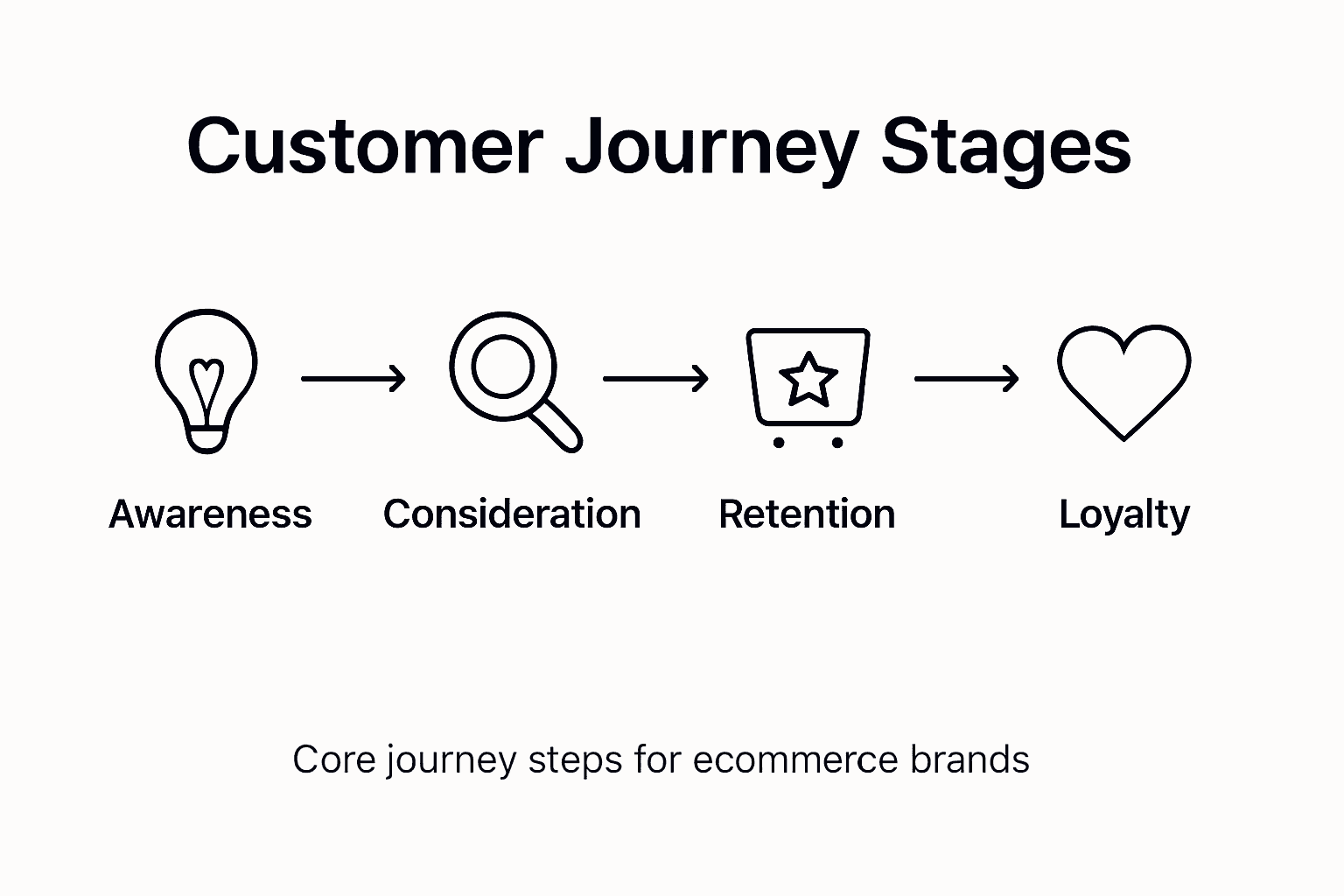
Customer journeys typically follow a standard progression across five key stages, each representing a critical interaction point between customers and brands. Research indicates these stages include Awareness, Consideration, Conversion, Retention, and Loyalty, forming a comprehensive framework for understanding customer experiences in ecommerce.
The specific nuances of these stages can vary dramatically depending on business models. Ecommerce studies demonstrate that while B2B, B2C, and C2C platforms share similar sequential stages, each has unique characteristics. For instance, B2B journeys tend to involve longer decision-making processes with multiple stakeholders, while B2C interactions are typically more direct and emotion-driven.
These core stages are not rigid checkpoints but fluid interactions that overlap and interconnect. Successful brands recognize that modern customers move between stages non-linearly, often cycling back and forth based on their evolving needs and experiences. Understanding these dynamic transitions allows businesses to create more responsive, personalized engagement strategies that anticipate and address customer requirements at each potential touchpoint.
Here’s how the customer journey stages differ by business model:
| Stage | B2B Ecommerce | B2C Ecommerce | C2C Ecommerce |
|---|---|---|---|
| Awareness | Industry events, referrals | Digital ads, social media | Peer recommendations |
| Consideration | In-depth research, proposals | Product reviews, promotions | User profiles, ratings |
| Conversion | Multiple decision-makers | Fast, emotional decisions | Simple peer transactions |
| Retention | Account management, support | Loyalty programs, discounts | Community engagement |
| Loyalty | Long-term contracts | Repeat purchases, advocacy | Platform satisfaction |
Pro tip: Develop a dynamic customer journey map that allows for non-linear progression, enabling your team to track and respond to customer interactions more flexibly and intelligently.
Mapping the Journey for Effective Engagement
Customer journey mapping represents a strategic approach for businesses to understand and optimize complex, multi-touchpoint customer interactions. This comprehensive process integrates multiple business functions and external partners to create coherent, positive experiences that align with customer expectations and brand objectives.

Research reveals that effective journey mapping goes beyond simple visualization. Systematic design of brand touchpoints plays a critical role in influencing customer loyalty by creating thematically consistent and context-sensitive interactions. Successful brands recognize that each touchpoint is an opportunity to reinforce brand perception, address customer needs, and build long-term relationship value.
Mapping the customer journey requires a holistic view that transcends traditional linear thinking. Modern ecommerce brands must anticipate customer needs, design flexible interaction paths, and create seamless transitions between different engagement channels. This approach demands continuous research, active listening, and a willingness to adapt strategies based on evolving customer behaviors and preferences.
Pro tip: Conduct quarterly customer journey audits to identify friction points, track changing customer behaviors, and proactively refine your engagement strategies.
Key Benefits of Automated Email Flows
Automated email flows represent a sophisticated strategy for enhancing customer engagement and driving business growth in ecommerce. These strategic communication tools deliver personalized messages precisely aligned with different stages of the customer journey, transforming how brands interact with their audience by providing timely, relevant information that reduces perceived risks and increases perceived value.
Continuous customer interactions through automated email flows serve as critical touchpoints for fostering loyalty and advocacy. By creating a seamless communication ecosystem, brands can maintain relationships beyond initial purchases, encourage repeat transactions, and support long-term customer retention. These automated sequences allow businesses to deliver targeted content, personalized offers, and strategic communications that feel individualized and contextually relevant.
The operational advantages of automated email flows extend far beyond simple communication. They streamline marketing efforts, reduce manual intervention, and create scalable engagement strategies that adapt to individual customer behaviors. Modern ecommerce brands can leverage these systems to segment audiences, trigger specific messages based on customer actions, and create a more intelligent, responsive marketing approach that feels personal and considerate.
Pro tip: Design your automated email flows with progressive personalization, gradually collecting and implementing customer preference data to make each subsequent communication more precisely targeted.
Avoiding Common Customer Journey Mistakes
Strategic customer journey management requires a comprehensive understanding of potential pitfalls that can derail customer experiences. Businesses frequently make critical errors by failing to account for the full spectrum of customer interactions, neglecting personalization, and overlooking the nuanced aspects of service recovery. These mistakes stem from fragmented touchpoint management and inadequate measurement of customer experience, ultimately weakening customer satisfaction and long-term loyalty.
E-commerce customer journey mistakes often manifest in overlooked areas such as delivery processes and communication gaps. Brands that ignore offline fulfillment aspects or fail to align delivery options with their product and brand identity risk creating negative customer experiences. The holistic journey extends far beyond online interactions, demanding seamless integration between digital and physical touchpoints.
Understanding these common mistakes requires a proactive approach to journey design. Successful brands develop robust strategies that anticipate potential friction points, create flexible communication channels, and continuously gather customer feedback. This means investing in comprehensive journey mapping, implementing sophisticated personalization technologies, and maintaining a vigilant approach to tracking and improving every stage of customer interaction.
Below are common customer journey mistakes and how to avoid them:
| Mistake Type | Impact on Customer | Prevention Strategy |
|---|---|---|
| Neglected touchpoints | Missed engagement | Map every customer interaction |
| Poor personalization | Low satisfaction | Use tailored content and messages |
| Unclear delivery info | Frustration, confusion | Communicate delivery options clearly |
| Siloed communications | Inconsistent experience | Integrate all channels and data |
Pro tip: Conduct monthly cross-departmental journey audits to identify and eliminate potential friction points before they impact customer satisfaction.
Elevate Your Ecommerce Customer Journey With Automated Email Excellence
Understanding the complexities of the customer journey is essential for ecommerce brands aiming to convert browsers into loyal customers. The challenge lies in creating seamless, personalized experiences at every stage—from awareness to loyalty—while avoiding common pitfalls like poor personalization and fragmented communications. The article highlights the power of automated email flows as critical touchpoints that nurture trust, increase engagement, and drive repeat purchases. If you want to transform these insights into real growth, it is time to leverage expert email marketing strategies tailored to your brand’s journey.
Take Action specializes in harnessing automation and segmentation within Klaviyo to craft email campaigns and flows that align perfectly with your customer’s unique journey. By combining human expertise with AI-driven insights, we help you increase open and click rates, recover abandoned carts, and build lasting customer retention systems. Don’t let friction points erode your revenue potential. Visit Take Action to start optimizing your automated email flows today. Discover how our campaign strategy and flow setup services can turn your customer journey into a powerful growth engine. Act now to make email marketing your most reliable revenue channel.
Frequently Asked Questions
What is the customer journey in ecommerce?
The customer journey in ecommerce is the complete sequence of experiences a customer has while interacting with an online brand, from initial awareness to purchase and post-purchase engagement.
Why is understanding the customer journey important for ecommerce businesses?
Understanding the customer journey is crucial because it helps businesses create seamless and personalized experiences, anticipate customer needs, and effectively engage with their audience at every stage of the interaction.
What are the key stages of the customer journey?
The key stages of the customer journey typically include Awareness, Consideration, Conversion, Retention, and Loyalty. Each stage represents a critical point of interaction between customers and brands.
How can businesses optimize their customer journey?
Businesses can optimize their customer journey by mapping out each touchpoint, continuously gathering customer feedback, implementing personalization strategies, and ensuring consistent communication across all channels.
Recommended
- Customer Journey Mapping: Powering Email Growth | Take Action Blog | Take Action
- Brand Storytelling Explained: Driving Ecommerce Growth | Take Action Blog | Take Action
- How to Tell Your Brand Story to Engage Customers Effectively | Take Action Blog | Take Action
- What is Omnichannel Marketing? Understanding Its Importance | Take Action Blog | Take Action