

Why Segmentation Matters for Ecommerce Growth
Nearly 80 percent of American ecommerce brands see a sharp rise in customer retention when they get segmentation right. For marketers using Klaviyo, understanding how to divide audiences based on real data is not just a technical skill, it is the foundation of creating marketing messages that actually connect. With precise segmentation and automation, you can move beyond average results and build campaigns that resonate with each customer, fueling lasting loyalty.
Table of Contents
- Segmentation Defined In Email Marketing
- Types Of Segmentation For Ecommerce Brands
- How Segmentation Drives Engagement And Revenue
- Avoiding Common Segmentation Pitfalls
- Integrating Segmentation With Klaviyo Automation
Key Takeaways
| Point | Details |
|---|---|
| Email Segmentation | Segmenting your email list improves engagement and conversion rates by allowing for targeted, personalized communication. |
| Diverse Segmentation Types | Utilize demographic, behavioral, psychographic, and geographic segmentation to create relevant customer groups. |
| Impact on Engagement | Effective segmentation leads to higher open rates, click-through rates, and conversion rates, driving revenue growth. |
| Avoid Pitfalls | Ensure data quality and avoid over-segmentation to maintain an effective, dynamic email marketing strategy. |
Segmentation Defined in Email Marketing
Email marketing segmentation is the strategic process of dividing your audience into distinct groups based on specific characteristics, behaviors, and preferences. Marketing segmentation involves classifying consumers within a market who share related needs and purchasing habits, allowing businesses to create targeted, personalized communication strategies that dramatically improve engagement and conversion rates.
At its core, segmentation goes beyond basic demographic information like age or location. It encompasses a comprehensive understanding of customer behavior, including purchase history, engagement levels, browsing patterns, and individual preferences. By breaking down your email list into precise segments, you can craft messages that speak directly to each group’s unique motivations and challenges, transforming generic marketing communications into highly relevant, resonant experiences.
The primary goal of email marketing segmentation is to enhance relevance and effectiveness. When you target relevant consumer groups based on behaviors and preferences, you simultaneously improve engagement metrics and ensure compliance with legal email marketing standards like the CAN-SPAM Act. Successful segmentation allows ecommerce brands to:
- Deliver personalized product recommendations
- Optimize email send times for maximum open rates
- Recover abandoned carts with targeted follow-ups
- Create more meaningful customer relationships
Pro tip: Start by segmenting your email list into 3-5 distinct groups based on purchase history, engagement level, and customer lifetime value to immediately improve your email marketing performance.
Types of Segmentation for Ecommerce Brands
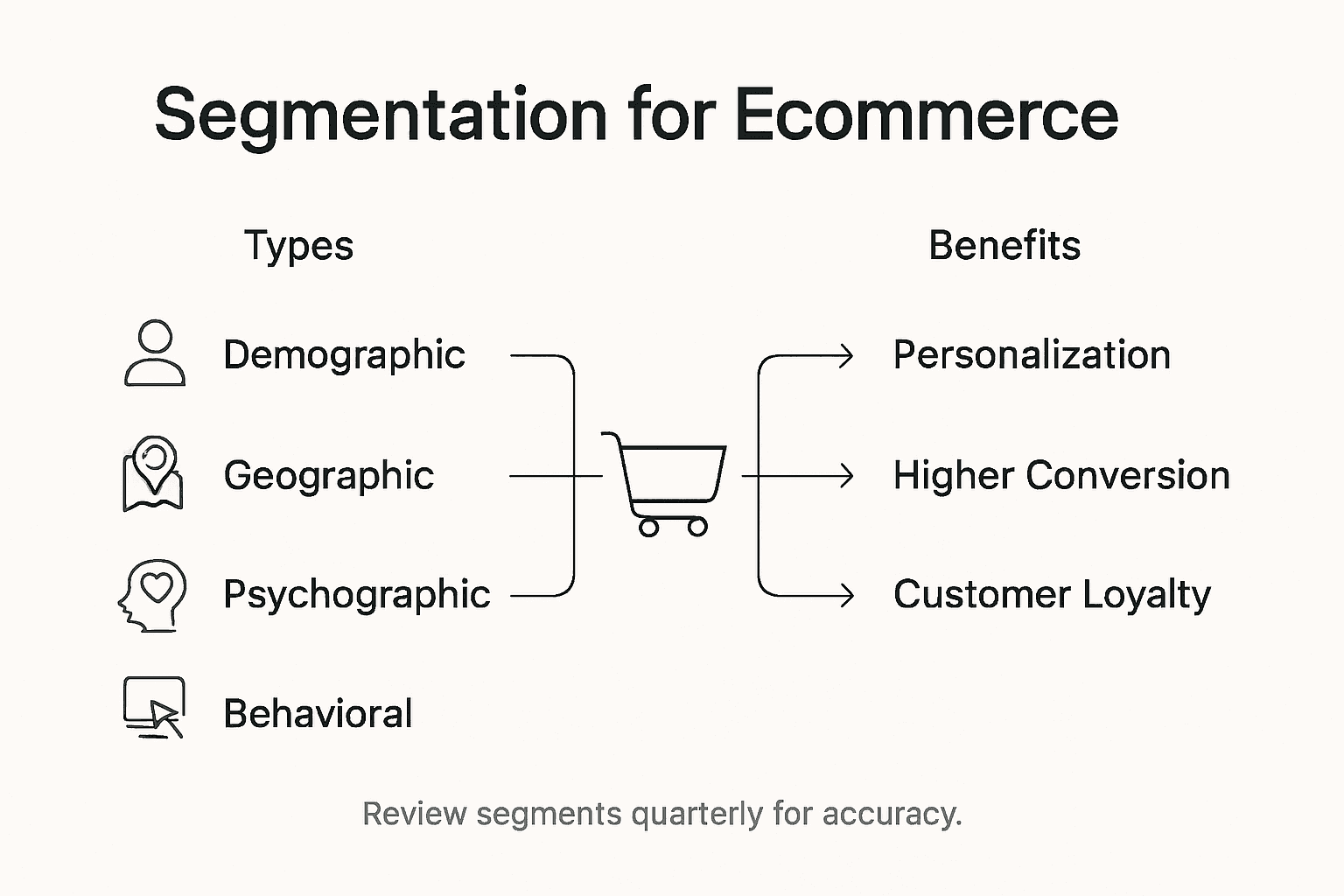
Ecommerce brands have multiple strategic approaches to segmentation, each designed to unlock deeper customer insights and drive targeted marketing efforts. Marketing segmentation strategies are built through an extensive selection of consumer attributes that help businesses create precise, meaningful customer groups.

Demographic Segmentation focuses on quantifiable characteristics like age, gender, income, education level, and occupation. This classic approach allows brands to create tailored messaging that resonates with specific population segments. For instance, a skincare brand might develop different email campaigns for teenagers versus professionals in their 40s, recognizing their distinct skincare needs and purchasing behaviors.
Behavioral Segmentation delves into customer actions and engagement patterns. Ecommerce brands utilize behavioral segmentation to analyze purchase history, loyalty levels, website interactions, and frequency of purchases. This type of segmentation helps identify high-value customers, potential churners, and opportunities for personalized recommendations. Key behavioral segments might include:
- First-time buyers
- Repeat customers
- High-value customers
- At-risk customers
- Seasonal purchasers
Psychographic Segmentation explores deeper psychological attributes like lifestyle, values, interests, and personality traits. This sophisticated approach moves beyond surface-level demographics to understand the underlying motivations that drive purchasing decisions. An outdoor gear company, for example, might segment customers based on adventure preferences, environmental consciousness, or fitness levels.
Geographic Segmentation considers location-based differences, recognizing that customer preferences can vary significantly by region, climate, urban/rural settings, and cultural contexts. This approach allows brands to customize offerings and marketing messages that feel locally relevant and timely.
Here’s a quick comparison of the main segmentation types for ecommerce brands:
| Segmentation Type | Key Characteristics | Best Used For | Example Application |
|---|---|---|---|
| Demographic | Age, gender, income, occupation | Broad audience targeting | Custom campaigns by age group |
| Behavioral | Purchase history, interactions | Loyalty building, retention | Win-back for lapsed shoppers |
| Psychographic | Lifestyle, values, interests | Emotional resonance, brand advocacy | Messaging for eco-conscious customers |
| Geographic | Location, climate, cultural norms | Localized offers and event promotion | Weather-specific product emails |
Pro tip: Combine multiple segmentation types to create hyper-targeted email campaigns that speak directly to your customers’ unique characteristics and behaviors.
How Segmentation Drives Engagement and Revenue
Effective segmentation allows businesses to concentrate marketing efforts to achieve the highest return on investment by creating personalized experiences that transform casual browsers into loyal customers. The strategic power of segmentation lies in its ability to turn generic marketing approaches into precision-targeted communication that speaks directly to individual customer needs and preferences.
Engagement is the critical bridge between customer interest and revenue generation. Personalized Marketing becomes possible through sophisticated segmentation, enabling brands to craft messages that resonate on a deeply individual level. By understanding specific customer attributes like purchase history, browsing behavior, and demographic characteristics, ecommerce brands can create targeted campaigns that feel less like marketing and more like a tailored conversation.
Revenue Impact of segmentation is profound and measurable. Engagement in marketing directly influences customer purchase behavior and conversion rates, transforming generic communication into powerful revenue drivers. Key engagement metrics dramatically improve when segmentation strategies are implemented:
The table below summarizes how segmentation impacts key marketing metrics:
| Metric | Segment-Based Approach | Impact on Results |
|---|---|---|
| Open Rate | Personalized subject lines | 20-30% improvement |
| Click-Through Rate | Relevant content targeting | 15-25% improvement |
| Conversion Rate | Precise product recommendations | 10-15% increase |
| Customer Lifetime Value | Ongoing tailored engagement | Significant growth |
- Open rates increase by 20-30%
- Click-through rates improve by 15-25%
- Conversion rates can jump by 10-15%
- Customer lifetime value grows significantly
The most successful ecommerce brands view segmentation not as a tactical tool, but as a strategic approach to building meaningful customer relationships. By continuously refining segments, analyzing customer data, and adapting messaging, businesses can create a dynamic marketing ecosystem that evolves with customer needs and preferences.
Pro tip: Implement a quarterly review of your customer segments to ensure your segmentation strategy remains accurate and responsive to changing customer behaviors and market trends.
Avoiding Common Segmentation Pitfalls
Segmentation pitfalls can significantly undermine marketing efforts if not carefully managed, creating inefficient strategies that waste time and resources. Understanding these potential missteps is crucial for ecommerce brands seeking to leverage segmentation effectively.
Over-Segmentation represents one of the most common mistakes. While precise targeting seems appealing, breaking your audience into too many narrow groups can fragment your marketing strategy, making communication complex and resource-intensive. Effective segmentation requires finding the right balance between specificity and scalability, creating segments that are meaningful yet manageable.
Data Quality is another critical consideration. Methodological rigor and unbiased data analysis are vital to avoid pitfalls that compromise segmentation outcomes. Common data-related errors include:
- Relying on outdated customer information
- Failing to validate data sources
- Ignoring potential demographic overlaps
- Not updating segments regularly
- Introducing unconscious investigator biases
Static Segmentation kills marketing effectiveness. Markets evolve, customer behaviors shift, and what worked yesterday might be irrelevant tomorrow. Successful ecommerce brands treat segmentation as a dynamic process, continuously refining their understanding of customer groups, monitoring changing preferences, and adapting their strategies accordingly.
Pro tip: Conduct a comprehensive segment audit every six months, reviewing data accuracy, segment performance, and potential new classification criteria to keep your marketing strategy agile and responsive.
Integrating Segmentation with Klaviyo Automation
Klaviyo’s marketing automation platform enables ecommerce brands to leverage granular customer segmentation by transforming raw data into powerful, actionable marketing strategies. The platform’s core strength lies in its ability to unify real-time profile and event data, creating dynamic segmentation capabilities that adapt to customer behaviors instantaneously.
Automated Workflow Design becomes seamless with Klaviyo’s sophisticated segmentation tools. By connecting customer data points across multiple touchpoints, brands can create intricate automation flows that respond to specific customer actions. These intelligent workflows might include abandoned cart recovery, post-purchase follow-ups, or re-engagement campaigns triggered by precise behavioral signals.
Segmentation Mechanics in Klaviyo allow for incredibly nuanced targeting. The platform processes customer data to provide marketing automation services with advanced segmentation capabilities, enabling marketers to build segments based on:
- Purchase frequency
- Average order value
- Product categories
- Engagement levels
- Customer lifecycle stages
- Geographical location
- Browsing behaviors
By integrating comprehensive data analysis with automated communication channels, Klaviyo transforms segmentation from a static concept into a dynamic, responsive marketing strategy. The platform’s real-time processing means segments can be adjusted instantly, ensuring that marketing messages remain relevant and timely.
Pro tip: Create a minimum of 5-7 core segments in Klaviyo, but remain flexible enough to dynamically adjust these segments as your customer base evolves and customer behaviors change.
Unlock Ecommerce Growth Through Smarter Segmentation
If you are struggling to turn generic email blasts into meaningful customer connections, this article highlights the exact problem. Effective segmentation is not just about dividing your audience but creating dynamic, data-driven groups that increase open rates, click-throughs, and conversions. You want to avoid over-segmentation, outdated data, or static lists that kill your campaign momentum. With concepts like behavioral and psychographic segmentation powering personalized flows, the key challenge is harnessing these insights into automated campaigns that evolve with your customers.
At Take Action, we specialize in solving these challenges by combining expert human strategy with AI-driven insights tailored for Klaviyo automation. Our proven approach helps ecommerce brands build scalable segmentation strategies, set up automated email flows like abandoned cart and post-purchase follow-ups, and maximize customer lifetime value. Imagine transforming fragmented customer data into clear growth opportunities while increasing engagement on every message.
Take the next step today to transform your email marketing from generic to genius.
Personalize your campaigns, boost conversions, and watch your ecommerce revenue grow with Take Action.
Ready to harness the full power of segmentation and automation? Visit Take Action now and discover how our dedicated email marketing solutions can scale your brand through targeted, data-driven campaigns.
Frequently Asked Questions
What is email marketing segmentation?
Email marketing segmentation is the process of dividing your audience into specific groups based on characteristics, behaviors, and preferences to craft personalized marketing messages that improve engagement and conversion rates.
Why is segmentation important for ecommerce brands?
Segmentation allows ecommerce brands to deliver targeted, relevant communications, personalize product recommendations, optimize email send times, and build meaningful customer relationships, all of which ultimately drive engagement and revenue growth.
What are the different types of segmentation for ecommerce brands?
The main types of segmentation include demographic (age, gender, income), behavioral (purchase history, engagement), psychographic (lifestyle, values), and geographic (location-based) segmentation. Each type provides unique insights that can enhance marketing strategies.
How can automation tools like Klaviyo enhance segmentation?
Klaviyo’s marketing automation platform enables ecommerce brands to leverage detailed customer data, allowing for dynamic segmentation and the creation of automated workflows that respond to customer behaviors, ensuring timely and relevant marketing communications.
Recommended
- Email Segmentation Strategies for Ecommerce Growth | Take Action Blog | Take Action
- Benefits of Segmentation: Unlocking Email Revenue Growth | Take Action Blog | Take Action
- SEO Matters: Complete Guide for Ecommerce Brands | Take Action Blog | Take Action
- Mastering Brand Positioning Strategies for Ecommerce Success | Take Action Blog | Take Action