
Boost ecommerce conversions with advanced Klaviyo strategies
TL;DR:
- Flows generate significantly higher and more consistent conversions than one-time campaigns.
- Building targeted, well-optimized flows is essential for long-term ecommerce growth.
- Advanced segmentation and multi-channel tactics, especially SMS, amplify flow effectiveness and revenue.
Most ecommerce brands spend the bulk of their email energy on campaigns: the weekly newsletter, the seasonal sale blast, the product launch. But flows outperform campaigns with 13x higher placed order rates, which means every hour you spend crafting a broadcast email is an hour you could have invested in automation that works around the clock. This guide breaks down exactly how to build, segment, and test Klaviyo flows that recover lost revenue, retain your best customers, and compound your results over time without adding headcount.
Table of Contents
- Understanding Klaviyo flows and why they outperform campaigns
- Building and optimizing core conversion-driving flows
- Segmentation and predictive analytics: Doubling conversions through targeting
- Testing, timing, and multi-channel: Maximizing every conversion opportunity
- What most ecommerce marketers miss about maximizing conversions
- Accelerate your ecommerce growth with expert-backed Klaviyo strategies
- Frequently asked questions
Key Takeaways
| Point | Details |
|---|---|
| Automated flows outperform campaigns | Klaviyo flows like abandoned cart and welcome series generate conversion rates up to 13x higher than traditional campaigns. |
| Segmentation drives results | RFM, predictive CLV, and behavioral segmentation can double click rates and increase revenue per recipient by up to 45%. |
| Testing and timing are crucial | A/B testing subject lines, offers, and flow timing routinely unlocks higher open and conversion rates. |
| Multi-channel amplifies impact | Combining SMS and email in key flows can drive up to 300% more revenue. |
| Retention trumps acquisition | Small increases in retention consistently lead to significant and sustainable revenue growth. |
Understanding Klaviyo flows and why they outperform campaigns
Before we get into tactics, it helps to be precise about what we mean. A campaign in Klaviyo is a one-time send to a defined list or segment, like a flash sale or a new arrival announcement. A flow is an automated sequence triggered by a specific action or condition, like someone abandoning a cart, completing a first purchase, or going quiet for 90 days. The difference sounds simple, but the performance gap is enormous.
Flows deliver a 2.11% placed order rate compared to 0.16% for campaigns, and a 5.58% click rate versus 1.69%. That is not a marginal difference. It is a structural one.
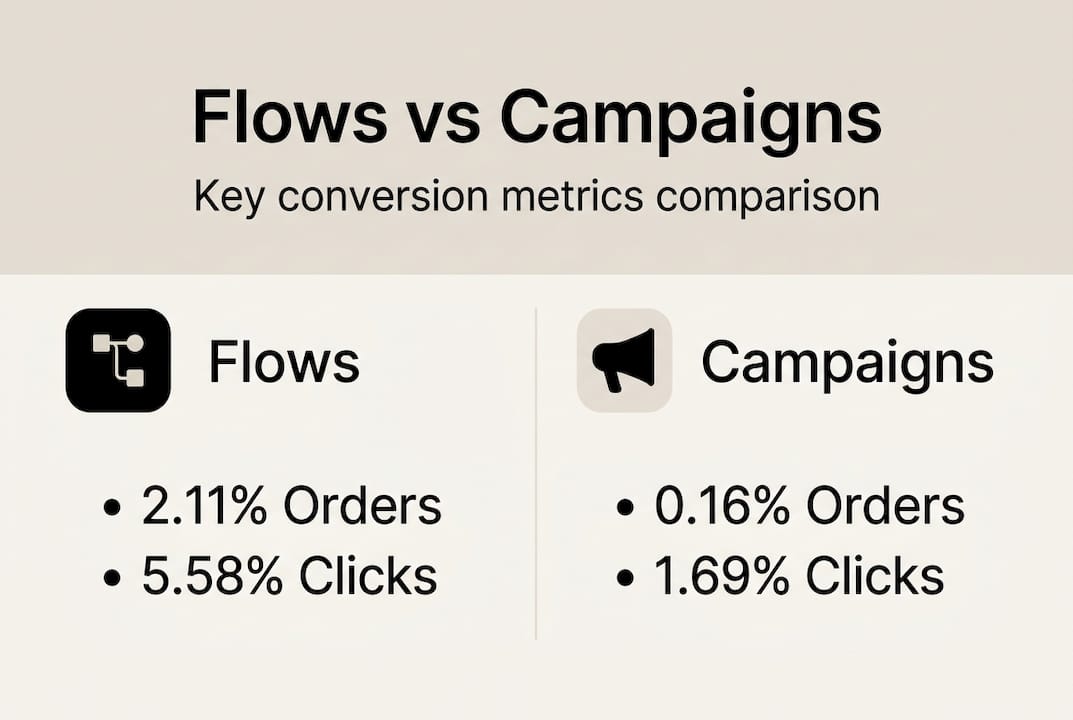
| Metric | Flows | Campaigns |
|---|---|---|
| Placed order rate | 2.11% | 0.16% |
| Click-through rate | 5.58% | 1.69% |
| Revenue driver | Automated, 24/7 | Manual, one-time |
The reason flows win comes down to two things: timeliness and relevance. When someone abandons a cart, a flow catches them within the hour, while the purchase intent is still warm. A campaign sent three days later to your full list cannot replicate that moment. Flows meet people exactly where they are in the buying journey, and that precision converts.
The four flows every ecommerce brand should have running are the abandoned cart flow, the welcome series, the post-purchase flow, and the winback flow. Each targets a different stage of the customer lifecycle, and together they form the backbone of a retention-first email program. You can explore email marketing tips and Klaviyo marketing funnels to see how these fit into a broader growth strategy.
The most common misconception we see among growing brands is that sending more campaigns will compensate for weak automation. It will not. Campaigns are great for staying top of mind and driving event-based revenue, but they cannot replace the compounding returns of well-built flows.
“Prioritizing flow setup over campaign frequency is the single highest-ROI shift most ecommerce brands can make in their email program.”
Pro Tip: If you are choosing between spending time on a new campaign or improving an existing flow, choose the flow. A better-timed abandoned cart sequence will keep earning for months. That campaign disappears after one send.
For a broader look at how automation fits into ecommerce growth strategies, it is worth thinking about flows as infrastructure, not just tactics.
Building and optimizing core conversion-driving flows
Knowing flows matter is one thing. Building them well is another. Here is how to approach each of the four core flows with intention.
-
Abandoned cart flow: Trigger this when someone adds an item to their cart but does not complete checkout. Send the first email within 1 hour, a second at 24 hours, and a third at 72 hours. The first email should be a simple, direct reminder. The second can introduce social proof or answer common objections. The third is where a small incentive makes sense if your margins allow it. Abandoned cart flows recover up to 30% of lost revenue, making this the highest-priority flow to get right.
-
Welcome series: Trigger when someone joins your list without purchasing. This is your chance to establish brand value before asking for a sale. Use 3 to 5 emails over 7 to 10 days to tell your story, highlight bestsellers, and build trust. Conversion here sets the tone for lifetime value.
-
Post-purchase flow: Trigger immediately after a first purchase. Confirm the order, set delivery expectations, then follow up with cross-sell recommendations and a review request. This flow turns one-time buyers into repeat customers, which is where the real margin lives.
-
Winback flow: Trigger when a customer has not purchased in a defined window. Time winback flows at 1.5x the average days between purchases for your category. For apparel, that is typically under 45 days. For hard goods with longer repurchase cycles, it may be 90 to 120 days.
| Flow | Trigger | First email timing | Goal |
|---|---|---|---|
| Abandoned cart | Cart add, no purchase | Within 1 hour | Recover lost sale |
| Welcome series | List join, no purchase | Immediately | Build trust, first purchase |
| Post-purchase | Order confirmed | Immediately | Retention, cross-sell |
| Winback | Lapsed purchase window | 1.5x avg purchase gap | Reactivate buyer |
For winbacks specifically, 2 to 3% of lapsed buyers convert even on large audiences, which adds up fast. Pair value-building content for at-risk customers with a discount offer only for those who have been fully lapsed. Over-discounting active buyers trains them to wait for deals. You can learn more about improving conversion rates and how flow timing plays into purchase behavior. For a deeper look at Klaviyo automation setup, the mechanics are worth studying carefully.
Segmentation and predictive analytics: Doubling conversions through targeting
Flows built without segmentation are like a billboard on an empty road. The message is there, but the right people are not seeing it at the right time. This is where Klaviyo’s segmentation and AI tools change the game.

RFM segmentation groups customers by recency (how recently they bought), frequency (how often they buy), and monetary value (how much they spend). It is one of the most reliable frameworks for identifying who needs what message. A high-frequency, high-value buyer should never receive the same winback email as someone who bought once two years ago.
Predictive CLV (customer lifetime value) segments use Klaviyo’s AI to forecast which customers are likely to buy again and how much they will spend. AI CLV segments yield 14 to 45% higher revenue per recipient, and a 5% increase in retention can boost profits by 25 to 95%. These are not marginal gains.
Here is how to build behavioral splits that actually move the needle:
- Cart value splits: Customers who abandoned a $200 cart deserve a different message than those who left a $20 item behind. Tailor urgency and incentives accordingly.
- Acquisition source splits: Someone who came in through a paid ad has different expectations than an organic search visitor. Adjust your welcome series tone to match.
- Engagement frequency splits: Highly engaged subscribers can receive more emails without fatigue. Low-engagement subscribers need fewer, more targeted sends.
- VIP segments: Recognize your top buyers with early access and exclusive offers, not just discounts. Recognition drives loyalty more reliably than price cuts.
Advanced segmentation in flows can double click rates and significantly increase revenue per recipient. The math on advanced segmentation strategies is compelling enough to make this a priority before you add any new flows.
Pro Tip: Use zero-party data, meaning information customers voluntarily share through quizzes or preference centers, to fuel personalization inside flows. Asking “what are you shopping for?” at signup gives you segmentation data that no algorithm can infer.
For foundational guidance on list segmentation and understanding the importance of segmentation for long-term revenue, both are worth bookmarking.
Testing, timing, and multi-channel: Maximizing every conversion opportunity
Even the best-built flows decay over time. Subscriber behavior shifts, seasonal patterns change, and what worked last quarter may underperform today. Ongoing testing is what separates brands that plateau from those that keep growing.
Here is how to run A/B tests in Klaviyo flows without creating chaos:
- Test one variable at a time. Subject line, send time, email content, or offer. Never two at once or you will not know what drove the result.
- Wait for statistical significance. A test with 200 sends per variant is not reliable. Aim for at least 1,000 sends per variant before drawing conclusions.
- Prioritize high-volume flows first. Your abandoned cart flow gets the most traffic, so tests there yield results faster.
- Document everything. Keep a simple log of what you tested, when, and what the result was. This builds institutional knowledge over time.
Subject line tests can boost open rates by 10 to 20 percentage points in high-volume flows, which is a meaningful lift when you are sending at scale.
On timing, the best send window varies by flow and audience. Abandoned cart emails sent within one hour consistently outperform those sent at the four-hour mark. Post-purchase follow-ups sent within 24 hours of delivery confirmation get higher review response rates than those sent a week later.
SMS is the other lever most brands underuse. SMS drives a 9.3% click-through rate and helped Montirex grow revenue by 300% when combined with email in their flows. SMS works best for urgency-driven moments: abandoned cart reminders, flash sale alerts, and back-in-stock notifications.
“Montirex combined email and SMS in their Klaviyo flows and saw a 300% increase in revenue. The channel combination was the differentiator.”
Common pitfalls to avoid:
- Over-discounting VIP customers in winback flows
- Ignoring cart value splits and sending the same offer to all abandoners
- Running SMS on the same cadence as email, which creates fatigue
- Stopping tests too early before reaching statistical significance
For a deeper look at how Klaviyo automation for growth and multi-channel marketing intersect, both resources are worth exploring.
What most ecommerce marketers miss about maximizing conversions
Here is the uncomfortable truth we see repeatedly: brands obsess over campaign volume because it feels productive. Scheduling sends, writing copy, hitting that launch button. It creates visible activity. But visible activity is not the same as compounding revenue.
The brands that consistently outperform their peers are not sending more emails. They are running tighter, smarter flows with better segmentation, and they treat those flows as living assets that get refined every quarter. Predictive, RFM-based retention strategies consistently outperform reactive, blanket approaches when it comes to long-term lifetime value.
A 5% increase in customer retention does more for your bottom line than doubling your acquisition budget. That is not a new idea, but most brands still act like acquisition is the only lever worth pulling.
The practical implication is this: invest in segmentation benefits and flow refinement before you add more sends to your calendar. Treat your automation stack like a product that needs iteration, not a setup-and-forget task. The brands that win long-term are the ones that build retention infrastructure first and use campaigns to amplify it.
Accelerate your ecommerce growth with expert-backed Klaviyo strategies
Putting these strategies into practice takes more than reading about them. The brands that see the fastest results are the ones working with partners who have already built and tested these systems across dozens of ecommerce accounts.
At Take Action, we specialize in building Klaviyo flows, segmentation frameworks, and multi-channel automation that drive measurable revenue, not just opens and clicks. Whether you need a full flow audit, a segmentation overhaul, or an email marketing agency partner to manage your program end to end, we bring the data and the execution. Book a strategy session and find out exactly where your current setup is leaving money on the table.
Frequently asked questions
What are the most effective Klaviyo flows for ecommerce conversions?
Abandoned cart, welcome series, post-purchase, and winback flows consistently drive the highest placed order and revenue recovery rates for ecommerce brands.
How does RFM or predictive segmentation improve Klaviyo conversions?
Advanced segmentation using RFM and predictive CLV can double click rates and increase revenue per recipient by up to 45%, making it one of the highest-leverage improvements you can make to any flow.
Should I use SMS in my ecommerce customer journeys?
Yes. SMS achieves a 9.3% click rate and can drive up to 300% more revenue when layered into high-intent flows alongside email, particularly for abandoned cart and back-in-stock moments.
How often should I update and test my Klaviyo flows?
Review and A/B test your flows every one to three months, prioritizing subject lines, send timing, and offer structure for the most consistent conversion rate improvement.
What ROI can I expect from advanced Klaviyo flows?
Case studies show ROI ranging from 100x to 300%, with brands using RFM-based targeting seeing 30% or more in conversion lifts compared to untargeted automation.
Recommended
- Optimize ecommerce growth with a performance agency | Take Action Blog | Take Action
- Boost ecommerce growth: SEO and Klaviyo automation | Take Action Blog | Take Action
- Boost ecommerce sales with top email marketing tips | Take Action Blog | Take Action
- Email Segmentation Strategies for Ecommerce Growth | Take Action Blog | Take Action
- 6 eCommerce Conversion Killers (And How Your Platform Can Solve Them)