

Boost ecommerce sales with top email marketing tips
Email marketing remains one of the most powerful revenue drivers for ecommerce brands, yet many marketers struggle to unlock its full potential. With inbox competition intensifying and privacy changes reshaping metrics, you need proven, strategic approaches that go beyond generic advice. This article reveals data-backed email marketing tips specifically designed for growing DTC brands using Klaviyo, covering everything from foundational segmentation to AI-powered optimization techniques that can transform your email program into a primary growth channel.
Table of Contents
- Key takeaways
- Set the foundation: essential criteria for effective ecommerce email marketing
- Harnessing automated email flows to maximize ecommerce revenue
- Strategic campaign emails: segmenting, testing, and optimizing for engagement
- Next-level optimization: leveraging AI, hygiene, and ethical frequency in 2026
- Partner with expert email marketing & retention agency
- What are the best email marketing tips for ecommerce brands?
- How can Klaviyo flows impact ecommerce revenue?
- What are ethical frequency and subscriber hygiene practices?
- How can AI improve email marketing results in 2026?
Key Takeaways
| Point | Details |
|---|---|
| Segmentation foundation | Strategic segmentation into Active customers, VIPs, Lapsed customers, and New subscribers delivers tailored messaging and higher engagement. |
| Revenue per recipient | Open rates are unreliable due to privacy changes, so revenue per recipient is the gold standard for measuring email impact alongside conversion rate and average order value. |
| Automated flows impact | Automated flows account for about fifteen to twenty percent of revenue and outperform campaigns by three to four times in engagement while requiring fewer sends. |
| Welcome and cart flows | A strong welcome series spans 3-5 emails over 7-14 days to set brand expectations, while abandoned cart and browse abandonment flows recover revenue by reminding customers of what they left behind and using urgency or incentives. |
| Suppression filters | Use suppression filters to exclude recipients who were emailed in the past 24 hours to prevent list fatigue and improve engagement. |
Set the foundation: essential criteria for effective ecommerce email marketing
Before diving into specific tactics, you need to understand what makes email marketing truly effective for ecommerce. Email marketing generates 20-40% of total revenue for most ecommerce brands, with optimized programs using Klaviyo reaching 50% or higher. This massive revenue contribution makes email your most cost-effective channel, but only when you build on the right foundation.
The cornerstone of successful email marketing is strategic segmentation. Rather than blasting your entire list with the same message, you need to divide your audience into meaningful groups that receive tailored content. The four core segments every ecommerce brand should implement are Active customers (purchased within 180 days), VIP customers (high lifetime value), Lapsed customers (no purchase in 180+ days), and New subscribers. Each segment requires different messaging frequency and content approaches.
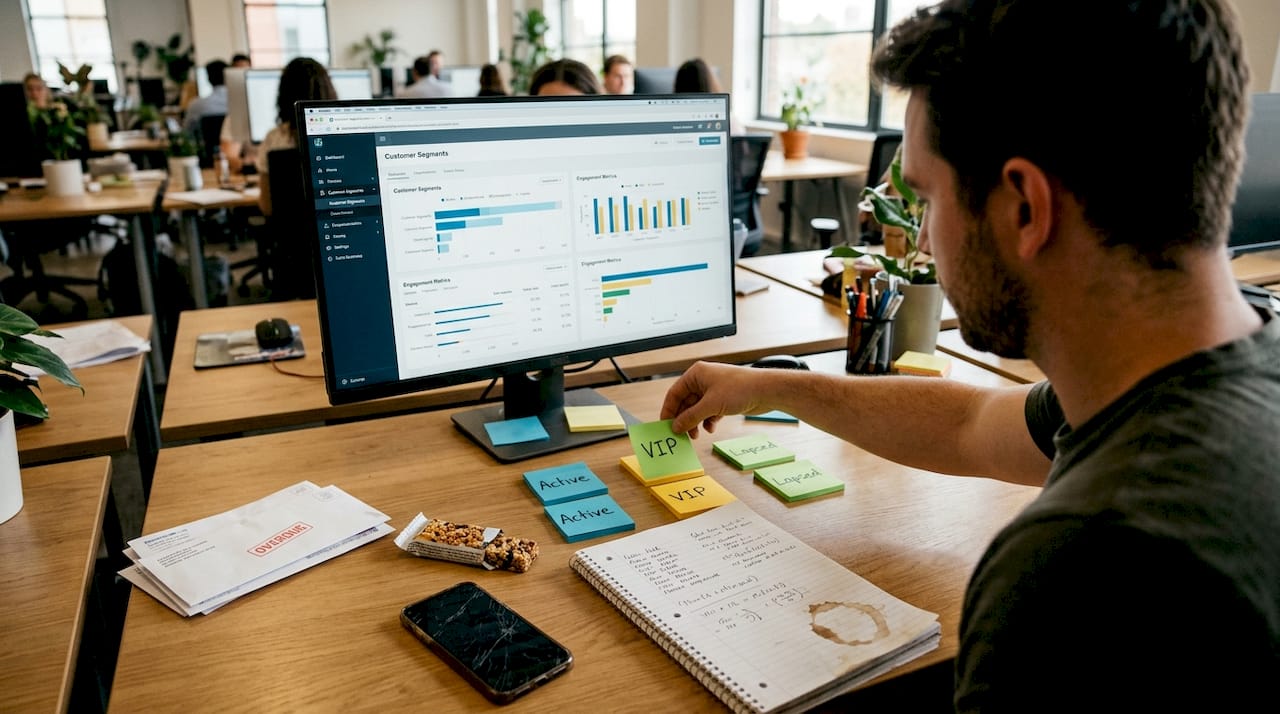
Your send cadence should vary by segment to maximize engagement without overwhelming subscribers. Active and VIP segments can handle 2-8 segmented campaigns per week, while Lapsed customers need careful re-engagement sequences. The key is implementing filters and guardrails to prevent audience overlap, ensuring no subscriber receives multiple emails on the same day unless strategically planned.
Pro Tip: Set up suppression filters in Klaviyo that automatically exclude anyone who received an email in the past 24 hours from your campaign sends. This simple guardrail prevents list fatigue and improves overall engagement metrics.
Shift your focus from vanity metrics to revenue-driven indicators. With iOS privacy changes making open rates unreliable, revenue per recipient (RPR) has become the gold standard for measuring email success. RPR tells you exactly how much revenue each email generates per person who receives it, giving you a clear picture of which campaigns and flows truly drive business growth. Track RPR alongside conversion rate and average order value to understand the complete revenue story.
Harnessing automated email flows to maximize ecommerce revenue
Automated flows represent the highest-leverage opportunity in your email program. Automated flows drive 15-20% revenue share, roughly half of total email revenue, while requiring far fewer sends than campaigns. These sequences outperform campaigns 3-4x in engagement because they reach customers at precisely the right moment with contextually relevant messages.
Your welcome series establishes the foundation for the entire customer relationship. When someone joins your list, they’re most engaged and receptive to your brand story. A strong welcome flow introduces your brand voice, sets expectations for email frequency, and often includes a first-purchase incentive. The best welcome series span 3-5 emails over 7-14 days, progressively educating subscribers about your products, values, and unique selling propositions.
Abandoned cart and browse abandonment flows recover revenue that would otherwise disappear. Cart abandonment rates hover around 70% for most ecommerce stores, representing massive lost opportunity. A well-crafted abandoned cart sequence reminds customers what they left behind, addresses common purchase objections, and often includes urgency elements or incentives. Browse abandonment flows target customers who viewed products but didn’t add to cart, using softer messaging to nurture interest.
Core Klaviyo flows for DTC brands include welcome sequences, abandoned cart recovery, browse abandonment, post-purchase education, and winback campaigns. Post-purchase flows are particularly valuable for building lifetime value. After someone buys, send educational content about product usage, complementary product recommendations, and requests for reviews. This sequence transforms one-time buyers into loyal customers while the purchase excitement is still fresh.
Winback flows re-engage customers who haven’t purchased recently, using personalization to remind them why they loved your brand. The most effective winback sequences reference past purchases, offer personalized product recommendations based on browsing history, and sometimes include special comeback offers. Timing matters: start your winback sequence around 90-120 days after the last purchase, depending on your typical purchase cycle.
Pro Tip: Layer conditional splits into your automated workflows for ecommerce brands based on customer actions. If someone opens but doesn’t click, send different follow-up content than if they clicked but didn’t purchase. This dynamic approach significantly improves conversion rates.
| Flow Type | Typical Revenue Contribution | Average Conversion Rate | Best Practice Send Cadence |
|---|---|---|---|
| Welcome Series | 8-12% of flow revenue | 3-5% | 3-5 emails over 7-14 days |
| Abandoned Cart | 25-35% of flow revenue | 8-15% | 3 emails over 24-48 hours |
| Post-Purchase | 15-20% of flow revenue | 10-18% | 4-6 emails over 30-60 days |
| Winback | 10-15% of flow revenue | 2-4% | 3-4 emails over 14-21 days |
Strategic campaign emails: segmenting, testing, and optimizing for engagement
While flows handle behavior-triggered messaging, campaigns give you control over promotional calendar and product launches. Understanding campaign benchmarks helps you set realistic targets and identify improvement opportunities. Average ecommerce campaigns see 31-38% open rates, 1.3-1.47% click rates, 0.08% conversion rates, and $0.048-0.11 RPR. Top 10% performers achieve 45-55% opens, 4.7% clicks, 0.44% conversions, and RPR 7x higher than average.
These benchmark gaps reveal massive opportunity. The difference between average and top performance isn’t luck but strategic execution across multiple dimensions. Start by segmenting every campaign with precision filters. Never send to your entire list. Instead, target specific customer groups with messages tailored to their purchase history, engagement level, and preferences.
A/B testing transforms guesswork into data-driven decisions. Test one variable at a time to isolate what actually moves metrics. Subject line testing typically yields the biggest immediate wins, but also test send times, preview text, email layouts, CTA placement, and offer structures. Run tests on segments of at least 1,000 subscribers for statistical significance, then send the winning variant to the remainder.
Implement mobile-first design principles since over 60% of email opens happen on mobile devices. Use single-column layouts, large tap-friendly buttons, and concise copy that delivers value quickly. Your CTA should appear above the fold on mobile screens, using action-oriented language that creates urgency without being pushy. Brand personality should shine through every element, from subject lines to sign-offs.
Dynamic content and product recommendations personalize campaigns at scale. Klaviyo’s dynamic blocks let you show different products, images, or copy to different segments within the same campaign. Product recommendation logic can display items based on past purchases, browsing behavior, or predictive analytics about what customers are likely to buy next. This personalization significantly boosts open rates and engagement compared to static, one-size-fits-all messages.
- Define your campaign goal (awareness, consideration, conversion) before writing a single word
- Segment your audience based on likelihood to engage with this specific message
- Craft subject lines that create curiosity or urgency without clickbait
- Design mobile-first templates with clear visual hierarchy
- Include one primary CTA that aligns with your campaign goal
- Set up A/B tests on high-impact variables
- Schedule sends based on your audience’s historical engagement patterns
- Monitor real-time performance and optimize future campaigns based on learnings
| Metric | Industry Average | Top 10% Performers | Your Target |
|---|---|---|---|
| Open Rate | 31-38% | 45-55% | 40%+ |
| Click Rate | 1.3-1.47% | 4.7% | 3%+ |
| Conversion Rate | 0.08% | 0.44% | 0.25%+ |
| Revenue Per Recipient | $0.048-0.11 | $0.35+ | $0.20+ |
Next-level optimization: leveraging AI, hygiene, and ethical frequency in 2026
Advanced email marketers in 2026 are leveraging AI to create dynamic, behavior-driven experiences that static campaigns can’t match. AI winback flows outperform static sequences by 1.5x in revenue per recipient because they trigger based on real-time customer signals rather than arbitrary time delays. Instead of sending a winback email exactly 90 days after last purchase, AI analyzes engagement patterns, browsing behavior, and purchase probability to determine the optimal moment for re-engagement.
Subscriber hygiene maintains list quality and protects deliverability. Many marketers fear removing subscribers, but keeping unengaged contacts hurts more than helps. Implement sunset policies that remove subscribers who haven’t opened or clicked in 90-120 days after a final re-engagement attempt. This practice improves your sender reputation, increases engagement rates across remaining subscribers, and reduces email costs.
Avoid OR filters in your segmentation logic, which create broad, unfocused audiences. Instead, use AND logic to refine targeting with multiple criteria that must all be true. For example, rather than targeting customers who purchased Product A OR viewed Product B, target those who purchased Product A AND have high engagement scores AND haven’t purchased in 60 days. This precision ensures your message reaches only the most relevant audience.
Ethical email marketing in 2026 prioritizes customer experience over short-term metrics. Send based on customer behavior signals rather than fixed schedules. If someone just purchased, pause promotional emails for a few days. If engagement drops, reduce frequency rather than increasing it. This behavior-based approach respects subscriber preferences while maintaining healthy long-term relationships.
Measure success through margin-adjusted KPIs that account for profitability, not just revenue. A campaign generating $10,000 in revenue from discounted products with 20% margins delivers less value than one generating $7,000 from full-price products with 60% margins. Track contribution margin per email to understand true business impact.
“The future of email marketing isn’t about sending more messages. It’s about sending smarter messages that respect customer preferences, leverage AI for perfect timing, and prioritize long-term relationships over short-term wins. Brands that embrace ethical frequency and AI-driven personalization strategies with Klaviyo will dominate their categories.”
Pro Tip: Create a master suppression segment in Klaviyo that combines recent purchasers, highly engaged browsers, and anyone who received an email in the past 16 hours. Apply this suppression to every campaign to prevent over-mailing your most valuable customers.
- Implement AI-powered send time optimization that learns individual subscriber preferences
- Use predictive analytics to identify customers at risk of churning before they lapse
- Create dynamic product recommendation blocks that update in real-time based on inventory and trends
- Build conditional flow paths that adapt based on customer actions and inactions
- Monitor engagement velocity (how quickly subscribers engage after send) to optimize future timing
Partner with expert email marketing & retention agency
Implementing these strategies requires expertise, time, and ongoing optimization that many growing brands struggle to maintain in-house. That’s where partnering with a specialized email marketing & retention agency transforms your results. Take Action combines human expertise with AI-driven insights to turn email into your primary growth channel, handling everything from strategic planning to execution and continuous optimization.
Our team has helped dozens of ecommerce brands dramatically increase email revenue through customized automated workflows and sophisticated segmentation strategies. We don’t use cookie-cutter templates. Every flow, campaign, and segment is tailored to your brand voice, customer journey, and revenue goals. Our data-driven approach means we’re constantly testing, learning, and optimizing to maximize your ROI.
Whether you’re just getting started with Klaviyo or looking to scale an existing program, we provide the strategic partnership you need to achieve sustainable growth. Our services include complete flow setup, campaign strategy and execution, advanced Klaviyo personalization strategies, A/B testing frameworks, and ongoing performance optimization. Let’s accelerate your ecommerce growth together.
What are the best email marketing tips for ecommerce brands?
How important is audience segmentation for email success?
Segmentation is critical for ecommerce email performance. Dividing your list into core segments like Active, VIP, Lapsed, and New customers allows you to send personalized messages that resonate with each group’s needs and behaviors. Segmented campaigns consistently outperform batch-and-blast approaches by 2-3x in conversion rates.
Which automated flows should every ecommerce brand implement?
Every ecommerce brand needs welcome series, abandoned cart recovery, browse abandonment, post-purchase sequences, and winback flows. These automated workflows for ecommerce handle critical customer touchpoints without manual effort, generating roughly half of total email revenue. Start with abandoned cart and welcome flows for immediate impact.
How often should I test my email campaigns?
Test continuously, but focus on high-impact variables. Run A/B tests on every major campaign, testing subject lines, send times, or creative elements. Aim for at least one meaningful test per week to build a knowledge base of what resonates with your audience. Document results to inform future strategy.
What role does AI play in modern email marketing?
AI enables dynamic personalization at scale that manual processes can’t match. Use AI for predictive send time optimization, product recommendations, and behavior-triggered sequences. AI-powered tools analyze patterns across thousands of customers to determine optimal timing and content for each individual subscriber.
How do I maintain email list hygiene?
Remove unengaged subscribers after 90-120 days of inactivity following a final re-engagement campaign. This practice improves deliverability, increases engagement rates among remaining subscribers, and reduces costs. Quality always beats quantity in email marketing, so focus on maintaining an engaged, responsive list.
How can Klaviyo flows impact ecommerce revenue?
Klaviyo flows generate disproportionate revenue compared to campaigns because they target customers at high-intent moments. Flows outperform campaigns 3-4x in engagement and drive approximately half of total email revenue despite requiring fewer sends. They work 24/7, automatically nurturing customers through critical journey stages like post-purchase education and cart abandonment recovery. This automation frees your team to focus on strategy while flows handle tactical execution. Well-optimized automated workflows for ecommerce brands become your most reliable revenue source.
What are ethical frequency and subscriber hygiene practices?
Ethical frequency means sending based on individual customer engagement signals rather than arbitrary schedules. If someone consistently opens and clicks, they can handle more frequent emails. If engagement drops, reduce frequency automatically. Behavior-based sending respects subscriber preferences while maintaining healthy long-term relationships. Subscriber hygiene involves removing contacts who haven’t engaged in 90-120 days after re-engagement attempts. This maintains list quality, improves deliverability, and ensures you’re investing resources in subscribers who actually want to hear from you.
How can AI improve email marketing results in 2026?
AI analyzes vast amounts of customer data to identify patterns and opportunities humans would miss. It personalizes product recommendations based on browsing history, purchase patterns, and similar customer behaviors. AI-driven winback flows deliver 1.5x higher revenue per recipient than static sequences by triggering at optimal moments based on real-time signals. AI also optimizes send times for each subscriber, predicts churn risk before it happens, and dynamically adjusts content based on engagement patterns. The result is more relevant, timely messages that drive significantly better results with less manual effort. Implement personalization strategies with Klaviyo to leverage AI capabilities fully.
Recommended
- Boost ecommerce productivity with remote work tips 2026 | Take Action Blog | Take Action
- 7 Service Business Marketing Ideas for Ecommerce Growth | Take Action Blog | Take Action
- Boost ecommerce growth: SEO and Klaviyo automation | Take Action Blog | Take Action
- How to build an email list for ecommerce success in 2026 | Take Action Blog | Take Action