

Content creation in digital marketing: A growth guide
TL;DR:
- Most e-commerce brands lack a deliberate, strategic approach to content creation.
- Organizing content around pillars and clusters improves coherence, authority, and revenue.
- Measuring success by revenue attribution rather than vanity metrics drives sustainable growth.
Most e-commerce brands treat content creation as something bolted onto their marketing strategy rather than baked into it. A few blog posts here, a promotional email there, and maybe a social caption written in a rush before a product launch. That approach feels productive, but it rarely drives meaningful revenue. Real content creation in digital marketing is a deliberate, structured process where every piece of content serves a specific goal, whether that’s moving a cold subscriber toward a first purchase or turning a one-time buyer into a loyal repeat customer. This guide gives you the definition, frameworks, and measurement tools to make that shift.
Table of Contents
- Defining content creation in digital marketing
- The essential types of content for e-commerce marketing
- Strategy frameworks: Pillar-cluster models and AI automation
- Measuring content effectiveness: Beyond vanity metrics
- Why most e-commerce brands get content creation wrong
- Level up your content marketing with Take Action
- Frequently asked questions
Key Takeaways
| Point | Details |
|---|---|
| Strategic content is essential | Planned, goal-focused content drives real results for e-commerce digital marketing. |
| Balance automation and human touch | AI can scale your efforts, but oversight ensures your brand voice remains authentic. |
| Content frameworks boost ROI | Organized pillar-cluster structures support authority, scalability, and effective automation. |
| Measure what matters | Focus on revenue attribution, not just opens or clicks, for true content impact. |
Defining content creation in digital marketing
Content creation in digital marketing is not just about publishing. It is the structured process of planning, producing, and distributing media assets that push defined business goals forward. For e-commerce brands, those goals almost always connect to revenue: acquiring new customers, increasing order frequency, or improving customer lifetime value. You can read a more detailed breakdown of content creation in marketing to see how these layers stack on top of each other.
The distinction between “content” and “strategic content” is where many brands lose money. Generic content fills a calendar. Strategic content maps to a funnel stage, a segment, and a measurable outcome. A welcome email that introduces your brand story is strategic. A newsletter that exists only because “we should be sending emails” is not.
AI tools have made content production faster and cheaper than ever before. But speed without direction creates a different problem. AI excels at scale but still needs careful human oversight to maintain your brand voice. When you feed AI a vague prompt and publish whatever comes out, you end up with content that could belong to any brand. Your audience notices, even if they cannot explain exactly why the message feels hollow.
“Content without strategy is just noise. For e-commerce, every email, every blog post, and every social message should trace back to a customer action you want to drive.”
Balancing creative human direction and AI automation is the actual skill. The brands winning at email marketing right now are not the ones using the most tools. They are the ones who know exactly what they want from each piece of content and use tools to execute that vision faster. That human-led, AI-assisted approach is what separates scalable content operations from chaotic ones.
The essential types of content for e-commerce marketing
Once you understand what strategic content creation looks like, the next question is: what should you actually be making? For e-commerce, there are three core content types that do the heavy lifting across the digital funnel.
Promotional content drives direct sales. Product announcements, limited-time offers, seasonal campaigns, and restock alerts fall here. This content converts, but only when your audience trusts you enough to listen.
Educational content builds that trust. How-to guides, buying advice, ingredient breakdowns, sizing help, and comparison content answer real questions your customers are asking before and after they buy. This type of content reduces hesitation and return rates while positioning your brand as an authority.
Storytelling content creates emotional connection. Behind-the-scenes updates, founder stories, customer spotlights, and brand mission content make people feel something. That feeling drives loyalty and word-of-mouth in ways that promotional content simply cannot replicate.

The ratio matters. Balancing one-third promotional, one-third educational, and one-third storytelling content in your newsletters consistently outperforms campaigns that lean too heavily on any single type. An all-promotional email list burns out your subscribers. An all-educational one fails to convert. The blend is what keeps people opening, clicking, and buying over time.
| Content type | Primary goal | Best channel | Funnel stage |
|---|---|---|---|
| Promotional | Drive immediate sales | Email, paid social | Bottom of funnel |
| Educational | Build trust and reduce doubt | Blog, email, video | Middle of funnel |
| Storytelling | Create loyalty and connection | Email, social, video | All stages |
Pro Tip: Use content pillars for ecommerce to systematize how you generate and organize ideas. A content pillar is a broad theme relevant to your audience, like “ingredient transparency” for a skincare brand. You then build clusters of related content around that pillar. This approach not only makes ideation faster but also makes repurposing content for email campaigns far more efficient. A single pillar blog post can become five email segments, three social captions, and one educational flow within Klaviyo without any additional research.
Adapting your content types to the customer journey stage is a detail that separates good email programs from great ones. A subscriber who joined your list yesterday should not receive the same promotional-heavy messaging as someone who has already made three purchases. Map your content mix to where each segment sits in the journey, and your relevance scores and conversion rates will reflect that precision.
Strategy frameworks: Pillar-cluster models and AI automation
Knowing your content types is one thing. Organizing them into a scalable system is another. The pillar-cluster model is the most effective framework available for e-commerce content operations right now, and it works across email, SEO, and social simultaneously.
Topical authority through pillar-cluster structures consistently outperforms brands that publish isolated, disconnected posts. When your content is organized around interconnected themes, search engines recognize you as an authority, and your audience experiences a coherent brand narrative rather than random messaging. That coherence compounds over time.
Here is how to build this system step by step:
- Identify your core pillars. Choose three to five broad topics that your ideal customer cares about and that connect directly to your products. For a supplement brand, these might be “gut health,” “energy and performance,” “sleep quality,” and “ingredient science.”
- Map cluster content around each pillar. For each pillar, generate ten to fifteen related subtopics. These become blog posts, email sequences, FAQ sections, and video scripts. The pillar strategy for ecommerce emails works especially well inside Klaviyo flows because each cluster naturally maps to a segment or behavioral trigger.
- Automate distribution. Once content exists, use automation to deliver it to the right segment at the right time. A post-purchase flow that delivers educational content from your “ingredient science” pillar reinforces the buyer’s decision and sets up the next upsell naturally.
- Monitor and refine. Run a content audit checklist every quarter. Identify which cluster content drives the most downstream revenue, double down on those topics, and cut what is not performing.
| Approach | Organization | Scalability | Brand coherence | SEO and authority |
|---|---|---|---|---|
| Scattered content | Random | Low | Weak | Minimal |
| Pillar-cluster framework | Structured | High | Strong | Significant |
AI automation fits cleanly into step three of this process. Use it to generate draft variations of cluster content, personalize email subject lines by segment, and test messaging across flows at a speed no human team can match manually. But keep human oversight on the strategy layer. The pillar choices, the cluster structure, and the brand voice standards must come from people who understand your customers, not from an algorithm optimizing for the nearest available pattern.
Measuring content effectiveness: Beyond vanity metrics
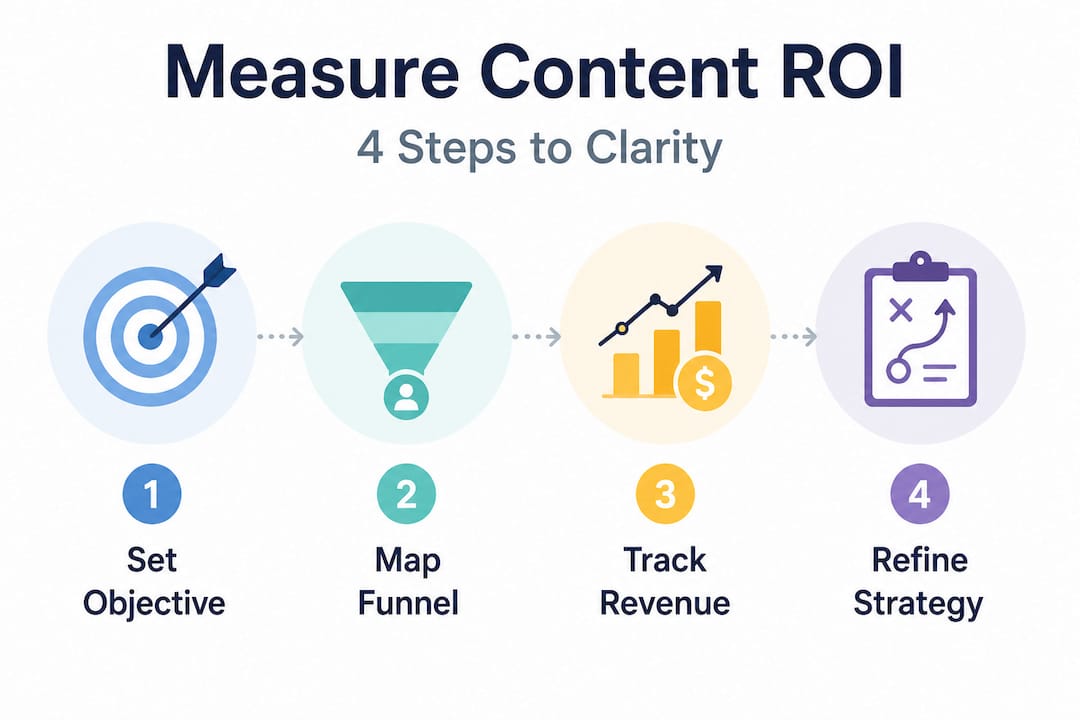
You have built a strategy, chosen your content types, and set up a pillar-cluster framework. Now the uncomfortable question: is any of it actually working? Most brands answer that question by looking at open rates, follower counts, and impressions. Those numbers feel good. They rarely tell you whether content is driving profit.
Vanity metrics measure attention. What you need to measure is revenue impact. Revenue attribution, not vanity metrics like opens, is how best-in-class marketers evaluate content performance. That means connecting specific content pieces to downstream purchasing behavior, repeat visits, and customer lifetime value changes.
Here is what meaningful measurement looks like in practice:
- Attributed revenue per email flow: In Klaviyo, you can see exactly how much revenue each automated sequence generates. If your post-purchase educational flow produces a 20% increase in second-order rate, that is a direct content ROI calculation.
- Content-influenced conversion rate: Track whether subscribers who consumed educational content convert at a higher rate than those who only received promotional messages. The answer is almost always yes, and that gap tells you how much your educational content is worth.
- Segment-level engagement trends: Look at click-to-conversion rates by segment, not just overall open rates. A segment with a 40% open rate and a 0.5% conversion rate is underperforming compared to one with a 20% open rate and a 3% conversion rate.
- Lifetime value by content exposure: Tag subscribers based on which content pillars they engage with most. Over time, compare the lifetime value of subscribers who consistently engage with educational content versus those who only interact with promotional sends. The difference is often significant.
Pro Tip: Map every content piece to a specific stage in your sales funnel before you create it. If you cannot answer “what action does this content move the customer toward,” you are creating content for its own sake rather than for revenue. That single filter removes most wasted content effort and forces clarity on what you actually need.
The shift from measuring ROI for ecommerce content through impressions to measuring it through revenue is not just a reporting change. It fundamentally changes which content you prioritize, how you allocate budget, and how you talk to your audience. Brands that make this shift stop chasing reach and start investing in retention, which is where the real compounding value lives in e-commerce.
Why most e-commerce brands get content creation wrong
Here is the uncomfortable truth that most content marketing guides will not say directly: volume is not a strategy. We have worked with brands that were sending four emails per week, publishing two blogs per month, and posting daily on three social platforms while their revenue from email was flat. They were producing a lot. They were not producing intentionally.
The trap is seductive. More content feels like more marketing. AI tools make it possible to generate enormous quantities of copy in minutes. But over-automating without human touch suppresses engagement and hurts deliverability, and brands that automate at scale without human review often watch their sender reputation erode quietly while their open rates drop week over week.
The brands that actually grow through content share one trait: they treat every content piece as a business decision, not a production task. They ask which customer segment needs this, what action it should drive, and how they will know if it worked. That discipline makes their output smaller in volume and dramatically higher in impact.
Human creativity also serves a function that automation genuinely cannot replicate. Your brand’s specific point of view, the tone that makes your customers feel like they are hearing from a person they trust, and the editorial instincts that make a subject line feel irresistible rather than generic, those come from people. AI can iterate on those human inputs at scale. It cannot originate them.
The other missed opportunity we see constantly is failing to connect content to audience-centric themes. The best content is not about your products. It is about your customers’ aspirations, frustrations, and questions, with your products appearing as the natural solution. When you organize content around what your customer actually cares about rather than what you want to sell, engagement rates climb and digital marketing agency content built on this principle consistently outperforms product-first approaches. Real success in e-commerce content comes from audience-first thinking mapped to real revenue outcomes, not reach, not volume, and not automation for its own sake.
Level up your content marketing with Take Action
Building a content system that drives consistent revenue takes more than good ideas. It requires the right frameworks, the right tools, and a team that understands both the strategic and technical sides of e-commerce marketing.
At Take Action, we specialize in building exactly this kind of system for e-commerce brands ready to make email their most reliable growth channel. From content pillar strategy to Klaviyo flow setup, campaign management, and revenue attribution reporting, we handle the complexity so you can focus on your brand. If you are ready to stop guessing and start growing, our ecommerce retention solutions give you a clear path from scattered content to a scalable, automated marketing engine that compounds over time.
Frequently asked questions
What is the main goal of content creation in digital marketing?
The main goal is to produce and distribute valuable media that drives measurable business outcomes like sales and customer retention, not just awareness or engagement metrics.
How can I tell if my content is driving revenue, not just clicks?
Use revenue attribution models in your email platform to connect specific content to actual sales, rather than relying on open or click rates as success indicators.
What’s the risk of over-automating content creation?
Over-automating without human review can erode your brand voice and hurt email deliverability because AI needs human oversight to maintain the authenticity that drives real engagement.
Which content types work best for e-commerce emails?
A balanced mix of promotional, educational, and storytelling content works best, with one-third of each type consistently outperforming single-focus email strategies in retention and conversion rates.