

Digital marketing basics for ecommerce retention wins
TL;DR:
- Improving customer retention by 5% can boost profits by up to 95%.
- Email marketing, automation, and personalized flows are essential for scalable retention.
- Most brands fail at retention because they treat it as a campaign, not a ongoing commitment.
Most ecommerce brands pour their budgets into acquiring new customers while their existing ones quietly disappear. That’s a costly mistake. Increasing retention by just 5% can boost profits anywhere from 25% to 95%, which makes retention one of the highest-leverage moves available to any online store. Understanding the digital marketing basics that drive repeat purchases isn’t a luxury anymore. It’s the foundation of a scalable, profitable business. This guide walks you through the channels, tools, and automation strategies, especially using Klaviyo, that turn one-time buyers into loyal, high-value customers.
Table of Contents
- Why retention outperforms acquisition in ecommerce
- The pillars of digital marketing for growth
- Unlocking email marketing’s power for retention
- Automation strategies: Scaling retention with Klaviyo
- Why most brands still miss out on retention’s full value
- Take action: Professional help to master retention
- Frequently asked questions
Key Takeaways
| Point | Details |
|---|---|
| Retention drives profit | Increasing customer retention by 5% can boost profits by up to 95%. |
| Digital basics matter | Mastering email, automation, and foundational digital channels supercharges ecommerce retention. |
| Automation multiplies impact | Effective automation, like Klaviyo flows, scales customer loyalty and repeat sales. |
| Personalization is key | Tailored, data-driven messaging leads to higher engagement and more repeat purchases. |
Why retention outperforms acquisition in ecommerce
Customer retention is simply the ability to keep buyers coming back after their first purchase. But its impact on your bottom line goes far deeper than most marketing leaders realize. Every time a customer returns, your cost to generate that revenue drops significantly because you’ve already paid to acquire them. That’s what makes retention such a powerful profit lever.
Here’s a number that should shift your perspective immediately: repeat customers spend 67% more by their third year compared to their first purchase. That means the longer you keep a customer engaged, the more valuable they become, often without any additional ad spend on your part. The compounding effect of loyal customers is one of the most underestimated forces in ecommerce.
Understanding customer retention importance helps you see why so many high-growth brands eventually plateau. They’ve mastered acquisition but neglected the relationships that would have sustained long-term revenue.
| Metric | Acquisition focus | Retention focus |
|---|---|---|
| Cost per sale | High (paid ads, influencers) | Low (email, loyalty programs) |
| Average order value | First-time, lower spend | 67% higher by year 3 |
| Profit margin | Thinner (high ad cost) | Wider (low re-engagement cost) |
| Revenue predictability | Volatile | Stable and compounding |
| Scalability | Expensive to scale | Scales efficiently |
“The brands winning in ecommerce aren’t just growing their customer list. They’re growing the value of every customer already on it.”
Even the best ecommerce retention strategies don’t work overnight. But the brands that commit to them build a defensible business that isn’t dependent on the next algorithm change or rising ad costs.
The most common retention challenges ecommerce brands face include:
- No post-purchase communication plan: Customers buy and never hear from the brand again.
- Generic messaging: Blanket emails that ignore purchase history or browsing behavior.
- Over-reliance on discounts: Training customers to wait for sales instead of building genuine loyalty.
- Ignoring churn signals: Missing the behavioral cues that predict when a customer is about to leave.
- Poor product education: Failing to help customers get value from what they already bought.
Effective ecommerce pricing strategies also play a role here. When customers feel they got a fair deal, they’re far more likely to return. Every marketing leader needs to understand these foundational dynamics before investing in any tools or campaigns.
The pillars of digital marketing for growth
Digital marketing isn’t one thing. It’s a collection of channels that, when used together, create a retention engine for your store. Each pillar serves a different purpose in the customer journey, and understanding how they interact is what separates high-performing ecommerce teams from average ones.
The five core pillars are:
- Email marketing: The highest ROI channel for retention. Delivers personalized messages directly to inboxes at low cost, with full ownership of your audience.
- Social media: Builds community and brand affinity. Keeps your brand visible between purchases and amplifies word-of-mouth from loyal customers.
- SEO (search engine optimization): Drives organic traffic from high-intent searches. Supports retention by educating customers and building trust through content.
- Paid advertising: Effective for acquisition, but increasingly important for retargeting existing customers with specific offers.
- Marketing automation: The backbone of scalable retention. Sends the right message at the right time based on customer behavior, without manual effort.
Each channel contributes to retention in distinct ways. Email nurtures loyalty through personalized flows. Social keeps customers engaged between purchases. SEO attracts returning buyers who search for the products they’ve come to trust. Paid ads can re-engage lapsed customers efficiently. And automation ties all of it together by ensuring no customer slips through the cracks.

The digital media strategy you choose should reflect your customer base. A brand selling premium skincare to women in their 30s will retain customers very differently than a store selling tech accessories to early adopters.
| Channel | Typical cost | Retention impact | Ease of use |
|---|---|---|---|
| Email marketing | Low | Very high | Moderate |
| Social media | Low to medium | Medium | Easy |
| SEO | Medium (time) | Medium | Complex |
| Paid advertising | High | Medium (retargeting) | Moderate |
| Marketing automation | Medium (setup) | Very high | Complex at first |
The ecommerce retention rate averages 38% across the industry in 2026, which means most brands are losing roughly 62% of their customers after a single purchase. The right channel mix can shift that number dramatically.
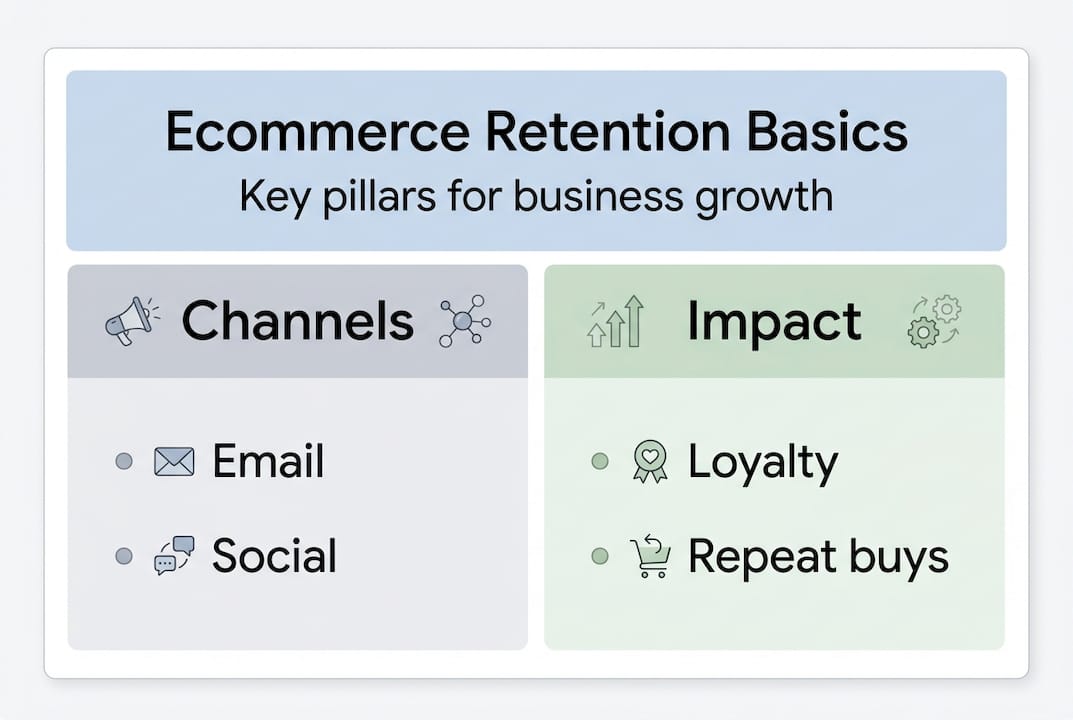
Pro Tip: Don’t try to master every channel at once. Pick the one where your customers already spend time, usually email, and build a retention system there first. Then layer in other channels as your strategy matures.
The digital marketing strategies guide breaks down how to sequence these channels for maximum retention impact. Pairing your channel selection with smart online pricing tactics also ensures your messaging lands with offers that feel compelling rather than desperate.
Unlocking email marketing’s power for retention
Email is the single highest-ROI digital marketing channel for ecommerce retention. It’s direct, owned, personal, and scalable. Unlike social media, you’re not at the mercy of an algorithm. Unlike paid ads, you’re not paying per click. When you own your email list and use it well, you build an asset that compounds in value over time.
The reason email outperforms other channels for retention is straightforward: it allows you to speak to customers as individuals, based on exactly what they’ve bought, browsed, or ignored. When someone receives an email that feels written specifically for them, they respond to it. That’s personalization at scale, and it’s what Klaviyo is built to deliver.
A 5% retention improvement can increase profits by 25% to 95%. Email automation is the most reliable way to achieve that kind of improvement consistently. Here’s how to launch your first retention flow in Klaviyo:
- Set up your Klaviyo account and integrate it with your store. Connect Shopify, WooCommerce, or your platform of choice. Klaviyo pulls in customer and order data automatically.
- Define your audience segments. Start with basic segments: new buyers, repeat buyers, and lapsed customers. These three groups need very different messaging.
- Build your welcome flow. Trigger a 3 to 5 email sequence when someone makes their first purchase. Introduce your brand story, set expectations, and encourage their second purchase within 30 days.
- Create a post-purchase flow. Send product education, care tips, or complementary product recommendations 7 to 14 days after purchase. This reduces buyer’s remorse and increases satisfaction.
- Set up a win-back flow. Target customers who haven’t purchased in 60 to 90 days with a personalized re-engagement email, followed by a soft offer if they don’t respond.
- Monitor and optimize. Review open rates, click rates, and repeat purchase rates monthly. Test subject lines, timing, and offers to improve performance over time.
The newsletter ideas for retention resource from Take Action gives you specific campaign concepts you can launch immediately, without starting from a blank page.
Retention stat to remember: A 5-point increase in retention can lift profits by as much as 95%. That’s not a rounding error. That’s a business transformation.
Pro Tip: Personalize every automated email with at least one dynamic field tied to purchase history. Even a simple “Based on your recent order of [product name]” dramatically increases relevance and click rates compared to generic copy.
Key KPIs to track for email retention campaigns:
- Open rate: Benchmark is 35% to 50% for retention flows in Klaviyo
- Click rate: Aim for 2% to 5% per email
- Repeat purchase rate: Track how many first-time buyers convert to a second purchase within 90 days
- Customer lifetime value (CLV): Rising CLV is the clearest sign your retention program is working
Automation strategies: Scaling retention with Klaviyo
Marketing automation is what transforms your retention strategy from a manual effort into a self-running system. Instead of sending one-off campaigns and hoping for the best, automation lets you deliver the right message to the right person at exactly the right moment in their customer journey.
Klaviyo is built specifically for ecommerce, which makes it the tool of choice for brands serious about retention. It uses behavioral triggers, real-time data, and advanced segmentation to make every message feel intentional. As a reminder, repeat customers spend 67% more by their third year with a brand. Automation is what keeps them engaged long enough to reach that milestone.
The key Klaviyo automations every ecommerce brand should have running:
- Cart abandonment flow: Recovers potential sales from customers who added items to their cart but didn’t complete the purchase. Typically a 2 to 3 email sequence sent within 24 hours.
- Post-purchase flow: Builds loyalty by following up with education, cross-sells, and gratitude messaging after a completed order.
- Browse abandonment flow: Re-engages customers who viewed a product but didn’t add it to their cart. This is an early signal of intent that many brands miss.
- Win-back flow: Targets lapsed customers with personalized messaging and a time-sensitive offer to bring them back before they churn permanently.
- Loyalty and VIP flow: Rewards your top spenders with early access, exclusive discounts, or special recognition. These customers are your most profitable segment.
Exploring loyalty program ideas can help you design the rewards component of these flows in a way that feels genuine, not transactional.
| Automation type | Average retention lift | Revenue impact |
|---|---|---|
| Cart abandonment | 15 to 20% recovery rate | Direct, immediate revenue |
| Post-purchase flow | 20 to 30% repeat purchase rate | Higher CLV within 90 days |
| Browse abandonment | 5 to 10% conversion rate | Converts warm intent to sales |
| Win-back flow | 10 to 15% re-engagement rate | Recovers lost revenue |
| Loyalty and VIP flow | 25 to 40% higher spend from VIPs | Long-term profit growth |
Pro Tip: Segment your automation by customer lifecycle stage, not just by the last action they took. A brand-new customer needs education. A three-time buyer needs recognition. A lapsed customer needs a reason to believe in you again. Sending the same message to all three will underperform every time.
The power of Klaviyo is that all of this can run simultaneously, in the background, without manual intervention. Once the flows are built, they generate revenue continuously while your team focuses on strategy and growth.
Why most brands still miss out on retention’s full value
After working with ecommerce brands across categories and budget levels, we’ve noticed a pattern that almost no one talks about openly: most brands don’t fail at retention because they lack the tools. They fail because they treat retention like a campaign instead of a commitment.
It’s easy to install Klaviyo and build a welcome flow. What’s harder is building the organizational discipline to actually act on the data it surfaces. That requires someone who reads the reports, adjusts the segments, rewrites underperforming emails, and keeps asking “why is this customer leaving?” That deeper work never trends on social media. There’s no viral thread about it. But it’s where the real competitive advantage lives.
Building online customer loyalty isn’t a tactic you deploy once. It’s a mindset you operationalize across your marketing, your product, and your customer experience. The brands that genuinely win at retention don’t just use better tools. They think about customers differently. They see every purchase not as a transaction, but as the beginning of a relationship that has real, measurable long-term value. That shift in perspective is rarer than it should be.
Take action: Professional help to master retention
If you’ve read this far, you understand the business case for retention. The harder part is executing consistently, especially while running a fast-moving ecommerce operation.
Most brands need more than knowledge. They need a system. At Take Action, we specialize in building exactly that. From Klaviyo flow setup to advanced segmentation strategies and ongoing campaign management, our team handles the technical and creative work so you can focus on growing your brand. Whether you’re starting your first retention program or optimizing one that’s already generating revenue, our email marketing solutions are built to deliver measurable results. Stop leaving repeat purchase revenue on the table. Let’s build a retention engine together.
Frequently asked questions
What is a good customer retention rate for ecommerce in 2026?
A strong ecommerce retention rate in 2026 is around 38% industry average, though top-performing brands consistently exceed this benchmark through personalized email and automation strategies.
How much can profit increase by improving retention rates?
Boosting retention by just 5% can increase profits by 25% to 95%, making it one of the highest-leverage improvements any ecommerce business can make.
Which Klaviyo automation is best for ecommerce retention?
Cart abandonment, post-purchase follow-up, and loyalty reward flows consistently deliver the strongest retention results, and running all three together creates a compounding effect that keeps customers engaged across the full lifecycle.
How do you measure retention campaign success?
Track repeat purchase rate, customer lifetime value, and the percentage of first-time buyers who make a second purchase within 90 days, since these metrics reveal whether your retention efforts are actually changing customer behavior.
Why do many brands struggle with customer retention?
Most brands struggle because they invest heavily in acquisition and leave post-purchase communication on autopilot, failing to build the ongoing, personalized engagement that turns first-time buyers into loyal, high-value customers.
Recommended
- Online Marketing Strategy: Driving Ecommerce Retention | Take Action Blog | Take Action
- 7 Innovative Ecommerce Newsletter Ideas for Higher Retention | Take Action Blog | Take Action
- Essential digital branding tips for ecommerce growth | Take Action Blog | Take Action
- UGC Digital Marketing: Driving Retention in Ecommerce | Take Action Blog | Take Action