

Digital marketing explained: driving ecommerce success
TL;DR:
- Most ecommerce brands fail to connect their digital marketing efforts into a measurable, customer-focused system. Effective digital marketing combines targeted channels like SEO, social media, and email into a cohesive strategy that drives discovery, purchase, and loyalty. Success requires disciplined execution, accurate attribution, and continual optimization based on revenue and customer lifetime value.
Most ecommerce brands are doing something in the digital space, but few are doing it in a coordinated, measurable way. There’s a big difference between posting on Instagram, blasting a promo email, and running Google ads separately versus connecting those efforts into a system that moves customers from discovery to purchase to loyalty. Digital marketing uses digital channels and technologies to connect with customers and influence purchasing decisions, and getting that definition right changes how you build your entire strategy.
Table of Contents
- What is digital marketing?
- The key channels of digital marketing for ecommerce
- Why email marketing is a cornerstone of digital marketing
- Moving from tactics to a structured digital marketing process
- The critical nuance: Attribution and measuring what matters
- The real reason most digital marketing falls short in ecommerce
- Supercharge your ecommerce marketing results with expert support
- Frequently asked questions
Key Takeaways
| Point | Details |
|---|---|
| Digital marketing defined | Digital marketing uses online channels like search, social, and email to attract and retain customers. |
| Channel integration matters | A connected, multi-channel strategy outperforms isolated tactics for ecommerce growth. |
| Email’s unique power | Email marketing drives sales and loyalty through direct, measurable communication with your audience. |
| Success needs structure | Planning, executing, measuring, and optimizing turns scattered techniques into real, scalable results. |
| Measure what counts | Proper attribution and conversion tracking are essential for smart decisions and ROI in digital marketing. |
What is digital marketing?
Digital marketing is not just one thing. It’s the full set of marketing activities that happen across digital channels: search engines, social media platforms, email inboxes, and websites. For ecommerce brands specifically, it’s the engine that attracts new customers, nurtures them toward a first purchase, and keeps them coming back.
The key distinction between digital and traditional marketing comes down to two things: targeting precision and trackability. A TV ad or print spread reaches a broad audience with little control over who sees it and almost no way to directly measure what happened after. Digital marketing, on the other hand, lets you pinpoint the exact customer profile you want to reach, deliver your message, and then watch exactly what they do next.
Here’s a quick comparison:
| Factor | Traditional marketing | Digital marketing |
|---|---|---|
| Targeting | Broad demographic buckets | Specific behaviors and interests |
| Measurement | Estimated impressions | Trackable clicks, opens, and conversions |
| Cost | High fixed costs | Flexible, scalable spend |
| Speed | Slow to execute and adjust | Fast iteration and real-time optimization |
| Personalization | Low, one-size-fits-all | High, personalized at scale |
The common digital marketing and retention channels available to ecommerce brands include:
- Search engine optimization (SEO): Organic visibility on Google when customers search for products
- Paid search (PPC): Ads that appear at the top of search results for targeted keywords
- Social media marketing: Organic and paid content on platforms like Instagram, TikTok, and Facebook
- Email marketing: Direct, personalized messages to subscribers who have opted in
- Content marketing: Blog posts, videos, and guides that attract and educate potential customers
- Affiliate marketing: Partnering with publishers and influencers to drive referred sales
“Digital marketing is marketing that uses digital channels and technologies to connect with customers and influence purchasing decisions; it commonly includes online channels such as search, social media, email, and websites.”
What separates mature ecommerce brands from the rest is that they treat these channels as a connected system, not a list of isolated tasks.
The key channels of digital marketing for ecommerce
Understanding which channels do what is critical before you invest time and budget. Each channel serves a different purpose in the customer journey: from first awareness all the way through repeat purchase. The mistake most brands make is treating them as silos, pouring money into ads without thinking about what happens after the click, or sending emails without aligning them to what customers just saw on social.
Here’s how the core channels map to the ecommerce customer journey:
| Channel | Primary purpose | Key metric | Sample ecommerce use case |
|---|---|---|---|
| SEO | Discovery and organic reach | Organic traffic, rankings | Blog content targeting product-related queries |
| Paid social | Awareness and retargeting | ROAS, CPM | Video ads for new product launches |
| Nurture and retention | Open rate, revenue per email | Abandoned cart flows and post-purchase sequences | |
| Website/CRO | Conversion | Conversion rate, AOV | Optimized landing pages and product descriptions |
| SMS | Immediate engagement | Click-through rate | Flash sale alerts and shipping notifications |
The concept of a digital media strategy is about making these channels reinforce each other. A customer might discover your brand on TikTok, visit your site, leave without buying, get retargeted on Instagram, click through and add to cart, then receive an abandoned cart email that finally closes the sale. That’s a multi-channel journey, and every step was digital.

The full digital funnel extends beyond just ads and websites. Email strategy, for example, must align with how customers discover and move through that funnel, not just what happens in the inbox.
Common mistakes brands make with their channel mix:
- Treating each channel as its own separate budget and goal rather than part of one funnel
- Measuring only vanity metrics like likes and impressions instead of revenue and retention
- Over-investing in acquisition channels while ignoring retention channels like email
- Launching campaigns without defining what a “win” actually looks like
- Scaling ad spend before fixing on-site conversion problems
Check out these email marketing tips for ecommerce if you want to get more out of one of the highest-ROI channels in your mix.
Why email marketing is a cornerstone of digital marketing
Of all the channels in the digital marketing mix, email consistently delivers some of the strongest returns for ecommerce brands. It’s direct, personal, and you own the relationship. Unlike social media platforms that can change their algorithms overnight or paid ads that stop the moment your budget runs out, your email list is an asset you control.
Email marketing is a form of digital marketing that involves sending promotional messages or newsletters to subscribers. It’s designed to build customer relationships and drive sales, and every campaign is trackable through engagement and conversion metrics.
What does good ecommerce email marketing actually look like? It’s not just promotional blasts. Strong email programs are built on:
- Segmentation: Grouping subscribers by behavior, purchase history, or lifecycle stage so the message matches where they are in their journey
- Automation: Triggered sequences that fire based on what a customer does, like browsing without buying or making a first purchase
- Value-first content: Emails that teach, inspire, or entertain before selling, building the trust that makes conversions easier
- Conversion focus: Clear calls to action, optimized subject lines, and consistent testing of send times and content formats
Key metrics to track in your email program:
- Open rate (aim for 35%+ in ecommerce)
- Click-through rate (measures engagement beyond the open)
- Revenue per email (the real bottom-line metric)
- Unsubscribe rate (signals whether your content is relevant)
- Conversion rate per flow vs. per campaign
Here’s a simple numbered process to launch or optimize an ecommerce email campaign:
- Define your audience segment: Who are you sending to and why does this message matter to them specifically?
- Set a clear conversion goal: What action do you want the reader to take?
- Write the email: Subject line, preview text, body copy, and call to action aligned with your goal
- Test before sending: Check rendering across devices, links, and personalization tokens
- Schedule and send: Choose timing based on your audience’s past engagement patterns
- Review performance: Look at open rate, clicks, and revenue within 48-72 hours
- Optimize: Adjust the subject line, content, or audience segment based on what the data shows
Pro Tip: Don’t try to build your entire email program at once. Start by mastering one high-impact segment, like recent purchasers or cart abandoners, before adding more flows. Depth beats breadth in the early stages.
Building an email list is the foundation. Once you have subscribers, email segmentation strategies are what separate average programs from high-performing ones. And when you’re ready to scale content production, repurposing content for email can dramatically cut the time you spend per campaign.
Moving from tactics to a structured digital marketing process
Tactics without process produce inconsistent results. You might hit a good month, but you can’t explain why it worked or reliably repeat it. That’s the difference between guessing and growing. In 2026, successful ecommerce marketers treat digital marketing as a structured process: plan, execute, measure, and optimize, rather than stacking disconnected tactics.
Here’s what each stage means in practice:
Plan: Define your goals, your audience segments, which channels you’ll use, and what success looks like. This includes setting your key performance indicators before anything goes live.
Execute: Build the campaigns, set up the automations, publish the content. This is where most brands focus almost all of their energy, which is exactly why they struggle.
Measure: Pull the data after campaigns run. Not just opens and clicks, but revenue, customer acquisition cost, and lifetime value signals.
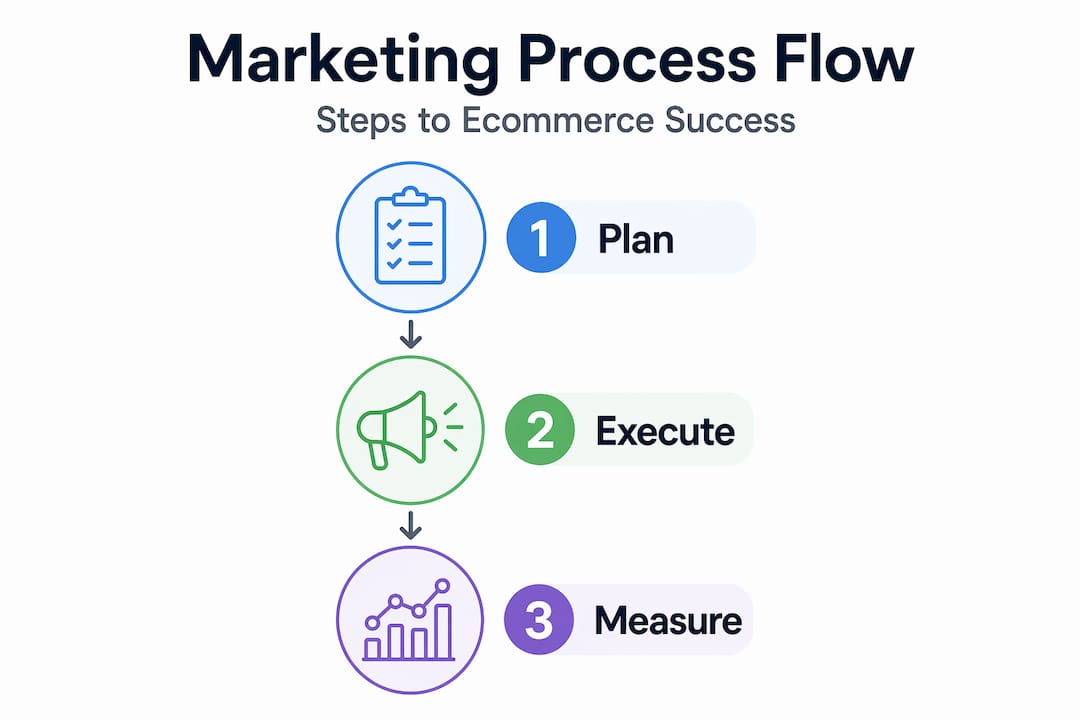
Optimize: Make one informed change at a time based on what the data actually shows, then retest. This is where compounding growth happens.
Here’s how that looks applied to a real ecommerce scenario:
- You plan a welcome email series targeting new subscribers who haven’t purchased yet
- You execute a three-email sequence over seven days with value content and a first-purchase offer
- You measure the conversion rate from subscriber to first buyer across the sequence
- You identify that email two has a 40% drop in clicks and test a different call to action
- You see conversion improve by 15% and roll that version into the permanent flow
- You repeat this process quarterly across all active flows
Chasing new tools and channels without mastering the basics is one of the fastest ways to drain your marketing budget. Brands that win consistently are usually the ones doing fewer things with much more discipline.
Pro Tip: Always define what a conversion means for each specific campaign before you launch it. A welcome email conversion is not the same as a winback campaign conversion. Setting this in advance prevents you from measuring the wrong signal and optimizing in the wrong direction.
Understanding how SEO and digital marketing agency impact compound together also matters when you’re thinking about this process at a channel level.
The critical nuance: Attribution and measuring what matters
Here’s where a lot of otherwise smart ecommerce brands run into trouble. You’re running ads, sending emails, posting on social, and seeing revenue come in. But do you actually know which channel, which campaign, or which touchpoint caused the sale? Attribution is the practice of crediting the right marketing activity for a conversion, and it’s surprisingly hard to get right.
The problem with poor attribution is that it leads to misleading optimization. If your email platform claims credit for every purchase where the buyer opened an email in the last seven days, but that buyer also clicked a paid ad before converting, you might cut ad spend thinking email is doing all the work. That’s an expensive mistake.
Steps for setting up tracking that actually reflects reality:
- Choose an attribution model: Last-click, first-click, linear, or data-driven. Know the tradeoffs of each for your ecommerce setup.
- Define conversion events clearly: What counts as a conversion? A completed purchase? A subscription? Map this in your analytics platform before campaigns launch.
- Set a baseline: Know your pre-campaign numbers so you can measure true lift, not just correlation.
- Cross-reference platforms: Email platforms, ad platforms, and Google Analytics rarely agree. Reconcile data before making decisions.
- Review attribution windows: A seven-day click window in email is very different from a one-day view-through window in paid social. Align these across platforms.
Brands that invest in robust attribution processes consistently see higher revenue per campaign because they’re optimizing based on real signal, not platform-reported flattery. Your digital media strategy should include an attribution review at least quarterly.
The real reason most digital marketing falls short in ecommerce
Here’s the harder conversation. Most brands that struggle with digital marketing aren’t struggling because they lack access to good information. The playbooks are everywhere. The real issue is execution discipline and the temptation to keep adding instead of deepening.
We’ve seen ecommerce brands with sophisticated tech stacks, Klaviyo automations set up, ad accounts running, and SEO content publishing, but still underperforming. The culprit is almost always a lack of message-market fit and closed-loop reporting. In other words, the right messages aren’t reaching the right people at the right stage, and nobody is measuring what’s actually working well enough to fix it.
There’s also a real danger in channel addiction. Every new platform that emerges pulls attention and budget. Brands pivot to the new thing before they’ve mastered the current thing. Less is genuinely more when it comes to channel selection, especially for brands under $5 million in annual revenue. Owning two or three channels with real depth will always outperform spreading thin across six.
What successful brands do differently is simple but hard: they commit to a weekly review cadence. They know their numbers. They make one focused change at a time. They don’t confuse activity with progress. And they treat email as a retention engine, not just a broadcast tool.
Ecommerce productivity tips can help you build the operational habits that make consistent execution possible, which is often the missing link between knowing what to do and actually doing it week after week.
Supercharge your ecommerce marketing results with expert support
Turning digital marketing strategy into consistent, measurable revenue takes more than a good plan. It takes the right systems, the right messaging, and someone who can hold the whole picture together as your brand grows.
At Take Action, we specialize in building and executing email marketing and retention strategies for ecommerce brands that are ready to stop guessing and start scaling. From setting up high-converting Klaviyo flows to crafting segmented campaigns that actually convert, we bring the structure and expertise that transforms scattered marketing into a real growth channel. Whether you’re starting from scratch or want to take what you have further, our email marketing and retention strategy team is ready to help. Explore what a focused, data-driven approach looks like for your brand with expert ecommerce marketing support built specifically around your goals.
Frequently asked questions
How is digital marketing different from traditional marketing?
Digital marketing uses online channels and technology to deliver targeted, measurable results, while traditional marketing relies on offline media like TV and print with limited tracking and audience control.
What channels are included in digital marketing for ecommerce?
Key channels are search engines, social media, email, websites, and other digital messaging platforms that together drive ecommerce discovery, purchase, and retention across the full customer funnel.
Why is email marketing important in digital marketing?
Email marketing builds customer relationships and drives sales through targeted, trackable campaigns that connect directly to the overall digital funnel and deliver some of the highest ROI available to ecommerce brands.
What is the biggest mistake in digital marketing strategy?
The biggest mistake is running scattered, disconnected tactics without a clear plan, consistent measurement, or defined conversion metrics, which produces random results that are impossible to reliably repeat or scale.
How should I measure digital marketing success for my store?
Define your conversion events carefully, set up proper attribution tracking across all channels, and optimize based on customer revenue and lifetime value rather than surface-level engagement metrics.