

How to Attract Online Leads with Klaviyo Email Automation
TL;DR:
- Building a targeted, segmented email list and automated flows outperforms batch campaigns in revenue.
- Focus on optimizing flows and behavior-based segments for consistent lead conversion and retention.
- Measure success using click, order, and revenue metrics rather than unreliable open rates.
Sending campaign after campaign and watching your open rates flatline is one of the most demoralizing experiences in ecommerce marketing. You put effort into the copy, the design, the offer, and still the leads don’t come. The frustrating reality is that batch campaigns underperform compared to lifecycle list-building, segmentation, and automated flows built around subscriber behavior. This guide walks you through exactly how to prepare your setup, build and segment a high-quality list, activate flows that consistently convert, and measure what actually matters so your email channel becomes a reliable lead engine.
Table of Contents
- Assess your email lead generation readiness
- Build and segment your list for maximum lead capture
- Activate automated flows to convert and retain leads
- Benchmark, measure, and optimize lead conversion
- A smarter approach: What most ecommerce brands miss about lead attraction
- Next steps: Accelerate your ecommerce lead growth with expert help
- Frequently asked questions
Key Takeaways
| Point | Details |
|---|---|
| Automated flows drive results | Welcome and behavior-triggered flows deliver higher conversion and revenue from fewer emails than batch campaigns. |
| Segmentation is crucial | Smartly segmenting new leads enables targeted nurture and sales messaging that outperforms generic approaches. |
| Benchmarks guide real improvements | Tracking click, placed order, and revenue metrics is more actionable than relying on open rates alone. |
| Retention requires timely action | Post-purchase flows activated within 30–60 days maximize repeat purchases and ongoing lead engagement. |
| Focus on revenue drivers | Improving average order value and cart size through targeted offers boosts lead conversion and lifetime value. |
Assess your email lead generation readiness
Before you launch any new automation or ramp up send volume, you need an honest look at what you’re working with. Skipping this step is how brands end up with technically live flows that produce almost no revenue because the foundational assets are weak.
Start with a simple checklist of what you need before any flow can perform at its potential:
- A confirmed Klaviyo account with tracking integrated on your store
- At least one sign-up incentive (a discount, free shipping threshold, or content offer)
- Functional sign-up forms embedded on key pages (homepage, product pages, exit intent)
- A starter audience segment that separates new subscribers from existing customers
- A basic welcome sequence already drafted, even if it’s only two emails
Here’s a quick reference table for the core components you need in place:
| Component | Why it matters | Minimum requirement |
|---|---|---|
| Klaviyo account + integration | Tracks behavior for flow triggers | Connected to your store |
| Sign-up form | Captures leads at key moments | One active form on homepage |
| Sign-up incentive | Increases opt-in rate | 10% off or equivalent |
| Audience segments | Enables targeted flows | New vs. returning subscribers |
| Welcome flow | First impression and conversion | 3-email minimum sequence |
| Campaign calendar | Keeps engaged list warm | 2 to 4 sends per month |
Once you check off each item, do a quick audit of your current list. Look at how many subscribers you’ve added in the last 90 days, what percentage are opening anything, and whether you have any defined segments beyond “all subscribers.” If the answer to that last question is no, you’re leaving significant revenue on the table. Klaviyo recommends list growth through targeted sign-up incentives and segmentation into dynamic audiences before orchestrating flows, because without organized segments your automation has no precision.
Focus on building your ecommerce email list with intention from day one, and pair it immediately with segmentation for email engagement so every new subscriber enters a relevant journey rather than a generic blast.
Pro Tip: If you have to choose between adding another campaign to your monthly calendar and building out one additional automated flow, always choose the flow. Flows run 24/7 and trigger at the exact right moment. Campaigns require constant manual effort and produce a fraction of the revenue per send.
Build and segment your list for maximum lead capture
With your assets in place, the next step is actively attracting and capturing leads into your Klaviyo list. This is where a lot of brands get sloppy. They set up one sign-up form, offer a generic 10% discount, and call it done. The brands that actually grow a high-converting list treat list building as a structured growth system, not a set-it-and-forget-it checkbox.
Here’s how to build that system step by step:
- Create a compelling sign-up incentive. Generic discounts work, but early access to new products, VIP-tier free shipping, or a curated quiz result perform even better for specific niches. Test two incentive types over 30 days and track which one produces more second-purchase customers, not just more sign-ups.
- Deploy forms strategically across your site. Homepage pop-ups capture broad traffic. Product page inline forms catch high-intent visitors. Exit-intent overlays recover abandoning visitors before they leave. Each placement should have its own Klaviyo source tag so you know which form converts best down the funnel.
- Build dedicated landing pages for paid traffic. If you’re driving any paid social, direct those ads to a landing page specifically built to capture email leads before the visitor even sees your product catalog. This lets you retarget via email even if they never purchase.
- Segment new leads immediately. The moment someone subscribes, tag them based on what form they used and what incentive they claimed. That behavioral data is the foundation of every personalized flow they’ll receive afterward.
The comparison below illustrates why segmented flows dramatically outperform batch campaigns:
| Metric | Batch campaigns | Segmented flows |
|---|---|---|
| Average open rate | 18 to 22% | 35 to 50% |
| Average click rate | 1 to 2% | 4 to 8% |
| Revenue per recipient | Low | 3 to 5x higher |
| Required manual effort | High (every send) | Low (set and optimize) |
| Audience relevance | Generic | Behavior-based |
These gaps exist because automated flows in Klaviyo are built on lifecycle logic and segmentation, not batch timing. A subscriber who browsed your best-seller three times but never added to cart is a completely different audience than someone who just signed up for your newsletter. Treating them the same is what kills conversion.
Once leads are tagged by source, behavior, and incentive, move them into email segmentation strategies that organize subscribers by purchase intent, product interest, and engagement level. Apply top email marketing tips to sharpen the first email every new segment receives because that first touchpoint sets the tone for everything that follows.
Pro Tip: Use behavior-based dynamic segments rather than static lists. A subscriber who clicks a product category link should automatically move into a segment that triggers a targeted browse abandonment flow. That kind of real-time segmentation is where Klaviyo’s true power lives.
Activate automated flows to convert and retain leads
Once you’ve segmented your leads, it’s critical to guide them through high-impact automated flows designed for conversion and retention. Most brands set up a welcome flow and stop there. The highest-performing ecommerce stores run four to six interlocking flows that guide subscribers from first hello to loyal repeat buyer.
Here’s how to build and activate each core flow:
- Welcome flow. Triggers immediately when someone subscribes. Should deliver the incentive, introduce your brand story, and make a clear first purchase offer. Three to five emails over seven to ten days is the standard structure. The goal is to convert the lead into a first-time buyer as quickly as possible.
- Browse abandonment flow. Triggers when someone views a product but doesn’t add to cart. Send one to two emails within 24 hours while the product is still top of mind. Include the viewed product, social proof, and a soft urgency nudge.
- Abandoned cart flow. Triggers when someone adds to cart but doesn’t complete checkout. This is your highest-revenue flow by a significant margin. Three emails over 48 hours with escalating urgency consistently recover 5 to 15% of abandoned carts.
- Post-purchase flow. Triggers after every order. This is where most brands drop the ball entirely. A strong post-purchase sequence thanks the buyer, sets expectations for delivery, educates them on the product, and seeds the next purchase with a cross-sell or loyalty offer.
The revenue impact of flows versus campaigns is not subtle. Klaviyo’s 2026 email benchmarks show flows materially outperform campaigns on both revenue efficiency and engagement, generating nearly 41% of total email revenue from just 5.3% of sends. That ratio is why building flows is a higher-leverage activity than increasing campaign frequency.
A common failure mode we see constantly: brands wait until a customer has been inactive for 180 days before sending a win-back email. By then, the relationship is cold and the deliverability hit from unengaged recipients damages your sender reputation. Start your re-engagement sequence at 60 to 90 days of inactivity. That window still has enough warmth to recover a meaningful percentage of lapsed buyers.
Retention is strongest when your post-purchase strategy is built around measurable repeat-purchase timing windows, not treated as an afterthought once the first order ships. Study your own data to find when your average customer makes a second purchase. Then position your post-purchase emails to arrive just before that natural window so you’re nudging behavior rather than chasing it.
Use Klaviyo automation tips to fine-tune trigger timing and add conditional splits based on purchase value or product category. Layer in personalization strategies to reference the specific product a customer bought and suggest genuinely complementary items rather than random cross-sells.
Pro Tip: Build behavior triggers into every flow branch. A customer who opens your post-purchase email but clicks the cross-sell link should automatically enter a product-specific browse abandonment sequence. That chain of behavior-triggered emails operates like a silent sales team running in the background every single day.
Benchmark, measure, and optimize lead conversion
With your flows activated, ongoing success depends on tracking, diagnosing, and refining based on what matters. Not every metric deserves equal attention, and one of the most expensive mistakes ecommerce marketers make is optimizing for the wrong signal.

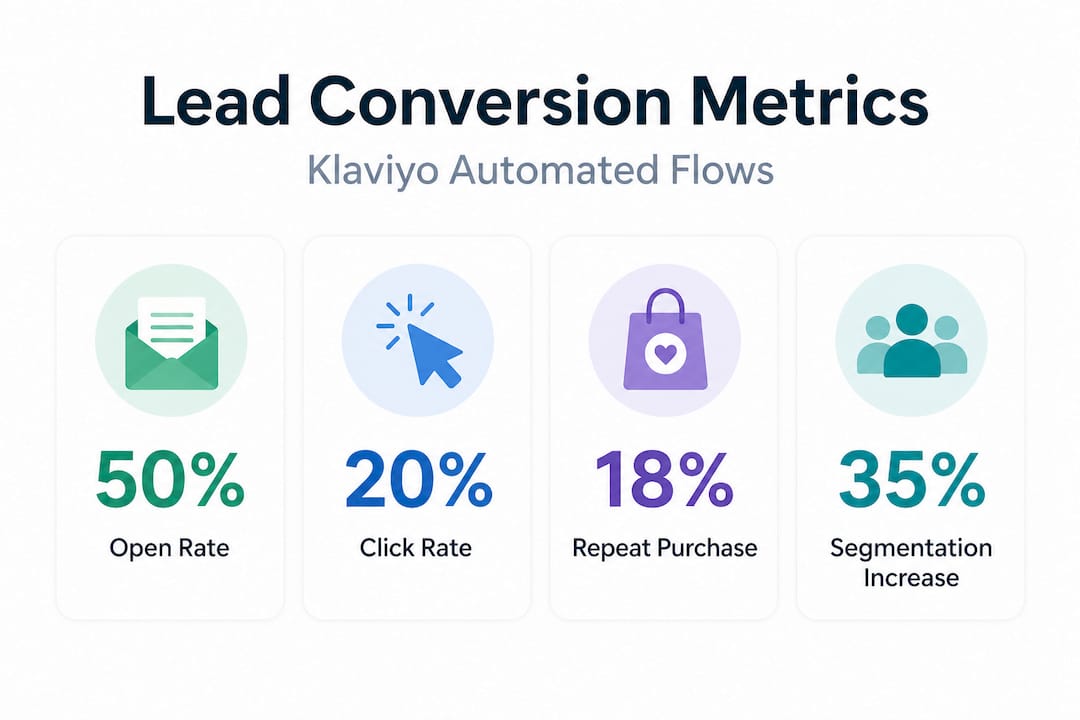
Open rate is the most visible metric in any email dashboard, but it’s also the least reliable. Apple’s Mail Privacy Protection (MPP) artificially inflates open rates by pre-loading pixels on protected devices. That means a 45% open rate on your welcome flow might include a significant percentage of phantom opens that don’t reflect genuine engagement. Measuring open rate alone to judge email performance leads to decisions based on misleading data, which is why click rate, placed order rate, and revenue per recipient should drive your optimization efforts instead.
Here’s a benchmark table for flows versus campaigns across the metrics that actually matter:
| Metric | Flow benchmark | Campaign benchmark |
|---|---|---|
| Open rate | 40 to 55% | 18 to 25% |
| Click rate | 4 to 9% | 1 to 2.5% |
| Placed order rate | 1 to 4% | 0.1 to 0.5% |
| Revenue per recipient | $1.00 to $4.00 | $0.05 to $0.20 |
When a flow is underperforming, look at the specific revenue drivers rather than the surface metrics. Low placed order rate on an abandoned cart flow usually points to one of these issues:
- Cart value too low to justify the purchase (offer a threshold-based free shipping nudge)
- Trust signals missing from the email (add reviews and guarantees)
- Timing too slow (first email should arrive within one hour of abandonment)
- No urgency mechanism (limited inventory or expiring discount)
- Wrong audience in the flow (existing customers who abandoned shouldn’t get a first-purchase discount)
Don’t chase surface metrics. A higher open rate that doesn’t produce more orders is just noise. Every optimization decision should trace back to one question: does this change produce more revenue per recipient? If it doesn’t, it’s a distraction.
Track performance at the flow level and the audience segment level, not just at the individual email level. One email in a sequence might have a lower click rate because it’s a plain-text trust email with no call to action, but if it improves overall flow completion rate and placed order rate, it’s doing its job perfectly.
Review measuring email engagement on a monthly cadence to catch early signs of list fatigue or deliverability issues, and audit for email marketing mistakes that commonly erode performance over time without obvious warning signs.
Pro Tip: Set a recurring monthly KPI review at the flow and segment level, not just the account level. Macro numbers look fine right up until they don’t. Flow-level data shows you exactly which part of your customer journey is leaking revenue.
A smarter approach: What most ecommerce brands miss about lead attraction
Here’s the uncomfortable truth about most ecommerce email programs. The brands sending the most campaigns are usually the ones with the least email-driven revenue per subscriber. More volume is not better. Volume without precision is just list burnout.
The brands that treat email as a lifecycle marketing strategy consistently outperform the ones chasing campaign frequency. They think of email as an always-on conversion system. Every subscriber is either moving closer to a first purchase, moving toward a second, or becoming dormant, and the job of the email program is to push them forward at every stage automatically.
The other major mistake we see is delaying segmentation. Brands often say they’ll “set up proper segments once the list is bigger.” That logic costs real money. Every subscriber who lands in a generic list and receives irrelevant content is a lead you’ve trained to ignore you. Segment from day one, even if your initial segments are basic. A new subscriber who expressed interest in a specific category belongs in a different nurture path than someone who came through a site-wide discount pop-up.
The final mindset shift worth internalizing is this: flows should receive the majority of your email strategy budget and attention, not campaigns. Campaigns have their place in driving seasonality and announcing new products, but they should amplify an already-functioning flow system, not substitute for one. Allocate 70% of your optimization effort to flows and behavioral segmentation. The remaining 30% covers campaign strategy and list hygiene. That ratio alone separates top-performing email programs from average ones.
Next steps: Accelerate your ecommerce lead growth with expert help
If this guide has surfaced gaps in your current email setup, you’re not alone. Most ecommerce brands have the Klaviyo account but not the full lifecycle infrastructure that makes it work.
At Take Action, we specialize in building exactly that infrastructure for growing ecommerce brands. Whether you need a complete email marketing and retention overhaul or targeted help with specific flows, our team brings the strategy, copywriting, segmentation, and ongoing optimization under one roof. We’ve helped brands turn their email channel from a secondary thought into their most predictable revenue stream. Visit our email agency for ecommerce to explore how we can build and optimize your Klaviyo ecosystem from the ground up, so your lead generation works even when your team is offline.
Frequently asked questions
What is the most effective Klaviyo tactic for attracting online leads?
Lifecycle list building combined with smart segmentation and automated flows dramatically outperforms general batch campaigns. Klaviyo’s own ecommerce guidance confirms that flows built on subscriber behavior are the highest-leverage mechanics for lead generation.
How do Klaviyo automated flows boost lead conversion rates?
Automated flows fire at precisely the right behavioral moment, making them far more relevant than scheduled campaigns. Klaviyo’s 2026 benchmarks show flows generate nearly 41% of total email revenue from just 5% of all sends.
Why shouldn’t I rely on open rates as my email performance metric?
Apple’s Mail Privacy Protection inflates open rates by pre-loading tracking pixels, making the metric unreliable. A smarter approach prioritizes click, placed order, and revenue per recipient as the true indicators of email performance.
When should I trigger post-purchase flows to improve retention?
Start your post-purchase sequence within 24 hours of delivery and target second-purchase nudges within the 30 to 60 day window. Klaviyo’s retention strategy research shows that waiting beyond 90 days typically misses the natural repeat purchase momentum entirely.
How can I improve low average order value (AOV) using Klaviyo?
Diagnose which customer segments have low AOV and target them with threshold-based offers, bundles, or cross-sell sequences rather than sending generic newsletters. Klaviyo’s Help Center guidance emphasizes addressing specific revenue drivers like AOV and cart size rather than chasing surface-level metrics.