
How to boost ROI with Klaviyo: proven email strategies
TL;DR:
- Automation flows generate significantly higher revenue and engagement than traditional campaigns.
- Using quality data and segmentation is essential for building effective, personalized email flows.
- Continuous testing and optimization of flows are crucial for maintaining high ROI in email marketing.
Most ecommerce emails get ignored. Brands blast the same message to their entire list, wonder why open rates stagnate, and then throw more budget at paid ads to compensate. The real problem is not the channel. It is the approach. Flows generate 41% of email revenue from just 5.3% of sends, proving that relevance and timing beat volume every time. This guide walks you through the exact Klaviyo-backed strategies, from foundational setup to advanced optimization, that turn email into your highest-ROI channel without guesswork.
Table of Contents
- Understand the ROI potential of automation flows
- Lay the groundwork: tools, data, and segmentation essentials
- Execute high-impact automation: flows that drive retention and revenue
- Optimize for maximum ROI: strategies, testing, and common pitfalls
- Why maximizing retention ROI is simpler—and harder—than marketers think
- Supercharge your ROI with expert help
- Frequently asked questions
Key Takeaways
| Point | Details |
|---|---|
| Automation flows trump campaigns | Automation flows generate significantly higher ROI and revenue per recipient compared to traditional broadcasts. |
| Segmentation fuels retention | Using RFM and zero-party data allows for highly targeted communication that boosts repeat purchases and customer value. |
| Comprehensive flow strategy wins | Combining welcome, abandoned cart, post-purchase, and win-back flows creates a customer journey that maximizes engagement and revenue. |
| Optimize and avoid pitfalls | Regular testing, efficient segmentation, and focus on deliverability prevent common mistakes and drive long-term ROI growth. |
Understand the ROI potential of automation flows
If you are still thinking about email marketing as a broadcast tool, you are leaving a lot of revenue on the table. The fundamental shift that separates high-performing ecommerce brands from average ones is understanding that automation flows and campaign blasts are two completely different animals.
Flows are triggered, behavior-based sequences. A customer browses a product and leaves. A flow fires. A shopper completes a purchase. A post-purchase flow kicks in. Campaigns are scheduled sends to a segment or full list, like a promotional email or a newsletter. Both have a role, but the performance gap is staggering.
According to Klaviyo’s email benchmarks, automation flows deliver 3x higher click rates and 13x higher placed order rates than traditional campaign sends. Think about what that means for your bottom line. Every automated trigger you set up is working for you around the clock, reaching customers at the exact moment they are most likely to buy.
Flows vs. campaigns: a performance comparison
| Metric | Automation flows | Campaign sends |
|---|---|---|
| Share of email sends | 5.3% | 94.7% |
| Share of email revenue | 41% | 59% |
| Revenue per recipient | 18x higher | Baseline |
| Click-through rate | 3x higher | Baseline |
| Placed order rate | 13x higher | Baseline |
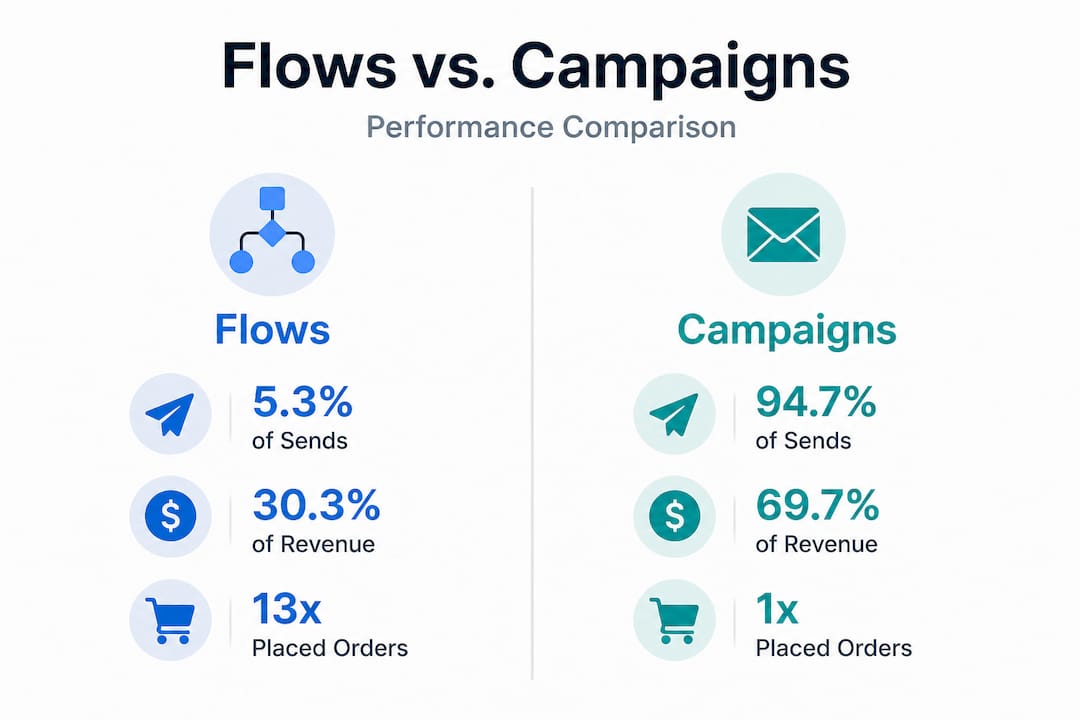
The numbers make the case clearly. You are doing far more heavy lifting with a much smaller percentage of sends when automation is dialed in properly.
Real brands are seeing results that validate this completely. Top Klaviyo case studies include GourmetGiftBaskets achieving 81x ROI, Coffee Beanery hitting 65x, and Smile Brilliant generating 39x returns. When email is optimized correctly, it routinely drives 20 to 50 percent or more of total ecommerce revenue.
Pro Tip: Do not compare your flows to your campaigns when assessing performance. Compare your flows to industry benchmarks for flows specifically. Your flow open rates, click rates, and revenue per recipient are the numbers that tell you whether your automation is truly working.
The reason flows outperform campaigns comes down to one principle: relevance wins. A welcome email landing in someone’s inbox minutes after they sign up is infinitely more relevant than a generic promo blast sent to 50,000 people on a Tuesday. When you pair the right message with the right moment, conversion follows naturally. For a broader look at email automation tools that complement Klaviyo’s capabilities, there are good comparisons available for retailers at different stages of growth.
Understanding the mechanics of why automation works also helps you invest in it with confidence. Klaviyo’s behavior-based triggers tap into customer psychology at the peak moment of intent. Someone who abandons a cart is not gone forever. They are often one well-timed, well-worded email away from completing the purchase. Building those triggers into your system is the foundation of high ROI. Explore how Klaviyo automation engagement works at a deeper level to understand why it improves customer lifetime value over time.
Lay the groundwork: tools, data, and segmentation essentials
Before you can build profitable flows, you need the right inputs. Great automation is only as effective as the data feeding it. Brands that skip this foundation end up with flows that fire at the wrong people, at the wrong times, with irrelevant messages.
Here is what you actually need before scaling:
- Klaviyo account with full site integration: Your store data, order history, and product catalog should sync automatically.
- Signup forms with progressive profiling: Capture email on entry, then use follow-up forms to gather more detail over time.
- RFM data structure: RFM stands for Recency, Frequency, and Monetary value. This tells you who your best customers are, who is drifting away, and who has never come back after one purchase.
- Zero-party data collection: This refers to information customers voluntarily give you, such as preferences, shopping goals, or product interests. It is more accurate than inferred behavioral data and enables far more precise personalization.
Collecting zero-party data via in-flow forms is one of the most underused tactics in Klaviyo. A simple post-purchase survey asking customers what they are shopping for next, or a preference quiz at signup, gives you the raw material to send emails people actually want to receive.
Key data inputs for effective Klaviyo segmentation
| Data type | What to collect | How to use it |
|---|---|---|
| RFM scores | Purchase recency, frequency, spend | Target VIPs, re-engage dormant buyers |
| Zero-party data | Preferences, intent, occasion | Personalize flow content and offers |
| Browse behavior | Pages viewed, products clicked | Trigger browse abandonment flows |
| Order history | Category, product, repeat status | Build upsell and replenishment flows |
Segmentation is where most brands either get it right or waste enormous effort. The benefits of segmentation go beyond just open rates. When you send the right message to the right person, you reduce unsubscribes, improve deliverability, and increase the lifetime value of your list.
Implementing RFM segmentation specifically, and tracking cohort behavior over time, is what enabled GourmetGiftBaskets.com to achieve that 81x Klaviyo ROI. They knew exactly who their most valuable customers were, and they built flows to nurture and retain them intentionally. For practical email segmentation strategies that work specifically for ecommerce growth, there are frameworks you can implement immediately without needing a data science team.
Pro Tip: Start your segmentation with just three groups: new subscribers, active customers, and lapsed buyers. Master these before you build granular sub-segments. Complexity before clarity is one of the most common reasons brands see poor ROI despite having Klaviyo set up.
Execute high-impact automation: flows that drive retention and revenue
With your data and segmentation in place, the next step is building the actual flows. Not all flows are created equal. Some generate the majority of your automated revenue, and those are the ones to prioritize first.
Here is the recommended build order for maximum early ROI:
- Welcome series (3 to 5 emails): This sets the tone for your brand relationship. Include a brand story email, a best-sellers email, social proof, and a soft offer. Spread them over 5 to 10 days.
- Abandoned cart flow (2 to 4 emails): Trigger within 1 hour of cart abandonment. Include the product image, a reminder of what they left behind, and social proof. The second email can introduce urgency. The third can test a small incentive.
- Browse abandonment flow (2 to 3 emails): Trigger after someone views a product page but does not add to cart. Lighter touch than cart abandonment, but often high intent.
- Post-purchase flow (3 to 4 emails): Confirm the order, set expectations for delivery, request a review, and then introduce a complementary product or upsell within 7 to 14 days.
- Win-back flow: Target customers who have not purchased in 90 to 180 days. Remind them what they loved, offer something exclusive, and give them a clear reason to return.
- Replenishment flow: For consumable products, trigger a reminder email when the product is likely running out based on average usage data.
- VIP and birthday flows: Reward your best customers with exclusive early access or personalized offers. These build loyalty and increase purchase frequency.
Building a comprehensive retention flow series across welcome, cart, post-purchase, and win-back sequences is what differentiates brands generating 30 to 50 percent of revenue from email versus those stuck at 10 percent.
For each flow, the structure matters as much as the volume. A post-purchase flow that only sends one order confirmation is not a retention strategy. It is a receipt. Adding a review request, a product education email, and a cross-sell recommendation turns that sequence into a revenue engine.

Retention focus compounds over time. Increasing your repeat purchase rate by even 1 to 2 percentage points creates compounding revenue gains because retained customers spend more, refer more, and cost less to serve than new acquisitions.
One layer many brands skip entirely is SMS. Adding SMS to high-intent moments like abandoned checkout, back-in-stock alerts, or shipping updates can increase revenue from those triggers by 20 to 30 percent on its own. Klaviyo handles SMS and email in one platform, so the setup is cleaner than most brands expect.
For more detail on how these automated workflow examples play out in real ecommerce contexts, there are walkthroughs that map out timing, triggers, and content structure. You can also find strong newsletter retention ideas to complement your automated flows with campaign content that keeps your audience engaged between purchase cycles.
Pro Tip: Build your abandoned cart flow before you optimize your welcome series. Cart abandonment has the most direct purchase intent, which means faster ROI for the time you invest.
Optimize for maximum ROI: strategies, testing, and common pitfalls
Getting your flows live is not the finish line. It is the starting point. The brands that generate 40 to 50 percent of revenue from email are not just running flows. They are continuously optimizing them.
Here is a structured approach to ongoing optimization:
- Test subject lines in your highest-open flows first. Your welcome email and cart abandonment first email get the most traffic. That makes them the best testing grounds for subject line improvements.
- Test send timing within flows. A one-hour cart abandonment delay might outperform a 30-minute delay for your specific audience. Let the data tell you.
- Test one element at a time. If you change the subject line and the offer in the same test, you will not know which variable drove the result.
- Review flow analytics monthly. Look at revenue per recipient, not just open rates. A flow with a 40% open rate but zero orders is a problem.
“Prioritize flow efficiency over volume; test subject lines and timing in high-open flows; use AI for recommendations.” The average CTR lift from Klaviyo’s AI-powered product recommendations is 3.75 percent, which adds up significantly across thousands of sends.
Klaviyo’s predictive analytics features let you estimate when a customer is likely to buy next, what they are likely to spend, and when they are at risk of churning. Using these predictions to trigger flows or personalize content is a level of sophistication that most brands have access to but very few are actually using.
Common pitfalls that quietly destroy ROI:
- Over-segmentation: Splitting your list into too many micro-segments means flows have tiny audiences and limited statistical significance for testing. Keep flow splits to 2 to 3 conditions maximum before you have serious list volume.
- Over-discounting: Training your customers to wait for a coupon before buying is a margin problem disguised as a conversion problem. Use discounts sparingly and strategically, not as a default lever.
- Ignoring deliverability: If you keep mailing unengaged subscribers, your sender reputation degrades and your emails land in spam. Sunset subscribers who have not opened or clicked in 90 to 180 days.
- Chasing vanity metrics: A 60% open rate means nothing if revenue per recipient is flat. Focus on the metrics that connect to actual money.
For actionable email sales tips that tie directly to Klaviyo performance, and a detailed breakdown of email mistakes to avoid that consistently undermine ROI, both resources are worth bookmarking for your optimization sprints.
Pro Tip: Set a calendar reminder every 30 days to review your top three flows by revenue. Most brands set up flows and never revisit them. Stale flows with outdated copy or broken product links are a silent revenue leak.
Why maximizing retention ROI is simpler—and harder—than marketers think
Here is the honest truth most marketing content will not tell you: the brands generating 50x ROI from Klaviyo are not doing anything exotic. They built the basics exceptionally well and then had the discipline to optimize them consistently over months and years.
What actually separates high-ROI brands is not their flow count or their segmentation complexity. It is their willingness to do the unsexy work. Checking deliverability regularly. Actually analyzing flow reports instead of just glancing at open rates. Keeping their list clean. Writing emails that sound like a person, not a press release.
The overcomplicated approach kills more email programs than neglect does. Brands get excited about advanced segmentation, build 15 separate audience splits, and then have flows with audiences of 200 people that never generate statistically meaningful data. You cannot optimize what you cannot measure.
Customer trust is also an underrated ROI driver. When customers feel like your emails are relevant, they open more, click more, and flag fewer messages as spam. That trust compounds into deliverability advantages over time. It is invisible on a dashboard but worth more than any subject line hack. Managing growth and retention through email is a long-term discipline, not a short-term tactic.
The most important thing you can do right now is not add another flow. It is to audit what is already running and make sure the fundamentals are tight.
Supercharge your ROI with expert help
You now have a clear picture of what moves the needle in Klaviyo: behavior-based flows, clean data, smart segmentation, and disciplined optimization. But knowing the strategy and executing it consistently are two different challenges. Many ecommerce teams have the intent but not the bandwidth.
That is exactly the gap Take Action fills. As a specialized email marketing and retention agency, we help ecommerce brands build, optimize, and scale Klaviyo automation that consistently drives 30 to 50 percent of revenue from email alone. From flow setup and strategy to long-term retention partnerships, we bring the expertise and execution capacity your team may not have in-house. If you are ready to stop leaving revenue on the table and start treating email as the growth channel it actually is, explore our Klaviyo retention strategies and see how we can build your highest-ROI channel together.
Frequently asked questions
What are the most profitable Klaviyo flows for ecommerce ROI?
Welcome, abandoned cart, post-purchase, win-back, and replenishment flows typically generate the highest returns when timed and personalized based on customer behavior. Building a comprehensive series across all these flow types is what separates brands driving 40 percent or more of revenue from email.
How does SMS increase Klaviyo ROI?
Combining email with SMS for key triggers like abandoned cart, shipping updates, and low stock alerts increases revenue by 20 to 30 percent over email alone, particularly for high-intent moments where speed matters.
How should I measure the effectiveness of my email flows?
Track revenue per recipient, repeat purchase rate, open rates, and click rates rather than vanity metrics like list size. Klaviyo’s built-in analytics make it easy to measure RPR over volume and tie flow performance directly to revenue.
How much can I expect to increase my revenue by focusing on retention?
Even a 1 to 2 percent increase in repeat purchase rate creates significant compounding revenue gains, because retained customers cost less to re-engage and tend to spend more per order over time.
What is zero-party data and how does it impact ROI?
Zero-party data is information customers intentionally share, like product preferences or purchase intent, which enables precise personalization in your flows. Collecting it via in-flow forms improves the relevance of your automated emails and lifts conversion rates meaningfully over generic messaging.