

Local content marketing strategies boost ecommerce sales 300%
Generic marketing campaigns treat every customer the same, missing the powerful opportunity to connect with local audiences. Ecommerce brands that ignore geographic personalization leave money on the table, while competitors using local content marketing strategies see engagement rates soar. Klaviyo’s geo-targeting capabilities combined with strategic local SEO create a retention engine that turns browsers into loyal customers. This guide reveals actionable strategies to implement location-based personalization that drives measurable growth for your ecommerce brand.
Table of Contents
- Key takeaways
- How Klaviyo powers geo-targeted content in ecommerce marketing
- Leveraging Shopify Markets for localized ecommerce content
- Crafting hyperlocal content and optimizing local SEO for ecommerce success
- Maximizing engagement and retention with location-based segmentation and messaging
- Take your local marketing to the next level
- Frequently asked questions about local content marketing strategies
Key Takeaways
| Point | Details |
|---|---|
| Geo targeted content | Klaviyo uses customer location to swap images offers and CTAs in emails through dynamic blocks based on city zip or proximity. |
| Limit location segments | Begin with broad geographic zones and maintain five to eight primary location segments to balance engagement with deliverability. |
| Shopify Markets localization | Shopify Markets syncs product data currencies and regional pricing into Klaviyo so one campaign template automatically adapts for each locale. |
| Test and preview | Always test geo segments with Klaviyo preview to ensure dynamic blocks render correctly across locales before sending. |
How Klaviyo powers geo-targeted content in ecommerce marketing
Klaviyo transforms generic email blasts into personalized local experiences using location data stored in customer profiles. The platform enables geo-targeted content via dynamic blocks using person properties like city, zip code, or custom store proximity properties. This capability means your welcome series can automatically show the nearest retail location, or your promotional campaigns can highlight region-specific inventory without creating separate campaigns for each market.
The technical setup involves assigning custom properties through segments and flows. You can create a radius segment that identifies customers within 25 miles of a store location, then use a flow to assign a “nearest_store” property automatically. Dynamic content blocks in your email templates then reference these properties to swap images, offers, and calls-to-action based on the recipient’s location. This approach eliminates manual coding complexity while maintaining sophisticated personalization.
Implementing email segmentation strategies for ecommerce growth requires balancing granularity with deliverability. Creating 50 micro-segments for every neighborhood might seem ideal, but it fragments your sending reputation and makes campaign management unwieldy. Start with broader geographic zones, then refine based on engagement data. Most brands find success with 5 to 8 primary location segments that capture meaningful differences in customer behavior and preferences.
Geo-targeting improves customer engagement by addressing location-specific needs your competitors ignore. A swimwear brand can promote different product lines to Florida customers versus Minnesota shoppers in March. A food retailer can highlight delivery availability and local pickup options based on warehouse proximity. These contextual touches signal that you understand your customer’s world, building trust that generic campaigns cannot achieve.
Pro Tip: Always use Klaviyo’s preview function to test each geo segment before sending. Check that dynamic content blocks display correctly for every location variation, especially when combining multiple conditional logic rules.
Leveraging Shopify Markets for localized ecommerce content
Shopify Markets takes localization beyond simple translation by syncing comprehensive product data across languages, currencies, and regional pricing structures directly into Klaviyo. The Shopify Markets Locale Aware Catalogs sync enables one campaign template to automatically adapt product information, prices, and checkout links based on the recipient’s market. This integration eliminates the need to manually create separate campaigns for each country or region you serve.
The power lies in automatic adaptation. When a customer in Canada opens your abandoned cart email, they see prices in CAD with appropriate tax calculations. A customer in the UK sees GBP pricing and metric sizing. The same campaign template pulls the correct localized catalog data without any manual intervention. This approach scales efficiently as you expand into new markets, since the infrastructure handles localization automatically once configured.
Previewing campaigns per locale before sending prevents costly localization errors. Shopify Markets handles currency conversion, but product descriptions, sizing charts, and promotional terms require human review to ensure cultural appropriateness and accuracy. Set up a checklist that includes verifying translated product names, checking that promotional disclaimers comply with local regulations, and confirming that linked landing pages match the email’s market context.

Combining Shopify Markets with Klaviyo maximizes true localization beyond surface-level language translation. You can segment by market to send region-specific product recommendations, adjust send times for local time zones, and reference local holidays and events in your messaging. A brand selling to both US and Australian markets can promote summer collections at opposite times of the year, with each market seeing seasonally appropriate products and messaging.
Balancing complexity and accuracy in localization workflows requires systematic testing. Start with your highest-revenue markets to validate the setup, then expand incrementally. Monitor metrics by market to identify where localization drives the strongest lift in engagement and conversion. Some markets may respond better to localized content than others, informing where to invest additional customization effort.
Pro Tip: Schedule monthly audits of synced product data across markets. Currency exchange rates fluctuate, and product availability changes. Regular reviews catch discrepancies before customers encounter them, protecting your brand reputation and preventing lost sales.
Crafting hyperlocal content and optimizing local SEO for ecommerce success
Local SEO tactics transform your ecommerce site into a discovery engine for nearby customers actively searching for your products. Optimizing your Google Business Profile with accurate hours, photos, and product categories ensures you appear in local search results that drive 300% growth for ecommerce businesses with physical presence. Creating location-specific landing pages with neighborhood names and local landmarks in your content helps search engines connect your offerings to geographic queries.
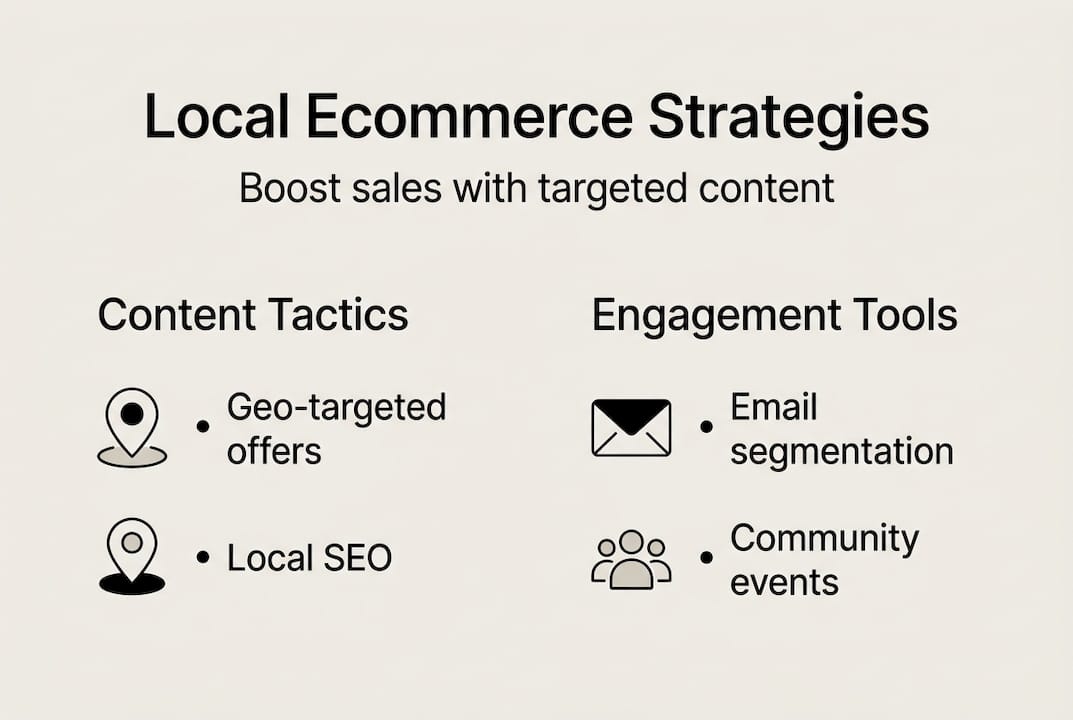
The ‘near me’ keyword phenomenon represents massive opportunity. Customers searching “running shoes near me” or “organic skincare near me” demonstrate high purchase intent. Hyperlocal content strategies that incorporate these phrases naturally throughout your site content, meta descriptions, and product pages capture this traffic. Pair these keywords with structured data markup that tells search engines your business locations, inventory availability, and pickup options.
Creating neighborhood guides and local event coverage builds authentic community connections that generic product pages cannot replicate. A home goods retailer might publish a guide to the best coffee shops in each neighborhood they serve, naturally mentioning their nearby store location. A fashion brand could cover local fashion events, tagging products worn by attendees. This content attracts local traffic while positioning your brand as a community participant rather than a distant corporation.
Collaborating with local businesses and influencers expands your reach through established community networks. Partner with a local coffee roaster to create a co-branded gift set, then cross-promote through both businesses’ channels. Sponsor a neighborhood festival and create content documenting your involvement. These partnerships generate backlinks from local websites, boosting your local SEO authority while introducing your brand to new audiences through trusted sources.
| Approach | Primary Benefit | Best For | Implementation Effort |
|---|---|---|---|
| Local SEO optimization | Captures high-intent search traffic | Brands with physical locations or local delivery | Medium, ongoing maintenance |
| Hyperlocal content creation | Builds community engagement and brand loyalty | Brands targeting specific neighborhoods | High, requires consistent content production |
| Google Business Profile | Increases visibility in map searches | All ecommerce brands with local presence | Low, one-time setup with regular updates |
| Location landing pages | Improves organic rankings for geo-specific queries | Multi-location retailers | Medium, scales with number of locations |
Consistently updating local pages and customer reviews maintains your SEO ranking momentum. Search engines favor fresh, relevant content that demonstrates ongoing business activity. Encourage customers to leave reviews mentioning specific locations and products. Respond to reviews promptly, using local context in your replies. Update your location pages when you add new services, change hours, or host events.
Pro Tip: Create a content calendar that ties hyperlocal content to community events, local holidays, and seasonal patterns specific to each market you serve. This ensures consistent publishing while maintaining genuine local relevance.
For comprehensive strategies on why SEO matters for ecommerce, consider how local optimization fits into your broader search strategy. Pairing local SEO with Google SEO agency expertise for ecommerce growth accelerates results by combining technical optimization with content strategy.
Maximizing engagement and retention with location-based segmentation and messaging
Segmenting customers by zip code, city, or store proximity transforms generic broadcasts into relevant conversations that drive action. Klaviyo’s segmentation engine lets you create dynamic groups based on location data, then target these segments with SMS and email flows designed for their specific context. A customer living within 10 miles of your flagship store receives different messaging than someone 500 miles away, with each message optimized for their relationship to your physical presence.
Creating targeted SMS and email flows for local events and VIP re-engagement follows a systematic approach:
- Build location segments in Klaviyo using zip code, city, or custom radius properties based on store coordinates
- Create event-specific campaigns highlighting in-store experiences, local pickup options, or regional promotions
- Set up triggered flows for customers who haven’t visited a nearby location in 60+ days, offering exclusive in-store incentives
- Design VIP re-engagement series for high-value local customers with personalized store visit invitations
- Test messaging variations by location to identify which offers and content resonate in each market
- Monitor engagement metrics by segment to refine targeting and optimize send frequency
Klaviyo benchmarks reveal the power of mobile-optimized, location-aware messaging. Mobile marketing campaigns achieve 53% purchase rates when properly targeted, with location segments boosting high-intent engagement by surfacing relevant nearby options exactly when customers are ready to buy.
53% of consumers complete purchases on mobile devices, making location-based segmentation essential for capturing high-intent shoppers who are physically near your stores or within your delivery zones.
Case studies demonstrate measurable impact from location-based strategies. Brands using local SEO and Klaviyo targeted campaigns see 300%+ revenue growth by combining geographic personalization with retention automation. Montirex and Shinola exemplify how pairing location data with sophisticated email and SMS flows drives both online sales and foot traffic to physical locations.
Prioritizing engagement quality over volume improves deliverability and long-term performance. Sending fewer, highly relevant location-based messages generates better results than frequent generic blasts. Customers appreciate messaging that respects their context, whether that’s promoting a store opening in their neighborhood or offering local delivery during a regional weather event. This relevance builds trust and reduces unsubscribe rates.
Implementing these strategies requires understanding your audience deeply. Research target audience research for email ROI to identify which location attributes matter most for your customers. Some brands find city-level segmentation sufficient, while others benefit from neighborhood-specific targeting. Let customer behavior data guide your segmentation granularity.
To engage customers with Klaviyo and boost open rates, combine location-based segmentation with compelling subject lines that reference local context. “Your neighborhood store has something special” performs better than “New arrivals now available” because it acknowledges the customer’s specific relationship to your brand.
Take your local marketing to the next level
Implementing sophisticated local content marketing strategies requires expertise across Klaviyo automation, SEO optimization, and content creation. Take Action specializes in building retention engines that combine geographic personalization with data-driven campaign strategy. Our team sets up location-based segmentation, dynamic content workflows, and local SEO infrastructure that drives measurable growth for ecommerce brands.
Partner with specialists who understand how to balance personalization complexity with operational efficiency. We help brands avoid costly trial and error by implementing proven frameworks for local targeting, then optimize based on your specific customer data. From Shopify Markets integration to hyperlocal content calendars, our ecommerce marketing solutions turn location data into revenue growth. Get measurable improvements in engagement, retention, and sales by leveraging expert guidance tailored to your brand’s unique market position.
Frequently asked questions about local content marketing strategies
What are local content marketing strategies?
Local content marketing strategies involve tailoring your marketing materials, messaging, and offers to specific geographic customer segments. This includes creating location-specific landing pages, optimizing for local search terms, and personalizing email content based on customer proximity to stores or regional preferences.
How does Klaviyo enable local content marketing?
Klaviyo enables local content marketing through dynamic content blocks that adapt based on person properties like city, zip code, or custom location fields. You can create segments by geographic criteria, then use conditional logic to display different images, offers, and calls-to-action for each location within a single campaign template.
What are the main advantages of local content marketing for ecommerce?
Local content marketing increases engagement by making messages more relevant to customer context, improves conversion rates by highlighting nearby pickup options or local inventory, and builds community connections that generic campaigns cannot achieve. Brands typically see higher open rates, click-through rates, and customer lifetime value from location-targeted campaigns.
How does local SEO fit into content marketing strategies?
Local SEO ensures customers searching for products in their area discover your brand through optimized Google Business Profiles, location-specific landing pages, and ‘near me’ keyword targeting. It works alongside content marketing by driving organic traffic to your localized content, then retaining those visitors through relevant messaging and offers.
What are common challenges when implementing local content marketing?
Common challenges include managing complexity as you add more location segments, maintaining data accuracy across multiple markets, and balancing personalization with operational efficiency. Solutions include starting with broader geographic zones before refining, implementing systematic testing processes, and using automation tools like Klaviyo to scale personalization without proportional resource increases.
Recommended
- Blog - Email Marketing Insights | Take Action | Take Action
- Content Marketing: Driving Ecommerce Growth Globally | Take Action Blog | Take Action
- Digital Marketing Agency Content That Drives Ecommerce Growth | Take Action Blog | Take Action
- 7 Top Content Marketing Trends for Ecommerce Growth | Take Action Blog | Take Action