

Master branding with Klaviyo email automation for growth
Most e-commerce brands leave significant revenue on the table by treating automated email flows as technical afterthoughts rather than strategic brand touchpoints. While campaigns get creative attention, flows that generate 30x more revenue per recipient often run with generic templates and minimal personalization. This guide shows brand managers how to integrate strategic branding with Klaviyo automation to unlock retention growth, boost customer lifetime value, and turn email into your primary revenue channel through data-driven personalization and behavioral segmentation.
Table of Contents
- Key takeaways
- Why integrating branding with Klaviyo email automation drives e-commerce growth
- Core Klaviyo flows and hyper-personalization techniques to reinforce brand identity
- Nuances and best practices: balancing frequency, relevance, and brand trust in automated email marketing
- Implementing a branded Klaviyo email automation strategy for retention and growth
- Unlock your brand’s growth potential with expert Klaviyo automation support
- Frequently asked questions
Key Takeaways
| Point | Details |
|---|---|
| Flows outperform campaigns | Automated flows typically generate significantly more revenue per recipient than campaigns when branded and personalized. |
| Hyper personalization boosts retention | Hyper personal ization using first party data markedly increases customer lifetime value and retention profits. |
| Behavioral segmentation beats batch | Behavioral segmentation delivers more relevant messages than traditional batch email strategies. |
| Consistent branding drives loyalty | Visual and tonal consistency across automated flows strengthens brand recognition and customer loyalty. |
| Data audits matter | Regular audits and data unification underpin successful retention growth. |
Why integrating branding with Klaviyo email automation drives e-commerce growth
Klaviyo’s core automated flows create consistent touchpoints across the customer lifecycle, from initial welcome sequences through post-purchase nurturing and win-back campaigns. Each flow represents a branded conversation triggered by specific customer behaviors, making them far more relevant than scheduled campaigns. When Klaviyo email and SMS drive 20-40% of revenue for top performing brands, it’s because these flows deliver personalized value at precisely the right moments.
The mechanics behind this performance combine behavioral triggers with brand-consistent messaging. A welcome flow introduces your brand story and value proposition to new subscribers. Abandoned cart flows recover revenue while reinforcing product benefits and addressing hesitation. Post-purchase sequences build loyalty through education, cross-sells, and review requests. Win-back flows re-engage dormant customers with personalized incentives that reflect their past preferences.
Brand managers who treat these flows as strategic brand experiences rather than transactional messages see dramatically higher engagement. Visual consistency using brand colors, fonts, and imagery creates instant recognition. Tonal alignment ensures every automated message sounds authentically like your brand. Content relevance means each flow delivers genuine value beyond promotional asks.
Consider how customer retention strategies compound over time. A customer who receives a thoughtfully branded welcome series is more likely to open subsequent flows. That increased engagement feeds behavioral data back into Klaviyo, enabling even more precise personalization in future messages. This virtuous cycle transforms email from interruption to anticipated communication.
“The brands winning with retention automation don’t just set up flows and forget them. They continuously refine messaging, test personalization variables, and ensure every touchpoint reinforces their unique brand positioning while delivering measurable value to customers.”
Key elements that make branded automation effective:
- Behavioral triggers that send messages based on actions, not arbitrary schedules
- Visual hierarchy that guides attention to key offers and calls to action
- Personalized content blocks that adapt based on customer data and preferences
- Consistent brand voice across all automated touchpoints and customer segments
- Strategic timing optimized through testing for each flow and audience
Core Klaviyo flows and hyper-personalization techniques to reinforce brand identity
Top performing brands run 7-10+ flows covering every stage of the customer journey. Welcome series introduce new subscribers to brand values and bestsellers. Abandoned cart and browse flows recover potential sales with personalized product reminders. Post-purchase sequences request reviews, provide usage tips, and suggest complementary products. Win-back campaigns re-engage customers who haven’t purchased recently. Subscription flows manage renewals and reduce churn.

Hyper-personalization transforms these standard flows into individualized experiences. Since 71% of consumers expect personalized interactions and a 5% retention increase boosts profits 25-95%, collecting and leveraging zero-party and first-party data becomes essential. Quizzes capture preferences. Browse behavior reveals interests. Purchase history indicates price sensitivity and category affinity. Profile properties store communication preferences.
| Flow Type | Primary Purpose | Personalization Methods |
|---|---|---|
| Welcome Series | Introduce brand and convert subscribers | Preference quiz results, signup source, initial browse behavior |
| Abandoned Cart | Recover incomplete purchases | Specific products viewed, cart value, previous purchase history |
| Post-Purchase | Build loyalty and drive repeat orders | Product purchased, usage timeline, complementary items |
| Win-Back | Re-engage dormant customers | Days since last purchase, favorite categories, past order value |
| Browse Abandonment | Convert browsers to buyers | Specific products viewed, view count, price point |
| Subscription Management | Reduce churn and optimize frequency | Usage patterns, delivery preferences, product satisfaction |
Behavioral segmentation takes personalization further by grouping customers based on actions rather than demographics. RFM analysis (recency, frequency, monetary value) identifies your most valuable customers for VIP treatment. Predicted lifetime value helps allocate retention investment efficiently. Engagement scoring ensures you send more messages to highly engaged subscribers and fewer to those at risk of unsubscribing.
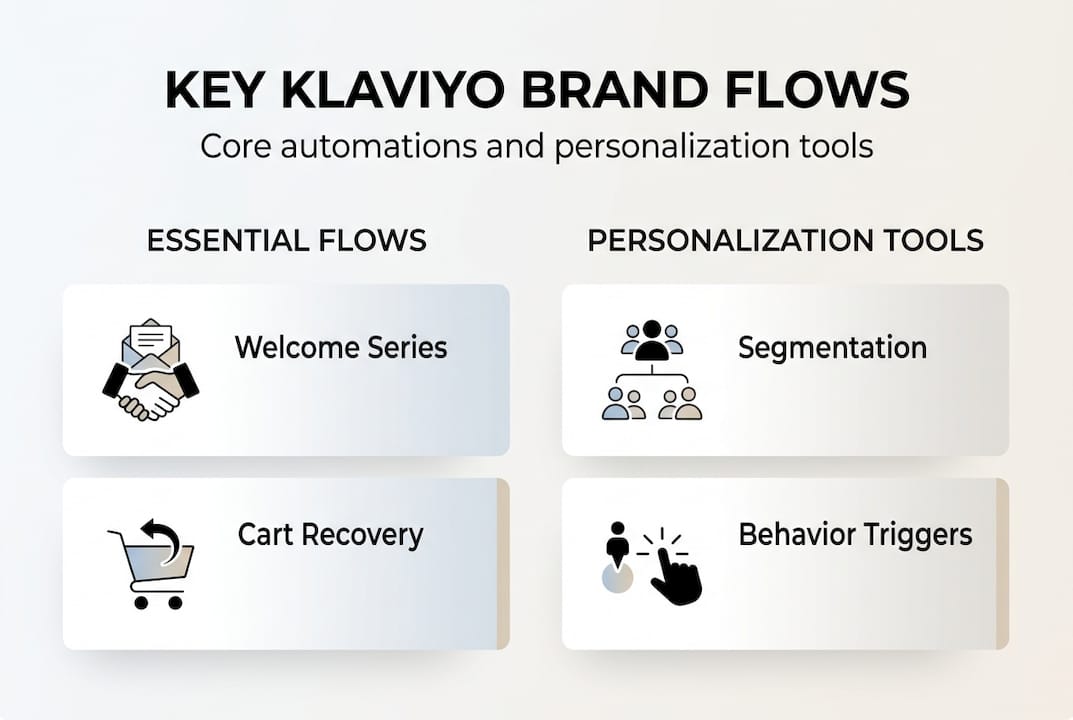
Implementing personalization strategies in Klaviyo requires systematic data collection and segmentation. Start by enabling all available integrations: Shopify for purchase data, loyalty programs for point balances, quiz platforms for preferences, customer service tools for satisfaction scores. This unified data foundation powers conditional content blocks that adapt each message to individual recipients.
Advanced email segmentation strategies layer multiple criteria for precision targeting. A win-back flow might send different messages based on both time since last purchase and average order value. High-value dormant customers receive premium incentives. Lower-value segments get educational content highlighting new products. This nuanced approach respects customer differences while maintaining brand consistency.
Pro Tip: Prioritize behavioral segmentation over demographic targeting. A customer who browses your site weekly but hasn’t purchased responds to different messaging than someone who bought once six months ago, regardless of their age or location. Behavior reveals intent and interest far more accurately than static attributes.
Nuances and best practices: balancing frequency, relevance, and brand trust in automated email marketing
Message frequency requires careful calibration. While automation enables sending more emails, relevance matters more than volume. Luxury brands often see stronger results by reducing send frequency while increasing personalization quality. Each message should deliver clear value, whether educational content, exclusive access, or genuinely helpful product recommendations.
Regional personalization becomes critical for global brands. Klaviyo’s localization features enable currency display, language adaptation, and region-specific offers within the same flow structure. A customer in Australia sees prices in AUD with local shipping timelines, while a US customer sees USD pricing and different delivery estimates, all from one automated flow.
Brand Indicators for Message Identification (BIMI) enhance inbox trust by displaying your logo next to emails in supported clients. This visual branding increases open rates and reduces the likelihood customers mark messages as spam. Implementing BIMI requires DMARC authentication but provides measurable brand recognition benefits.
Common mistakes undermine even well-branded flows. Sending welcome series to existing customers wastes opportunities and damages credibility. Behavioral segmentation achieves 11% conversion compared to 1.2% for batch sends, yet many brands still blast identical messages to entire lists. This approach not only underperforms but trains customers to ignore your emails.
Modular flow design prevents message duplication and fatigue. Instead of separate flows for each scenario, build reusable content blocks and logic that adapts based on customer state. This architecture reduces development time by 60% while ensuring customers never receive redundant messages. A customer who abandons a cart shouldn’t also receive a browse abandonment email for the same product.
Key practices for maintaining effective online marketing strategy:
- Suppress customers across flows to prevent multiple messages for the same action
- Set frequency caps at the profile level to respect customer preferences
- Test send times by segment, as optimal timing varies by customer behavior
- Monitor engagement trends weekly to catch deliverability or relevance issues early
- Avoid sending welcome flows to customers with previous purchase history
Attribution accuracy requires proper tracking configuration. Klaviyo’s Extended ID connects email engagement to downstream purchases across devices and sessions. Without this, you’ll undervalue email’s contribution to revenue. Many brands discover their flows drive 2-3x more revenue than basic attribution suggests once they implement comprehensive tracking.
Pro Tip: Enable Extended ID and configure proper attribution windows before evaluating flow performance. Default last-click attribution typically undervalues email’s role in the customer journey, especially for considered purchases with longer decision cycles.
Implementing a branded Klaviyo email automation strategy for retention and growth
Successful implementation starts with data unification. Connect every customer touchpoint to Klaviyo: point-of-sale systems for in-store purchases, CRM platforms for service interactions, quiz tools for preference data, and your e-commerce platform for online behavior. This comprehensive view enables truly personalized flows that reflect the complete customer relationship.
Weekly audits ensure flows remain optimized as your business evolves. Review performance metrics: open rates, click rates, conversion rates, and revenue per recipient. Test AI-generated subject lines and content variations. Identify underperforming segments and refine targeting criteria. Regular optimization using Klaviyo compounds results over time.
| Metric | Benchmark | Growth Target | Measurement Frequency |
|---|---|---|---|
| Flow Open Rate | 45-55% | 60%+ | Weekly |
| Flow Click Rate | 8-12% | 15%+ | Weekly |
| Revenue per Recipient | $0.50-$1.50 | $2.00+ | Weekly |
| Conversion Rate | 3-5% | 8%+ | Weekly |
| Unsubscribe Rate | <0.3% | <0.2% | Daily |
Implementing branded automation systematically:
- Audit existing flows to identify gaps in customer lifecycle coverage
- Map brand guidelines to email templates including colors, fonts, and voice
- Collect zero-party data through welcome quizzes and preference centers
- Build behavioral segments based on RFM analysis and engagement scoring
- Design modular content blocks that adapt based on customer attributes
- Configure suppression logic to prevent message overlap and fatigue
- Implement Extended ID tracking for accurate multi-touch attribution
- Test personalization variables systematically to identify highest-impact elements
Measuring incremental revenue separates correlation from causation. Use Klaviyo’s holdout groups to compare customers who receive flows against control groups who don’t. This reveals true lift rather than simply attributing revenue that would have occurred anyway. Most brands discover their flows generate 15-25% incremental revenue beyond baseline.
Branding elements that drive flow performance:
- Visual hierarchy that guides attention to primary calls to action
- Consistent color palette that reinforces brand recognition instantly
- Authentic voice that sounds like your brand across all touchpoints
- Relevant content that addresses specific customer needs and interests
- Strategic imagery that showcases products in aspirational contexts
Scaling retention through automated workflow examples requires balancing standardization with personalization. Templates ensure brand consistency, but dynamic content blocks enable individual relevance. The most effective flows feel personally crafted while running entirely on automation.
Complement flows with strategic campaigns using newsletter ideas that drive engagement between automated touchpoints. Educational content, behind-the-scenes stories, and exclusive previews keep your brand top of mind without relying solely on promotional messages.
Unlock your brand’s growth potential with expert Klaviyo automation support
Implementing sophisticated branded automation requires both strategic vision and technical execution. Take Action specializes in helping e-commerce brands leverage Klaviyo’s full potential through expert flow design, data integration, and ongoing optimization. Our approach combines human creativity with AI-driven insights to build retention systems that consistently drive 20-40% of total revenue.
We handle the complete implementation: auditing existing flows, designing branded templates, configuring behavioral segments, and establishing measurement frameworks. Our clients avoid common pitfalls like message duplication and poor attribution while benefiting from proven strategies that maximize customer lifetime value.
Partner with our email marketing and retention agency to transform your Klaviyo account into a revenue-generating system. We provide ongoing support for data unification, creative development, and performance optimization, ensuring your automation evolves with your business. Explore our retention services to discover how strategic email automation can become your most profitable marketing channel.
Frequently asked questions
How many automated flows should my e-commerce brand run with Klaviyo?
Top performing brands run 7-10+ flows including welcome series, abandoned cart, browse abandonment, post-purchase, win-back, and subscription management sequences. Covering all customer lifecycle stages maximizes retention revenue and ensures no opportunity goes unaddressed. Start with core flows and expand based on your business model and customer behavior patterns.
What is hyper-personalization and why does it matter for e-commerce retention?
Hyper-personalization uses detailed customer data to tailor content, offers, and timing individually rather than sending identical messages to broad segments. Since 71% of consumers expect personalized experiences and a 5% retention increase boosts profits 25-95%, leveraging behavioral data and preferences creates significant competitive advantage. It transforms generic automation into relevant conversations that build lasting customer relationships.
How can I balance email frequency and brand relevance without overwhelming customers?
Focus on message relevance and behavioral triggers rather than arbitrary send schedules. Use segmentation to send fewer, more targeted emails based on customer actions and preferences. Luxury brands achieve growth by reducing volume while increasing personalization quality. Implement suppression logic across flows and set profile-level frequency caps to respect individual tolerance levels.
What role does BIMI play in branded email automation?
Brand Indicators for Message Identification display your logo next to emails in supported inbox clients, significantly enhancing brand recognition and trust. This visual consistency reinforces your identity across all automated touchpoints and reduces spam complaints. Implementing BIMI requires DMARC authentication but provides measurable improvements in open rates and customer confidence in your messages.
How do I measure the true incremental revenue from Klaviyo flows?
Use Klaviyo’s holdout group functionality to compare revenue from customers receiving flows against control groups who don’t. Enable Extended ID tracking to capture multi-touch attribution across devices and sessions. This reveals actual lift rather than simply crediting revenue that would have occurred without automation. Most brands discover flows generate 15-25% incremental revenue beyond baseline when measured properly.
Recommended
- Improving Customer Engagement with Klaviyo Automation | Take Action Blog | Take Action
- Boost ecommerce growth: SEO and Klaviyo automation | Take Action Blog | Take Action
- Optimize ecommerce growth with a performance agency | Take Action Blog | Take Action
- Engage Customers with Klaviyo: Boost Open Rates 40% in 2026 | Take Action Blog | Take Action