

Measuring marketing ROI for Klaviyo email campaigns
TL;DR:
- Measuring email marketing ROI requires accurate attribution, full cost accounting, and validation through incrementality testing.
- Focusing on automated flows instead of campaigns delivers higher returns and more efficient resource allocation.
Measuring marketing ROI sounds straightforward until you actually sit down to do it. For ecommerce marketers running email in Klaviyo, the challenge is not just running the numbers. It is knowing which numbers to trust, which costs to include, and whether the revenue Klaviyo reports is genuinely caused by your emails or simply correlated with purchases that would have happened anyway. Misread this data and you will either over-invest in tactics that are not working or cut programs that are quietly driving real revenue. This guide walks you through attribution setup, ROI calculation, incrementality testing, and flow optimization so you can report email performance with confidence.
Table of Contents
- Understand Klaviyo’s conversion attribution and how it shapes measured ROI
- Prepare your data: accurately calculate email marketing ROI with full cost accounting
- Execute incrementality testing to verify true email marketing impact
- Optimize ROI by prioritizing automated email flows over campaigns
- Why combining attribution with incrementality testing reveals the full email ROI story
- How Take Action helps ecommerce brands maximize email marketing ROI
- Frequently asked questions
Key Takeaways
| Point | Details |
|---|---|
| Klaviyo attribution window | Choosing the right conversion window in Klaviyo crucially affects your email revenue reporting accuracy. |
| Fully loaded ROI calculation | Include all related marketing costs, not just software or ad spend, to measure true email marketing ROI. |
| Incrementality testing importance | Randomized holdouts help prove the causal lift of your email campaigns beyond standard attribution. |
| Automated flows outperform campaigns | Prioritizing flows typically leads to higher email engagement and revenue compared to campaign emails. |
| Balanced measurement approach | Combine Klaviyo attribution dashboards with periodic incrementality testing for best operational and strategic insights. |
Understand Klaviyo’s conversion attribution and how it shapes measured ROI
Before you can start calculating marketing ROI, you need to understand how Klaviyo decides which purchases to credit to your emails. Get this wrong and every number downstream is built on a shaky foundation.
Klaviyo attributes email conversions within a default 5-day window using last-touch attribution. That means if a customer opens or clicks an email and then buys anything within five days, that purchase gets credited to the most recent email they interacted with. The window is adjustable, but most accounts run on the default.
This matters for a few reasons:
- Last-touch attribution only fires on opens or clicks. If a customer receives your email but never opens it, Klaviyo will not attribute their purchase to that send, even if they were influenced by the subject line or saw a preview in their inbox.
- Viewing results too soon inflates your miss rate. Pull campaign revenue 12 hours after a send and you will see a fraction of what the final attributed revenue will be. Give it the full five days.
- The window length changes your reported ROI. A 1-day window will show less revenue than a 5-day window. A 7-day window will show more. There is no single “correct” setting, but consistency matters. Pick one and stick to it so you can compare results over time.
- Last-touch can misattribute in multi-channel environments. A customer who clicked a Facebook ad on Monday and opened your email on Tuesday may have been converted by the ad, but Klaviyo credits the email.
To get a more grounded view of how to monitor digital marketing ROI with Klaviyo, start by auditing your attribution window settings and documenting them so everyone on your team interprets reports from the same baseline.
Pro Tip: If you sell higher-consideration products with longer purchase cycles, consider extending your attribution window to 7 or 14 days. Conversely, if you run frequent flash sales, a shorter window prevents revenue from one campaign bleeding into another.
Now that we understand Klaviyo’s attribution model, we can explore how to prepare accurate inputs for ROI calculation.
Prepare your data: accurately calculate email marketing ROI with full cost accounting
Most ecommerce teams undercount their costs. They subtract the Klaviyo subscription fee from attributed revenue and call it ROI. That number will look impressive and tell you almost nothing useful.

The standard formula for marketing return on investment is straightforward. Calculate marketing ROI using ((Revenue – Marketing Cost) / Marketing Cost) × 100, where marketing cost includes agency fees, creative labor, software, and salaries. The formula is simple. The discipline is in what you put into it.
Here is how to build accurate inputs, step by step:
- Pull Klaviyo-attributed revenue for the period you are measuring. Go to the campaign or flow report and record the “Revenue” figure. This is your numerator starting point.
- List every cost associated with email for that period. This means the Klaviyo plan cost, any agency or freelancer fees, the hours your in-house team spent on email (multiply hours by loaded hourly rate), photography, copywriting, and design.
- Allocate shared tool costs proportionally. If your design tool is used 40% for email and 60% for social, attribute 40% of that cost to email.
- Plug into the formula. ((Klaviyo Revenue – Total Email Cost) / Total Email Cost) × 100.
The table below shows how different cost assumptions change your reported ROI on the same $30,000 in attributed revenue:
| Scenario | Attributed revenue | Total costs included | Calculated ROI |
|---|---|---|---|
| Minimal costs (software only) | $30,000 | $500 | 5,900% |
| Partial costs (software + agency) | $30,000 | $3,000 | 900% |
| Full costs (software + agency + labor + creative) | $30,000 | $8,500 | 253% |
All three scenarios use the same revenue figure. The difference in reported ROI is entirely a function of cost discipline. The 253% figure is the one worth reporting. It is also the one that helps you build a realistic case for investing more in email.
Pro Tip: Build a simple spreadsheet that auto-pulls from your Klaviyo revenue reports and has fixed inputs for recurring monthly costs. Update variable costs like creative production once per campaign cycle. This turns a manual chore into a 15-minute monthly task.
With clear ROI inputs, the next step is executing reliable measurement and testing practices.
Execute incrementality testing to verify true email marketing impact
Here is the uncomfortable reality about last-touch attribution: it tells you who bought after engaging with an email. It does not tell you whether they bought because of the email. For high-frequency email senders, this distinction is significant, because many of your best customers would have purchased regardless of whether they received that particular campaign.
Incrementality testing uses randomized holdouts to isolate the true causal impact of email campaigns and avoid inflated attribution.
The mechanics are simple:
- Create a holdout group before your send. Randomly suppress 10-15% of your audience from receiving the campaign or flow.
- Let the conversion window close. Wait out the full 5-day (or your custom) attribution period.
- Compare conversion rates. If your exposed group converts at 4.2% and your holdout group converts at 3.8%, your incremental lift is 0.4 percentage points.
- Calculate incremental revenue. Multiply that lift by your audience size and average order value. That is your true causal revenue figure.
“The gap between attributed revenue and incremental revenue is not a measurement error. It is a signal about how often your best customers would buy without email. That number belongs in your ROI model.”
Incrementality testing is especially critical now that iOS privacy changes have reduced open-rate reliability. Since Klaviyo’s last-touch model depends partly on opens, and open tracking has become less precise, holdout tests give you a tracking-independent source of truth. You can run these on your highest-volume email ROI tests quarterly and use the results to calibrate how much you trust your standard attribution reports.
After verifying your ROI measurements, it is time to look at where the biggest optimization opportunities actually live.
Optimize ROI by prioritizing automated email flows over campaigns
If you are treating campaign emails and automated flows as interchangeable when assessing marketing effectiveness, you are missing the most important input in your ROI model.
Automated flows outperform campaigns with 3x higher click rates and 13x higher placed order rates, generating about 41% of email revenue from only 5.3% of sends. Let that ratio sink in. Nearly half of email revenue from one in twenty emails sent.
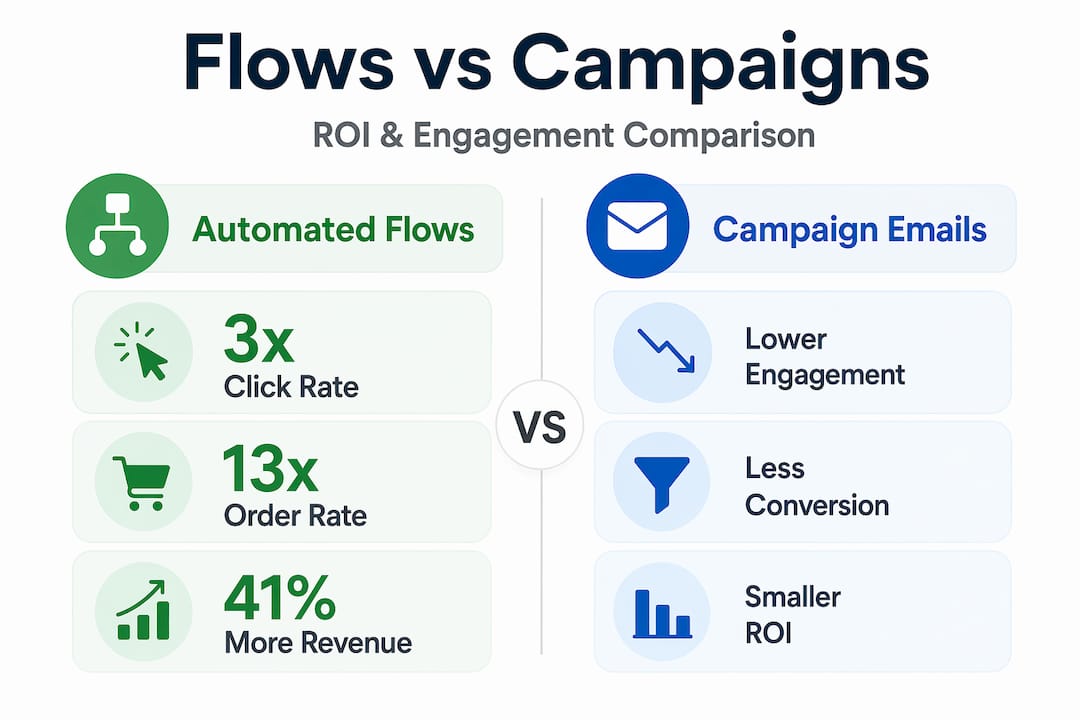
| Metric | Automated flows | Campaign emails |
|---|---|---|
| Average click rate | Higher by ~3x | Baseline |
| Placed order rate | Higher by ~13x | Baseline |
| Share of email revenue | ~41% | ~59% |
| Share of total sends | ~5.3% | ~94.7% |
| Revenue per send | Significantly higher | Lower |
This is why separating your ROI analysis for flows versus campaigns changes your optimization decisions entirely:
- Welcome series: Your highest-intent audience. New subscribers who opted in recently. ROI here is almost always strong because you are reaching people at peak curiosity.
- Abandoned cart flows: These are the closest thing to free revenue in ecommerce email. The customer already showed purchase intent. A well-timed sequence recaptures that.
- Post-purchase flows: Often ignored, these drive repeat purchase rates and lifetime value, which dramatically improves ROI calculations when you factor in customer lifetime value rather than just first-order revenue.
- Browse abandonment and back-in-stock flows: Lower volume, but conversion rates are high because these triggers fire on demonstrated behavioral intent.
When you are thinking about where to invest time in improving marketing ROI, flow optimization comes before campaign frequency almost every time. Learn more about tactics that boost ecommerce email sales and email automation options worth building into your stack.
Pro Tip: Run your ROI formula separately for each major flow. You will almost certainly find that your abandoned cart flow has a higher ROI than your newsletter campaigns, even after allocating a fair share of setup and creative costs to it.
With an optimization focus defined, it is time to reflect on how measurement practices influence the broader marketing decisions you make.
Why combining attribution with incrementality testing reveals the full email ROI story
Here is an opinion that makes some marketers uncomfortable: Klaviyo’s attribution model is a great operational tool and a poor board-level proof of value.
It is not a flaw in Klaviyo’s design. It is a feature built for speed and daily usability. You need to know which flow is working, which subject line performed, and which segment is driving revenue. Last-touch attribution answers all of those questions quickly. But when you take that number to finance and say “email drove $200,000 last quarter,” you are making a causal claim that the attribution model technically cannot support.
A two-layer measurement approach that combines Klaviyo default attribution for daily decisions with periodic incrementality testing gives you the most accurate and actionable email ROI insight. Use Klaviyo attribution every day to optimize sequences, prioritize flows, and identify underperformers. Run incrementality tests on your most important flows and campaigns quarterly to validate that the revenue you are reporting is genuinely caused by email, not just correlated with it.
The brands that get this right treat their Klaviyo dashboard the way a pilot uses flight instruments: essential for navigation, but not a replacement for looking out the window. Attribution tells you what happened. Incrementality testing tells you why. You need both to make decisions that hold up under scrutiny.
One more thing worth saying: separating your flow ROI from your campaign ROI is not just a calculation exercise. It shifts your resource allocation. When you see that flows deliver 41% of revenue from 5% of sends, it justifies investing in better flow creative, tighter segmentation, and more sophisticated trigger logic. That investment pays off in a way that sending one more campaign per week almost never does. A balanced approach to email ROI tracks both, but invests in what the data actually rewards.
How Take Action helps ecommerce brands maximize email marketing ROI
Getting all of this right consistently is where most in-house teams get stuck. Setting up attribution windows correctly, building holdout tests, calculating fully-loaded ROI, and optimizing flows simultaneously is a lot to manage alongside everything else running through an ecommerce operation.
Take Action is a specialized email marketing and retention agency that works exclusively in Klaviyo to help ecommerce brands do exactly this. The team configures attribution settings to match your sales cycle, implements incrementality testing to prove causal revenue lift, and builds or refines automated flows designed for maximum engagement and conversion. From welcome series to abandoned cart recovery to post-purchase sequences, everything is built with measurable ROI as the core objective. If you want expert hands on your Klaviyo account and a clear picture of what your email program is actually worth, see how the team works.
Frequently asked questions
What is Klaviyo’s default conversion attribution window for email marketing?
Klaviyo’s default attribution window is 5 days, meaning a purchase is attributed to an email if the recipient opens or clicks it and then buys within that five-day period.
How do I calculate true email marketing ROI?
Use the formula ((Klaviyo-attributed revenue – total email costs) / total email costs) × 100, and make sure to include all costs such as agency fees, software subscriptions, internal labor, and creative production.
Why is incrementality testing important for email marketing?
Incrementality testing compares purchase rates between email recipients and a randomly suppressed holdout group, which isolates the causal lift that email actually drives rather than revenue that would have happened regardless.
Should I focus more on campaigns or automated flows to improve ROI?
Automated flows should be your first priority because they outperform campaign emails significantly on click rates and purchase rates, generating a disproportionate share of email revenue relative to their send volume.
Recommended
- Monitor digital marketing ROI with Klaviyo: 41% revenue | Take Action Blog | Take Action
- How to boost ROI with Klaviyo: proven email strategies | Take Action Blog | Take Action
- Marketing Budget: 25% to Klaviyo = 45% Revenue Boost | Take Action Blog | Take Action
- Why invest in email marketing: proven ROI and retention power | Take Action Blog | Take Action