

Multi-channel marketing: boost retention & ROI in 2026
TL;DR:
- Brands with three or more channels see up to 287% higher retention and purchase rates.
- Multi-channel focuses on presence; omnichannel unifies customer data for personalized experiences.
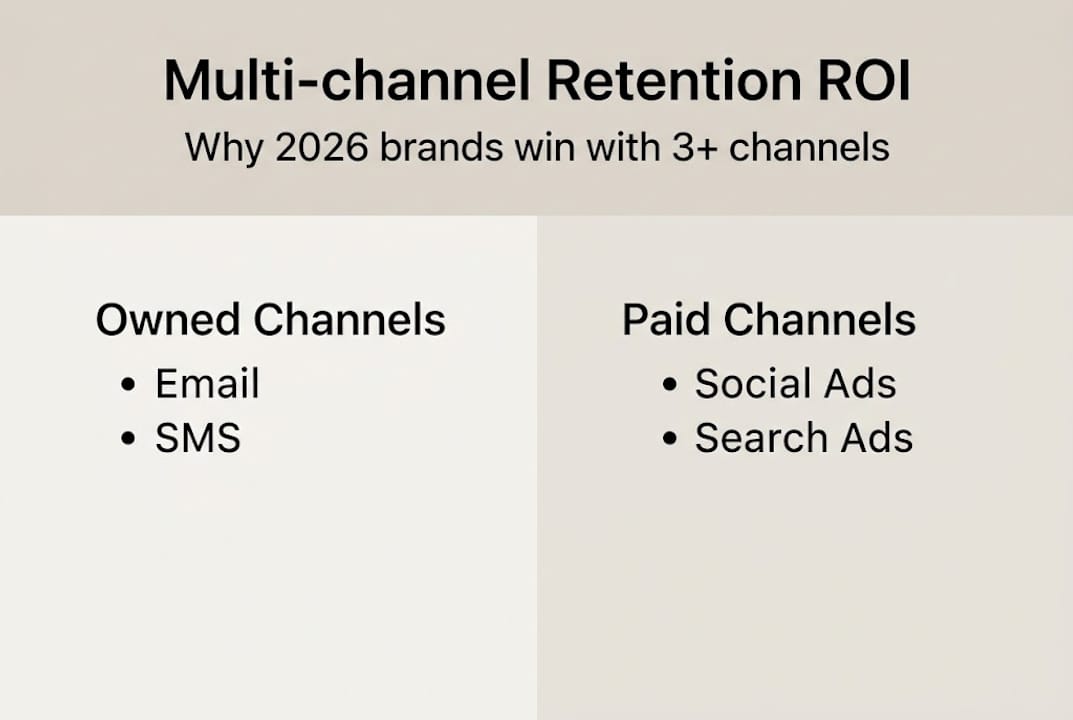
- Prioritize owned channels like email and SMS, and expand cautiously based on proven ROI.
Brands using three or more marketing channels achieve 287% higher purchase rates than those relying on a single channel. That gap is not a rounding error — it represents real revenue left on the table every month you stay siloed. For ecommerce marketing managers and brand owners, the pressure to diversify beyond paid ads is real, and the payoff for doing it right is massive. This guide breaks down what a multi-channel marketing approach actually means in practice, which channels move the needle most for retention, how to automate the whole stack, and how to measure what matters.
Table of Contents
- What is a multi-channel marketing approach?
- How multi-channel marketing drives ecommerce retention and revenue
- Best practices: Building and automating your multi-channel marketing stack
- Measuring multi-channel success: Key metrics and optimization tips
- A smarter perspective: Why ‘less is more’ for multi-channel success
- Ready to optimize your multi-channel strategy?
- Frequently asked questions
Key Takeaways
| Point | Details |
|---|---|
| Boost retention and ROI | Multi-channel marketing can dramatically increase purchase rates, retention, and overall ROI for ecommerce. |
| Best channels for ROI | Owned channels like email and SMS generally provide the highest returns for ecommerce automations. |
| Start with 3–5 channels | Focusing on 3 to 5 well-managed channels delivers the optimal mix of broad reach and efficient resource use. |
| Automate and measure | Centralize your customer data and use automation and clear metrics to refine and scale your marketing. |
| Less can be more | Success comes from depth and data, not from marketing on every channel at once. |
What is a multi-channel marketing approach?
At its core, multi-channel marketing means reaching customers across multiple independent channels — email, SMS, social media, paid search, and mobile apps — with the goal of maximizing reach and engagement. Each channel operates somewhat on its own terms, with its own messaging, cadence, and metrics. The key word here is independent. Channels are not always talking to each other in real time.
For ecommerce brands, that typically looks like this: a customer sees a retargeting ad on Instagram, receives an abandoned cart email, and later gets an SMS with a discount code. Each touchpoint is deliberate, but they are managed separately. That is multi-channel in practice.
Here is how the most common ecommerce channels stack up by primary role:
| Channel | Primary role | Owned or paid |
|---|---|---|
| Retention and lifecycle | Owned | |
| SMS | Urgency and time-sensitive offers | Owned |
| Social media | Awareness and community | Paid/organic |
| Paid search | Acquisition and intent capture | Paid |
| Mobile app/push | Re-engagement | Owned |
Now, a term you will hear often alongside multi-channel is omnichannel. They sound similar but work very differently. The core distinction is that multi-channel focuses on presence across platforms, while omnichannel integrates all those platforms around a unified customer experience. In omnichannel, your email tool, SMS platform, and ad network share the same customer data in real time. In multi-channel, they might not.
Key differences at a glance:
- Multi-channel: Each channel has its own strategy and data; focus is on reach
- Omnichannel: All channels share data and messaging is consistent and personalized at every step
- Multi-channel pros: Easier to launch, lower upfront complexity, faster to test
- Multi-channel cons: Risk of inconsistent messaging, data silos, and missed personalization opportunities
“The gap between multi-channel and omnichannel is not about the number of channels — it is about whether those channels share intelligence.” That distinction matters most when you are scaling.
For brands building their social content strategy alongside email, understanding this difference helps you decide how tightly to integrate before adding more channels. A well-run multi-channel setup is a strong foundation. The right time to consider shifting toward omnichannel is when you have consistent data across at least three channels and the tools to unify them. Understanding customer retention impact at each touchpoint is what guides that decision. For more on the mechanics of integrated commerce, omnichannel commerce explained is worth a read.
How multi-channel marketing drives ecommerce retention and revenue
The numbers behind multi-channel marketing are hard to argue with. Brands using three or more channels see retention improve by up to 287% compared to single-channel brands, with purchase rates climbing 287% to 494% higher. ROI runs about 2x higher on average, and customer lifetime value (CLV) increases by roughly 30% when a consistent multi-channel experience is present.

Let’s break down channel-level ROI so you can see where to prioritize:
| Channel | Average ROI per $1 spent | Best use case |
|---|---|---|
| $36 to $42 | Retention, lifecycle, winback | |
| SMS | $21 to $71 | Flash sales, cart recovery, VIP offers |
| Paid social | $2 to $5 | Acquisition, lookalike audiences |
| Paid search | $2 to $8 | High-intent acquisition |
Email and SMS dominate owned-channel ROI by a wide margin. That is not a coincidence. These channels reach customers directly, without paying a platform for every impression. You own the list. You control the timing. And because both channels support sophisticated automation, you can deliver the right message at the right moment without constant manual effort.
For customer retention strategies, the combination of email and SMS is especially powerful. A post-purchase email sequence builds loyalty. An SMS 48 hours before a subscription renewal nudges action. Together, they create a retention rhythm that keeps customers coming back without requiring paid re-acquisition.
What drives CLV higher is consistency. When a customer hears from your brand across multiple touchpoints — all reinforcing the same value, same tone, same offer logic — they develop stronger brand affinity. That affinity translates directly into repeat purchases. Brands serious about driving customer lifetime value treat each channel as a compounding asset, not a one-off tactic.
The bottom line: adding channels is not just about reach. It is about creating more moments for a customer to re-engage, remember your brand, and return to buy again.
Best practices: Building and automating your multi-channel marketing stack
Knowing the impact is one thing. Building the stack is another. Here is a practical sequence for ecommerce brands at any stage:
- Start with owned channels first. Email and SMS should anchor your stack. They are the highest ROI, the most controllable, and the easiest to automate. Do not invest heavily in paid channels until your owned channels are converting consistently.
- Add one paid channel based on where your audience actually spends time. If your buyers are on Instagram, start with Meta ads. If they are searching for your product category, start with Google. Do not guess — use your analytics.
- Set up a unified customer data platform (CDP) or at minimum, sync your email and SMS tools. Real-time data sync across channels reduces cart abandonment by up to 19%. That number alone justifies the integration investment.
- Build three core automation flows before adding campaigns. Welcome series, abandoned cart recovery, and post-purchase follow-up are your highest-leverage automations. Get these right first.
- A/B test messaging across channels. Your SMS audience and your email audience are not identical, even if they overlap. Test subject lines, send times, and offer types separately per channel.
Pro Tip: When setting up your abandoned cart flow, trigger the first email within 30 minutes of abandonment, follow with an SMS at the 3-hour mark if no action, and send a final email with a small incentive at 24 hours. This three-step sequence consistently outperforms single-channel recovery attempts.
For brands building out their online marketing strategy, the sequence above gives you a clear launch path without overwhelming your team. Once those core flows are running, expand into ecommerce newsletter ideas for ongoing campaigns, and invest in collecting customer feedback to refine segmentation over time.
Measuring multi-channel success: Key metrics and optimization tips
Automation without measurement is just noise. You need clear KPIs across every channel to know what is working and where to invest more.
The metrics that matter most for multi-channel ecommerce:
- Customer lifetime value (CLV): Your north star metric. If CLV is rising, your retention engine is working.
- Return on ad spend (ROAS): Tracks paid channel efficiency. Compare ROAS by channel monthly.
- Retention rate: What percentage of customers buy again within 90 and 180 days?
- Attribution: Which channel gets credit for a conversion? Use data-driven attribution, not last-click, to understand the full customer journey.
- Channel-specific open, click, and conversion rates: These tell you whether your messaging is resonating per platform.
AI-driven personalization is changing what is possible here. Predictive models can flag which customers are likely to churn before they do, triggering win-back sequences automatically. They can also identify which channel a specific customer responds to best, and route future messages accordingly. That level of targeting lifts both conversion rates and CLV without adding headcount.
Pro Tip: Before scaling any channel, require it to prove ROI over a minimum 60-day window. Too many brands scale based on a single good week. Sixty days smooths out seasonality and gives you a reliable signal.
“Start with three channels that prove their value, then scale. Adding channels before you have clean attribution is like adding lanes to a highway before you have fixed the on-ramps.”
Common optimization mistakes to avoid: ignoring cross-channel attribution, treating all customers as one segment, scaling paid spend before owned channels are profitable, and skipping measuring ecommerce ROI at the channel level. Smart brands also invest in ecommerce loyalty programs as a retention layer that amplifies every channel’s performance by giving customers a reason to keep engaging.
A smarter perspective: Why ‘less is more’ for multi-channel success
Here is a view that might push back on some of the excitement around multi-channel: the biggest mistake we see ecommerce brands make is not under-investing in channels. It is spreading too thin, too fast.
Brands that launch on five channels simultaneously with mediocre execution in each consistently underperform brands that dominate two channels with exceptional data, personalization, and automation. Volume of channels is not a strategy. Depth of execution is.
The brands winning at multi-channel right now are not the ones on every platform. They are the ones who know their customer data cold, have tight automation sequences, and only add a new channel when they have clear evidence it will deliver incremental revenue — not just additional reach. Check out our marketing insights for real examples of this principle in action.
Our advice: pick three channels, build them right, measure everything, and only expand once you have a system that can absorb more complexity without breaking. Lean beats sprawling every time.
Ready to optimize your multi-channel strategy?
If this guide has confirmed what you already suspected — that your current stack has gaps — the next step is getting specific about where to focus. At Take Action, we work with ecommerce brands to design, automate, and scale retention-first marketing systems built around email and SMS as the core, with every channel earning its place through proven ROI.
As email and retention experts, we combine Klaviyo expertise with a data-driven approach to build automation flows that actually move the needle. Whether you need to overhaul your existing setup or build from scratch, Take Action solutions are designed to grow with your brand. Reach out to explore a custom consultation and find out exactly which channels and automations will deliver the highest return for your specific business.
Frequently asked questions
What is the difference between multi-channel and omnichannel marketing?
Multi-channel uses separate independent channels for customer engagement, while omnichannel creates a seamless, integrated experience by unifying data and messaging across all those channels.
How many channels should ecommerce brands use for best results?
Brands typically see the highest ROI with 3 to 5 channels rather than trying to be everywhere at once — prove value with three first, then scale.
Which channels deliver the best ROI for ecommerce marketing?
Owned channels consistently win: email returns $36 to $42 for every dollar spent, while SMS returns $21 to $71, making both far more efficient than paid alternatives.
What automation tools are essential for multi-channel marketing?
A unified customer data platform (CDP) and real-time sync tools are critical — unified CDP adoption is linked to significant retention lifts by eliminating data silos across channels.
How do you measure success in multi-channel marketing?
Focus on CLV and ROAS tracked across all channels, alongside channel-specific retention rates and data-driven attribution to understand the full customer journey.
Recommended
- Online Marketing Strategy: Driving Ecommerce Retention | Take Action Blog | Take Action
- Blog - Email Marketing Insights | Take Action | Take Action
- Top marketing funnels for Klaviyo in 2026: Boost retention | Take Action Blog | Take Action
- Master influencer marketing ROI for ecommerce in 2026 | Take Action Blog | Take Action