

Overcoming small business challenges: Actionable e-commerce solutions
TL;DR:
- Small e-commerce businesses have advantages in agility, personalization, and automation over larger firms.
- Effective email marketing, especially cart recovery and segmentation, significantly boosts revenue despite challenges.
- Strategic adaptation to operational and customer retention issues creates competitive advantages in tough economic conditions.
More than half of small business owners in the United States right now are being squeezed by inflation, with 53% naming it their top concern heading into 2026. But here’s what most people miss: large companies are not the only ones built to survive economic pressure. E-commerce small businesses actually have a structural advantage when it comes to adapting quickly, personalizing the customer experience, and using automation tools that were once only available to enterprise brands. This article breaks down the real challenges you face, explains their impact in plain numbers, and gives you proven strategies, especially through email marketing, to grow even when conditions are tough.
Table of Contents
- The top challenges small businesses face in 2026
- Operational roadblocks in e-commerce growth
- Overcoming customer retention and cart abandonment
- The power of email segmentation for revenue growth
- A new way to think about small business challenges
- Take the next step: Grow, retain, and win
- Frequently asked questions
Key Takeaways
| Point | Details |
|---|---|
| Inflation leads 2026 challenges | Over half of small business owners cite inflation as their top concern, affecting operations and growth plans. |
| E-commerce faces unique hurdles | Operational barriers like logistics, fraud, and payment processing are critical issues for e-commerce businesses. |
| Customer retention unlocks growth | Multi-email abandoned cart sequences and segmented campaigns significantly boost recovered revenue. |
| Segmentation drives results | Targeted email segmentation delivers up to 760% more revenue compared to generic campaigns. |
The top challenges small businesses face in 2026
Small businesses are operating in one of the most complicated economic climates in recent memory. The combination of rising costs, labor shortages, and supply chain fragility has created a multi-front battle that demands both strategic thinking and tactical agility. Understanding these challenges clearly is the first step to addressing them in a way that actually sticks.
Inflation tops the list as the most reported challenge for small businesses in Q1 2026, cited by 53% of owners, up from 45% last quarter. That jump is significant. It reflects not just higher costs for inventory and operations, but compressed margins at every stage of the business. When your cost of goods rises but customers resist paying more, the pressure lands directly on your profit line.
Beyond inflation, small business owners are dealing with a cluster of closely related issues that compound the problem. Here is a breakdown of the most commonly reported challenges right now:
| Challenge | Prevalence among small businesses | Primary impact |
|---|---|---|
| Inflation and rising costs | 53% | Reduced margins, pricing pressure |
| Staffing and hiring | 41% | Lower productivity, customer service gaps |
| Supply chain disruptions | 38% | Inventory delays, stockouts |
| Technology adoption | 29% | Operational inefficiency |
| Fraud and payment security | 24% | Revenue loss, customer trust erosion |
Each of these issues feeds the others. For example, when supply chains are disrupted, you carry more safety stock, which ties up cash you might otherwise spend on marketing or talent. When you cannot hire, customer service suffers, which directly damages retention rates.
Staffing has become especially tricky because hiring freezes and budget constraints mean small teams are being asked to do more with less. Many e-commerce businesses are running lean operations where a single employee handles customer service, social media, and fulfillment. That kind of overextension creates mistakes, delays, and burnout.
Technology adoption is another pressure point that often gets underestimated. Many small business owners know they need better tools but feel overwhelmed by the options and costs. The reality is that the right platforms, particularly in email marketing and customer relationship management, often pay for themselves quickly through recovered revenue and improved retention.
Fraud is a growing concern too, particularly for online stores. As e-commerce volume increases, so do attempts at chargeback fraud, account takeovers, and fake orders. Addressing fraud is not just a financial issue. It also damages your reputation and erodes the customer trust you have worked hard to build.
Understanding these five core challenges gives you a realistic map of where the friction is. With that map in hand, let’s look more closely at the operational side.
Operational roadblocks in e-commerce growth
Now that we see the big picture, let’s focus on the operational demands e-commerce brands must manage every day. Running an online store is far more complex than it looks from the outside. Behind every smooth purchase experience is a chain of processes that can break at multiple points, and any one of those breaks can cost you customers, revenue, and momentum.
E-commerce small businesses face significant operational challenges including scaling logistics, securing payment processing, protecting against fraud, and managing inventory amid supply chain disruptions. Each of these areas demands dedicated attention, especially as your order volume grows.
Here are the four core operational struggles that most growing e-commerce businesses encounter:
- Logistics and shipping scalability: As order volumes grow, your fulfillment process needs to scale with them. Manual processes that worked at 50 orders a day collapse at 500. Third-party logistics providers can help, but integrating them into your existing tech stack requires planning and ongoing coordination.
- Payment processing and fraud protection: Accepting payments online means managing chargebacks, verifying customer identities, and staying compliant with payment regulations. A single data breach or a wave of fraudulent orders can wipe out weeks of profit.
- Inventory management amid supply chain shocks: Supply chain disruptions have not fully resolved, and small businesses with limited inventory buffers are particularly vulnerable. Stockouts mean lost sales. Overstocking ties up cash. Finding the balance requires real-time visibility into your data.
- System integration and technology adoption: Many small e-commerce businesses use a patchwork of tools that do not communicate with each other. When your email platform, CRM, and store backend are siloed, you lose time, accuracy, and the ability to personalize at scale.
“Integrating unified payment systems, scalable platforms, multiple suppliers, and AI analytics positions e-commerce businesses to handle operational complexity and grow sustainably.” — eCommerce Growth Strategies
Pro Tip: Do not rely on a single supplier for your core product lines. Building relationships with two or three suppliers for your most important SKUs gives you a fallback when disruptions hit and often gives you better negotiating leverage on pricing.
The good news is that these operational challenges have increasingly practical solutions. Scalable platforms like Shopify and WooCommerce come with built-in integrations that reduce the friction of connecting your tools. Pair that with a sound e-commerce digital strategy and you have a foundation strong enough to grow on.
Building operational resilience is not about perfecting every system before you scale. It is about identifying your highest-risk bottlenecks and removing them one at a time. Start with the area causing the most revenue loss or customer complaints, fix it systematically, then move to the next.
Overcoming customer retention and cart abandonment
With operations under control, success hinges on maximizing revenue from your existing customers, especially at the point of sale. One of the most persistent revenue leaks in e-commerce is cart abandonment, and the numbers are striking.

The average cart abandonment rate sits at 70.22%, meaning roughly seven out of ten shoppers who add items to their cart never complete the purchase. For most e-commerce brands, this represents more lost revenue than any operational inefficiency or marketing gap. The customer already showed intent. They chose your product. Something stopped them at the finish line.
Recovering even a fraction of those abandoned carts through targeted email sequences can transform your revenue picture. Here is a direct comparison of recovery performance:
| Email sequence type | Cart recovery rate |
|---|---|
| Single abandoned cart email | 18% |
| Three-email abandoned cart sequence | 29% |
That 11-point difference is not trivial. On $50,000 in monthly abandoned cart value, a three-email sequence recovers roughly $5,500 more per month than a single email approach. Over a year, that compounds into real money without requiring any additional advertising spend.
To build a high-converting abandoned cart email, you need to include the right elements. Here are the must-have features in order of priority:
- A clear subject line that references the specific product the customer left behind, not a generic “You forgot something” message.
- Product images and details so the customer can immediately recognize what they were considering.
- A single, prominent call-to-action that takes them directly back to their cart without extra steps.
- Social proof such as reviews or star ratings for the specific item to overcome hesitation.
- An incentive in the final email of the sequence, typically a small discount or free shipping, to close the deal with price-sensitive shoppers.
- A sense of urgency if it is honest, such as low stock alerts or a time-limited offer.
“Three-email sequences for cart abandonment outperform single-email approaches by a significant margin, making automation a clear priority for any retention-focused e-commerce brand.”
Pro Tip: Segment your abandoned cart emails by cart value. High-value carts deserve a personalized approach, possibly including a direct offer from your team. Lower-value carts can be handled fully through automation. This tiered approach improves both recovery rates and your return on effort.
Pairing your cart recovery flows with smart e-commerce newsletter ideas keeps your brand top of mind between purchase occasions, reducing the likelihood of abandonment in the first place.
The power of email segmentation for revenue growth
Now let’s unlock one of the most overlooked levers for boosting retention and lifetime value: segmentation. Most small business email programs send the same message to every subscriber, which is the equivalent of a retail associate giving the exact same pitch to every single person who walks through the door regardless of what they came in looking for.
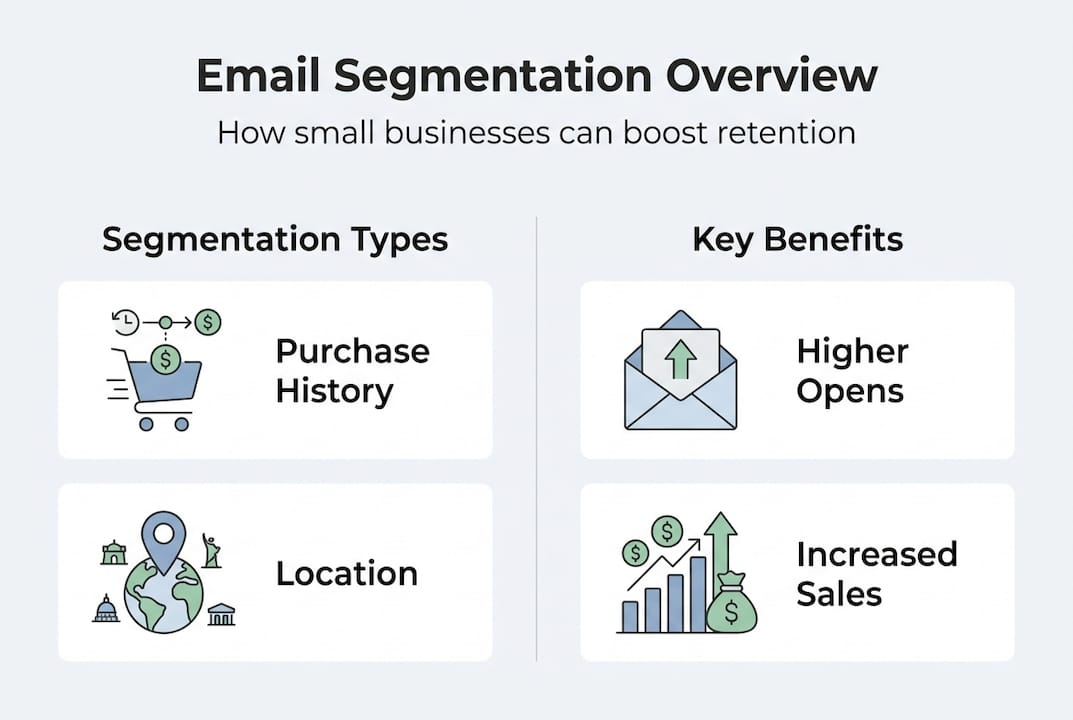
Segmented email campaigns generate 760% more revenue compared to non-segmented ones. That is not a marginal improvement. It is a structural shift in how email performs for your business. The reason is simple: people respond to messages that feel relevant to them, and segmentation is what makes relevance possible at scale.
Here are the main types of segmentation every e-commerce brand should be using:
- Purchase history segmentation: Group customers by what they have bought, how much they have spent, and how recently they purchased. This allows you to send replenishment reminders, cross-sell recommendations, and VIP offers to the right people.
- Behavioral segmentation: Track how subscribers interact with your emails and website. Someone who clicked on a product page twice but never purchased is a different conversation than someone who has not opened an email in 90 days.
- Demographic segmentation: Age, location, and gender can all influence product relevance. A brand selling skincare to both men and women, for example, should not send the same messaging to both groups.
- Engagement-based segmentation: Separate your active subscribers from inactive ones. Sending win-back campaigns to dormant subscribers, rather than including them in every broadcast, protects your sender reputation and improves overall deliverability.
- Lifecycle stage segmentation: Treat new subscribers differently from repeat buyers and treat your highest-value customers differently from occasional shoppers. Each stage of the customer lifecycle has different needs and motivations.
Getting started with segmentation does not require complex technology. Most email platforms, including Klaviyo, allow you to create segments based on simple rules within minutes. Start with one or two segments, measure the difference in open rates and revenue, then expand from there.
Understanding segmentation strategies at a deeper level shows you how to layer multiple criteria together for more precise targeting. You can also explore list segmentation techniques specifically built for e-commerce, as well as the broader benefits of email segmentation including its effect on deliverability and brand trust.
Pro Tip: Combine your abandoned cart sequences with a win-back campaign for lapsed customers. If a customer abandoned a cart six months ago and has not purchased since, a win-back email with a personalized offer based on that abandoned product can reactivate them at a very low cost. Many brands see 10 to 15% reactivation rates from well-timed win-back campaigns, which is revenue that would otherwise disappear entirely.
A new way to think about small business challenges
Here is the honest truth most business content avoids: the challenges facing small e-commerce businesses in 2026 are not actually disadvantages compared to larger competitors. They are invitations to move faster, build deeper customer relationships, and adopt tools that larger companies spend months getting approved through internal bureaucracy.
When inflation forces you to optimize every dollar, you get sharper at measuring what works. When your team is small, every customer interaction matters more, and that intimacy creates loyalty that no big-box retailer can replicate with a loyalty card.
Small businesses adopt retention marketing faster than enterprises because there is no committee to convince. You see the data, you test a new segment, and you see the result within days. That speed is a genuine advantage. Understanding why segmentation matters is not just a technical question. It is a strategic one about using your agility to outperform brands with ten times your budget.
The businesses that come out ahead in difficult economic cycles are not the ones with the most resources. They are the ones who refuse to treat constraints as permanent limitations. Every operational challenge you solve, every abandoned cart you recover, and every segmented campaign you launch is a compounding investment in a customer base that becomes more loyal over time. That is where real competitive advantage lives.
Take the next step: Grow, retain, and win
If anything in this article resonated, it is probably because you already know you are leaving revenue on the table. The gap between knowing what to do and having the time, tools, and expertise to do it well is exactly where most small e-commerce businesses get stuck.
Take Action specializes in closing that gap. As a dedicated email marketing support agency focused on e-commerce retention, we build the automation flows, segmentation strategies, and campaign systems that turn your email list into a consistent revenue engine. From abandoned cart sequences to post-purchase flows and win-back campaigns, our team at Take Action brings the strategy and execution so you do not have to figure it out alone. Let’s put your retention on autopilot.
Frequently asked questions
What is the biggest challenge for small businesses in 2026?
Inflation is the top challenge for small businesses in Q1 2026, affecting margins, hiring decisions, and the ability to invest in growth.
Why do e-commerce small businesses struggle with customer retention?
Recovering abandoned carts and re-engaging lapsed customers requires automated systems most small businesses have not set up yet, and with a 70.22% cart abandonment rate, the revenue impact is substantial.
What operational improvements have the highest impact?
Integrating unified payment systems, using AI analytics for inventory visibility, and building relationships with multiple suppliers significantly improve operational resilience and protect against disruptions.
How much more revenue do segmented emails generate?
Segmented campaigns generate 760% more revenue than non-segmented ones, making it one of the highest-return tactics available to e-commerce brands of any size.