

Email Is the Backbone of Every Successful Product Launch
Email is the single most reliable owned channel for turning launch interest into revenue, and the teams who win treat it as a sequence, not a single blast. If you’re launching something new this quarter, run a 3- to 7-email sequence that spans the tease, the announcement, and the follow-up, and prioritize your VIPs and most engaged subscribers before you ever hit the wider list. The role of email in product launches isn’t just “send an announcement.” It’s building a coordinated campaign that catches attention at three or four different moments instead of one.
Three things to do this week:
- Draft a 30 to 90 second demo asset now. It becomes your hero content in every email that follows.
- Segment your list into VIPs, engaged subscribers, and everyone else, before you write a single subject line.
- Build a resend plan for non-openers into the sequence from day one, not as an afterthought.
Statistic Callout: Open rates on a well-timed launch teaser often beat the announcement email itself, and resending to non-openers with a fresh subject line recovers 15 to 30% more opens in many launches.
Key Takeaways
A sequenced, segmented email campaign consistently converts more launch interest into revenue than a single announcement email ever will.
| Point | Details |
|---|---|
| Run a sequence, not a blast | Send 3 to 7 emails across pre-launch, launch window, and post-launch phases instead of one announcement. |
| Segment before you write copy | Give VIPs and engaged subscribers the full sequence early; compress cold segments to two emails. |
| Resend to non-openers | A fresh subject line 48 to 72 hours after send one recovers 15 to 30% more opens. |
| Track revenue per recipient | Tag each email with distinct UTMs so you can see which phase of the sequence drove the sale. |
| Build it as a repeatable system | Take-action sets up the Klaviyo segmentation, automations, and resend logic so the playbook works on every future launch. |
Table of Contents
- Why Email Matters More Than Other Launch Channels
- What Is the Ideal Launch Email Sequence and Timing?
- Templates and Subject Lines That Get These Emails Opened
- How Should You Segment Your Launch Emails?
- What Metrics Actually Prove a Launch Email Worked?
- How Automation Makes Launch Emails Repeatable
- Your Two-Week Pre-Launch Checklist
- How Take-action Runs Launch Email Programs for Ecommerce Brands
- Get Help Building a Launch Sequence That Doesn’t Rely on Luck
- Sources
Why Email Matters More Than Other Launch Channels
Social platforms rent you attention. Email rents you almost nothing, because once someone hands over their inbox address, you own that relationship until they unsubscribe. Algorithmic feeds decide who sees your launch post and when. Your email list doesn’t have that gatekeeper. Every subscriber who opted in is reachable on your schedule, at a moment you choose, with a message built specifically for them.
That control matters because launch attention is not evenly distributed. Most opens on a launch email cluster in the first 24 to 48 hours, which means email gives you a predictable window to coordinate paid ads, social posts, and PR around a single moment instead of hoping algorithms cooperate.
Email also complements the rest of your launch stack rather than competing with it:
- It drives traffic to landing pages that are built to convert, not just inform.
- It reinforces in-app messages for existing users who might otherwise miss a feature announcement.
- It creates a paper trail of engagement data (opens, clicks, replies) that social platforms rarely hand back to you.
Statistic Callout: There are more than 4.5 billion email users worldwide, which is why email remains the widest-reaching owned channel available for most launches, ecommerce or otherwise.
Social and PR create noise around a launch. Email converts that noise into people who actually show up and buy.
What Is the Ideal Launch Email Sequence and Timing?
Treat your launch email sequence like a mini campaign with three distinct phases, not one email with a deadline attached. Marketing teams that run this way consistently see more revenue captured than teams that fire off a single announcement, because a sequence catches people who missed the first message, ignored the second, and only convert on the third.
Here’s the structure that works across most product categories:
- Pre-launch (2 to 3 emails). Tease the problem you’re solving without revealing the full solution, then open a waitlist or early-access signup. This phase builds anticipation and gives you a warm list to announce to later.
- Launch window (2 to 3 emails). Send the announcement itself, followed by a detail/FAQ email that answers objections, then a resend to everyone who didn’t open the first message with a new subject line.
- Post-launch (1 to 2 emails). Follow up with social proof (reviews, usage stats, early customer wins) and a feedback or activation nudge that pulls new users deeper into the product.
A 14-day sprint is a solid default timing model for most ecommerce launches: roughly a week of teasers and waitlist building, then a tight launch window, then a week of post-launch follow-up. It’s long enough to build real anticipation without losing momentum.
Not every launch needs the full 14 days, though:
- Compressed sprint (5 to 7 days): Use this for minor feature updates, seasonal product drops, or restocks. Cut the pre-launch phase to one teaser and move straight into announcement plus resend.
- Standard sprint (14 days): Use this for a new product line, a flagship SKU, or anything you want a genuine waitlist for.
- Extended cadence (3 to 4 weeks): Use this for enterprise products, major platform launches, or anything requiring buyer education before purchase. Add a second detail email that walks through use cases.
The mistake most brands make isn’t picking the wrong timeline. It’s collapsing all three phases into one email and hoping the announcement alone carries the weight of a full campaign.
Templates and Subject Lines That Get These Emails Opened
Every email in your sequence needs a job, and the subject line should signal that job before the reader even opens it. Here are formulas that work across the sequence:
- Teaser: “Something’s coming for [audience]” or “We’ve been building this for months”
- Waitlist: “Get early access before everyone else” or “You’re on the list. Here’s what’s next”
- Announcement: “[Product name] is here” or “The wait is over”
- Resend (new subject): “Last chance to see what we launched” or “Did you miss this?”
- Social proof: “Here’s what early customers are saying” or “500 people already switched”
- Last chance: “This closes tonight” or “One more day for [offer]”
The announcement email carries the most weight, so keep it simple: one line stating the outcome the product delivers, a demo video near the top, and a single call to action. Skip the second and third CTA buttons. Successful launch emails lead with the outcome, not the feature list, and they resist the urge to cram every benefit into one send.
The single most reusable asset across your entire launch, email included, is a 30 to 90 second demo video. It gets the viewer to the “aha” moment faster than any paragraph of copy ever will.
Follow-up emails do different work. The detail or FAQ email should anticipate the three questions your sales team hears most. The social proof email should use specific examples or named customers rather than vague enthusiasm. The last-chance email should create real urgency, not manufactured scarcity, and a well-placed P.S. line often outperforms the main CTA for driving a final click.
Pro Tip: Put your demo video’s thumbnail directly below the subject-line preview text so it renders in the inbox before the recipient even opens the email. That small placement change can lift click-through on its own.
How Should You Segment Your Launch Emails?
Sending the same five emails to your entire list is the fastest way to waste a launch. A great launch to the wrong segment underperforms a mediocre launch sent to the right one, which is why segmentation deserves as much planning time as the copy itself.
Split your list into three practical tiers before you write a single email:
- VIPs and early-access subscribers. Past purchasers, loyalty members, or anyone who’s engaged heavily with your brand. Send them the full sequence first, often 24 to 48 hours before the general list, as a genuine perk.
- Engaged subscribers. People who’ve opened or clicked in the last 60 to 90 days. They get the complete sequence on the standard timeline.
- The broader list. Subscribers who haven’t engaged recently. Compress their sequence to two emails: the announcement and one resend. Sending five emails to a cold segment just trains them to ignore you faster.
Personalization inside each segment matters just as much as the segment itself. If someone bought a specific product category before, reference it directly in the announcement rather than sending generic copy. If a subscriber browsed a related product page but never purchased, that browse signal is a strong hook for a more education-focused version of the announcement. Lifecycle stage (new subscriber vs. repeat customer vs. lapsed buyer) should also change your tone. A new subscriber needs context your best customer already has.
Take-action’s approach to segmentation strategies for ecommerce brands treats these tiers as living lists that update automatically as behavior changes, so the VIP segment for your next launch isn’t the same static export you pulled six months ago.
Pro Tip: Build your VIP segment definition into Klaviyo (or whichever platform you use) as a saved, self-updating segment months before launch day. Scrambling to pull that list the week of launch almost always means missing someone who should have gotten early access.
What Metrics Actually Prove a Launch Email Worked?
Four numbers tell you almost everything: open rate, click-through rate, conversion rate, and revenue per recipient. Open rate tells you whether your subject lines and send timing worked. Click-through rate tells you whether the content once opened, held up. Conversion rate and revenue per recipient tell you whether any of it actually mattered to the business.
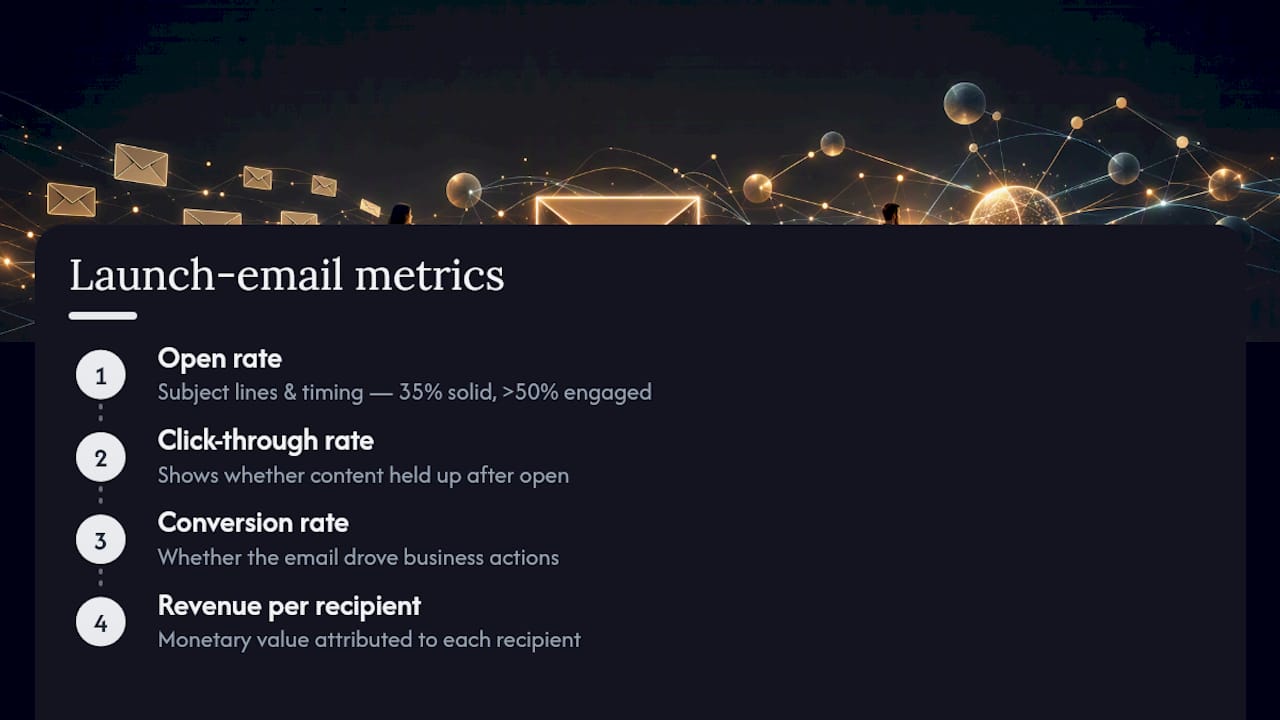
Statistic Callout: A 35% open rate is considered solid for launch emails, and anything above 50% signals a genuinely engaged list. Teaser emails frequently outperform the announcement itself on opens, since curiosity outperforms a fully revealed offer.
Attribution is where most teams lose the thread. Tag every link in every launch email with UTM parameters specific to that email’s position in the sequence (teaser vs. announcement vs. resend), not just a generic “launch” campaign tag. That level of detail is what lets you see which phase of the sequence actually drove the purchase, rather than crediting everything to the last click before checkout. Set up landing page events to track scroll depth and demo-video plays too.
Multi-touch attribution is more honest than last-click for sequences specifically because the goal of a multi-email campaign is to touch the same person more than once before they convert. If your analytics only credit the final email, you’ll systematically undervalue the teaser and announcement emails that built the intent in the first place. Take-action’s guide to email marketing analytics and KPIs breaks down how to set this up inside Klaviyo without needing a separate attribution tool.
How Automation Makes Launch Emails Repeatable
The resend to non-openers is the highest-leverage automation most teams skip. Change the subject line, swap the preview text, and send it 48 to 72 hours after the original. That single step recovers 15 to 30% more opens in many launches, according to the Flowjam launch playbook, which makes it close to free revenue for the five minutes it takes to set up.

Automation should extend past the sequence itself. Anyone who clicks the announcement but doesn’t buy should flow into a short product-education series that addresses the objection they likely had. Anyone who does buy should move into a post-purchase flow that starts building the next cross-sell moment. Take-action’s breakdown of automated ecommerce workflows covers how these flows connect without overlapping or duplicating sends.
None of this works without an owner. Assign one person to run the weekly check on open rates, resend timing, and flow performance for at least a month after launch. A sequence with no owner quietly stops being checked by week two.
Pro Tip: Set a recurring 15-minute Friday check-in for the two weeks following launch. That’s usually enough time to catch a stalled flow or an underperforming subject line before it costs you real revenue.
Your Two-Week Pre-Launch Checklist
Get these assets locked before day one of your sequence: the demo video, a landing page built to convert (not just inform), your CTA button copy, an FAQ document your support team has reviewed, and UTM tracking on every link.
A day-by-day framework that keeps a 14-day sprint on track:
- Day -14: Finalize demo video and landing page. Confirm segmentation lists are current.
- Day -7: Send teaser email 1 to VIPs and engaged subscribers.
- Day -3: Send teaser email 2 or open waitlist signup to the broader list.
- Day 0: Send the announcement email to all segments, staggered by tier.
- Day +2: Resend to non-openers with a new subject line.
- Day +7: Send social proof and feedback/activation follow-up.
Watch for these red flags in the final prep window:
- A single announcement email with no resend plan behind it.
- Sending the identical message to VIPs and cold subscribers with zero segmentation.
- No one assigned to monitor performance after send day.
- A demo video that’s still “almost done” three days before launch.
How Take-action Runs Launch Email Programs for Ecommerce Brands
Take-action treats a launch sequence the same way it treats any retention program: as an operating system with a clear owner, a weekly measuring rhythm, and a defined place inside the brand’s broader revenue workflow rather than a one-time project that gets forgotten after send day.
Inside Klaviyo, the automations that show up in nearly every launch build include a segmented send order (VIPs first, engaged second, broad list last), an automatic resend to non-openers with a swapped subject line, and a post-click flow that routes anyone who clicked the announcement into product education specific to the item or category they viewed. For ecommerce brands, that click-to-education routing matters more than most teams expect. Someone who clicks through on a specific product variant needs a different follow-up than someone who clicked generically, and measuring activation within the first 7 days is usually the clearest early signal of whether a launch is actually working or just generating opens.
Pro Tip: Build the post-purchase flow before launch day, not after. The first wave of buyers deserves the same automated follow-up as buyer number one thousand.
First-Person Practitioner Note
Most teams under-resource the launch sequence because they treat email as the easy part after the “real” work of building the product. It isn’t. The habit that changes outcomes isn’t cleverer copy. It’s assigning one owner and a weekly fifteen-minute check-in for the two weeks after send day. Everything else, the segmentation, the resend, the KPIs, falls apart without that rhythm. Try running a five-email sequence on your next launch instead of one announcement, and track it weekly. You’ll notice the difference by week two.
— Take
Get Help Building a Launch Sequence That Doesn’t Rely on Luck
Take-action is the alternative to guessing your way through launch week: a Klaviyo-focused retention agency that builds the segmentation, the automations, and the resend logic once, so your next five launches run on the same reliable system instead of starting from scratch every time.
Take-action’s core services map directly onto what a launch sequence actually needs: campaign strategy, Klaviyo flow setup for welcome and post-purchase, segmentation into VIP and engaged tiers, and long-term management so the resend rules and activation flows keep working after the initial build. The goal isn’t just a good-looking announcement email. It’s higher open and click rates across the full sequence, revenue recovered from non-openers who would have otherwise gone cold, and a playbook your team can reuse for the next product drop without rebuilding it from scratch.
If your next launch is on the calendar, talk to Take-action about building your launch sequence before you write the first subject line.
Sources
- Product Launch Email Sequence | GTM Playbook
- How to announce a product launch in 2026: Playbook + Timing | Flowjam
- Product Launch Email Templates (7-Email Sequence) - Scale Growth Digital
- Product launch email best practices and examples | Userpilot
- Number of e-mail users worldwide | Statista