

SEO for service businesses: your step-by-step growth guide
TL;DR:
- Building a structured local SEO strategy centered on Google Business Profile is essential for visibility.
- Creating detailed, localized service and location pages boosts rankings and user engagement.
- Off-page authority signals like citations, backlinks, and reviews are crucial for local trust and ranking.
Your competitor appears in every local map pack while your phone stays quiet. You offer better work, faster turnaround, and happier customers, yet Google keeps sending leads to the business down the street. That gap is not random. It is the direct result of a structured local SEO strategy your competitors built and you have not yet. This guide walks you through every critical layer, from Google Business Profile setup to off-page authority building, so you can close that gap, generate high-quality inbound leads, and build the kind of trust that keeps customers coming back without paying for every single click.
Table of Contents
- Understanding SEO for service businesses
- Setting the foundation: Google Business Profile and local optimization
- Creating high-performing service and location pages
- Off-page SEO and authority building for service businesses
- Our hard-won lessons: What actually works (and doesn’t) in service business SEO
- Ready to amplify your SEO results?
- Frequently asked questions
Key Takeaways
| Point | Details |
|---|---|
| Google Business Profile first | Optimizing GBP is essential for local search visibility and map pack dominance. |
| Unique, detailed pages | Create distinct service and location pages with rich content tailored to each market. |
| Authority matters | Build relevance and trust with consistent local citations and honest reviews. |
| Quality over shortcuts | Focusing on real value, not SEO hacks, yields higher retention and sustained growth. |
Understanding SEO for service businesses
Service business SEO is a fundamentally different game from what most general marketing articles describe. When an ecommerce brand optimizes for search, the focus is product pages, category structure, and transactional intent. Service businesses operate in a completely different landscape where geography, trust, and service discovery shape almost every ranking decision Google makes.
Think about it this way: someone searching “best HVAC repair near me” is not browsing. They need help now. Google knows this and responds by surfacing local results, specifically the Map Pack, before organic listings even appear. That reality reshapes your entire SEO strategy. Understanding why SEO matters for ecommerce actually reinforces how different the service model is: product-based businesses optimize for volume and price signals, while service businesses must earn trust before a single call happens.
The core of local SEO for service businesses sits squarely on Google Business Profile. As the foundation of local search, GBP optimization determines whether you appear in the Map Pack above organic results entirely. That means your profile is not a secondary concern. It is your primary digital storefront.
Here is what actually drives local rankings for service businesses:
- Proximity: How close is your business to the searcher’s location?
- Relevance: Do your categories and descriptions match what they are searching for?
- Prominence: How many reviews, citations, and authoritative links point to your business?
- Review velocity: Are you consistently receiving new, legitimate reviews?
- NAP consistency: Does your Name, Address, and Phone number match across every listing?
Off-page factors carry enormous weight too. Local citations from platforms like Yelp and industry-specific directories, combined with quality backlinks from local websites, signal to Google that your business is legitimate and trusted in your community. Spammy links or inconsistent directory listings will actively suppress your rankings.
“The biggest mistake service businesses make is treating their Google Business Profile as a one-time setup task rather than a living, actively managed asset.”
Common barriers that hold service businesses back include incomplete GBP profiles, thin or duplicated website content, no review acquisition strategy, and poor NAP consistency across the web. Each of these individually can stall your rankings. Combined, they can make your business nearly invisible in local search. Local content marketing strategies that feel natural and community-driven solve multiple of these problems simultaneously.
Setting the foundation: Google Business Profile and local optimization
With the strategy differences understood, it is time to lay your foundation. Local optimization and GBP setup come first, because without them, even a beautifully designed website will struggle to rank for the searches that matter most.
Step-by-step GBP setup for 2026:
- Claim and verify your Google Business Profile through Google Search or Maps
- Select your primary category with precision (not just “contractor” but “licensed electrician” or “residential plumber”)
- Add all relevant secondary categories that reflect your actual services
- Define your service areas by city, county, or radius depending on how you operate
- Write a detailed business description using natural language that includes your core services and your city
- Upload a minimum of ten high-quality photos including your team, equipment, completed jobs, and any physical location
- Enable messaging and Q&A, then actively respond to both
- Request reviews from every satisfied customer immediately after job completion
Accurate categories, service areas, photos, and reviews are the four pillars that determine Map Pack visibility in 2026. Miss one and your rankings will reflect it.

| Element | Importance | Optimization tip |
|---|---|---|
| Business category | Critical | Choose the most specific primary category available |
| Service areas | High | List all cities you actively serve, not just your home base |
| Photos | High | Upload real job photos weekly, not stock images |
| Reviews | Critical | Aim for consistent new reviews every month |
| Business description | Medium | Use natural language with your core services and city name |
| Posts | Medium | Publish weekly updates, offers, or project highlights |
| Q&A | Medium | Seed your own questions and answer them thoroughly |
For service-area businesses that operate without a physical storefront, the rules shifted significantly. Service-area businesses should hide their address in GBP and rely entirely on defined service areas, along with unique location pages on their website, to avoid spam penalties while still ranking in the cities they serve.
Pro Tip: NAP consistency is not just about major directories. Run a citation audit using a tool like BrightLocal or Whitespark to find every instance of your business name, address, and phone across the web. A single mismatch, even an old suite number, can erode the trust signals you have worked to build. Fix them all, then monitor quarterly.
SEO for ecommerce growth reinforces this principle: technical foundations must be airtight before content and link building deliver their full potential. The same logic applies to service businesses. GBP and citation consistency are your technical foundation. Everything else builds on top of them.
Creating high-performing service and location pages
With your Google Business Profile solid and verified, the next layer is your website. Specifically, your service pages and location pages are where search engines and users evaluate whether you are worth contacting. This is where most service businesses leave serious money on the table.
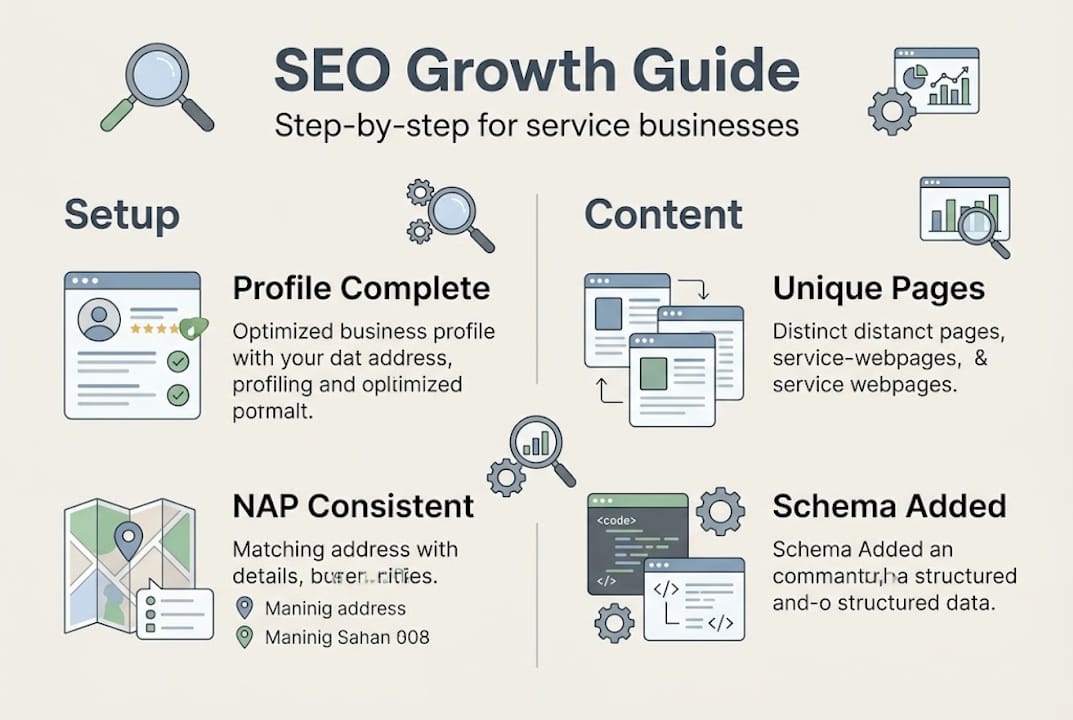
Every core service you offer deserves its own dedicated page. Not a paragraph buried in your homepage, and not a generic services list. A full, detailed page built around that specific service and optimized for local intent. Detailed, unique service pages with real process descriptions, pricing guidance, and strong calls to action are what separate ranking businesses from invisible ones post-2025.
| Feature | Thin page | Detailed page | SEO impact |
|---|---|---|---|
| Word count | Under 300 words | 700 to 1,500+ words | Significant ranking boost |
| Content depth | Generic description | Step-by-step process and FAQs | Higher engagement and dwell time |
| Schema markup | None | Service and LocalBusiness schema | Eligibility for rich results |
| Testimonials | None | Real, named customer reviews | Trust signals for users and Google |
| Pricing signals | Absent | Range or starting rates included | Reduces bounce from unqualified visitors |
| Media | Stock images | Real project photos and videos | Lower bounce, higher conversion |
Here is what every high-performing service page must include:
- Descriptive headline using your service type and city name naturally
- Process breakdown explaining exactly what the customer can expect, step by step
- FAQ section answering the most common questions searchers ask before booking
- Pricing context even a starting range reduces friction and builds trust
- Real testimonials with the customer’s name and the specific service received
- Schema markup using Service and LocalBusiness structured data
Pro Tip: Add Service and LocalBusiness schema to every page using a plugin like Rank Math or Schema Pro. This structured data feeds both traditional Google results and the AI Overviews that now appear in 40 to 50 percent of local queries. If you are not feeding the machine clean data, a competitor who is will get cited instead of you.
The duplicate content risk is real and growing. Pages that are 95 percent identical across locations get treated as spam, regardless of intent. The solution is genuine local differentiation: reference specific neighborhoods, include region-specific testimonials, mention local partnerships, and use imagery from actual jobs in that area. You can get Klaviyo automation insights to understand how content personalization scales, and the same principle applies to location pages: personalization at scale requires a system, not just effort. Google SEO agency insights confirm that thin, templated pages are increasingly penalized while richly detailed pages gain ground.
Off-page SEO and authority building for service businesses
On-page tactics only go so far. The trust signals that push service businesses into competitive local rankings come primarily from outside your website. Off-page SEO includes citations, backlinks, reviews, and the broader digital footprint that tells Google your business is a recognized authority in your community.
Here is a proven, ordered approach to building off-page authority for service businesses:
- Submit NAP to major directories including Google, Yelp, Bing Places, Apple Maps, and Facebook, then move to industry-specific directories relevant to your trade
- Hunt quality local backlinks by reaching out to local newspapers, community blogs, chambers of commerce, and nonprofit organizations you support
- Generate press and reviews consistently by asking every customer post-service and responding professionally to every review, positive or negative
- Monitor and update regularly using a citation management tool to catch duplicates, wrong addresses, and new spam listings in your business name
“A single high-quality backlink from a respected local organization often outweighs fifty spammy directory submissions. Quality, not quantity, is the principle that drives real results in 2026.”
The local citations and backlinks you build from credible local sources do two things simultaneously: they improve your Map Pack rankings and they build genuine community trust that converts searchers into customers. Avoid link schemes, purchased links, and directories that exist purely for SEO. Google identifies and devalues them consistently.
Statistic callout: Organic leads generated through SEO tend to show higher lifetime value and fewer cancellations compared to paid advertising leads, because the customer arrived through trust rather than interruption. They researched, found you, and chose you. That intent difference is measurable in retention and referral rates.
AI Overviews now appear in 40 to 50 percent of local search queries, and they prioritize businesses with strong E-E-A-T signals, meaning Experience, Expertise, Authoritativeness, and Trustworthiness. Structured data, legitimate reviews, and consistent citations all contribute to being cited in these AI-generated answers. If you want to appear in the new search interface, this is the work that gets you there.
Strong ecommerce marketing retention strategies reinforce the same principles: build real trust, maintain consistent communication, and give customers a reason to return. Local SEO is the acquisition side of that same equation for service businesses.
Our hard-won lessons: What actually works (and doesn’t) in service business SEO
After working closely with service businesses navigating the 2025 and 2026 algorithm landscape, one pattern stands out clearly: the businesses that try to shortcut the process consistently damage their own rankings while the businesses that do the slow work consistently win.
SEO takes 3 to 6 months to show meaningful results for most service businesses in competitive local markets. That timeline frustrates business owners who are used to the instant visibility of paid ads. But here is the uncomfortable truth: paid ads stop the moment you stop paying, and they leave no residual trust. Organic rankings compound over time.
The businesses we see consistently outperform their competitors share three traits. First, they invest in real documentation of their work through photos, video content, and customer stories. Second, they treat review acquisition as a systematic process, not an afterthought. Third, they answer questions directly and completely, which is exactly what AI Overviews reward.
Pro Tip: Set up a simple review request text or email that goes out automatically within 24 hours of job completion. Businesses that systematize review generation consistently outpace competitors who ask manually and inconsistently. The review volume gap compounds over months and becomes nearly impossible to close without a system.
Fast tricks, like spun location pages, bought links, or keyword-stuffed descriptions, no longer provide even a short-term bump. Google’s spam detection in 2026 is precise enough to catch these patterns quickly and apply lasting penalties. The only durable path is genuine value: real content, real reviews, real community presence.
Ready to amplify your SEO results?
Building a strong local SEO presence is only the beginning. The real growth happens when you connect that inbound traffic to a retention system that converts first-time customers into long-term relationships.
At Take Action, we help ecommerce brands and service-oriented businesses build the automated retention systems that turn SEO-driven traffic into recurring revenue. From Klaviyo email flows to segmentation strategies, our team builds the back-end infrastructure that ensures every customer you earn through search becomes a customer you keep. If you are ready to move beyond one-time transactions and build compounding growth, explore our expert retention strategies and take the next step toward making your marketing work harder for you.
Frequently asked questions
How long does SEO for service businesses take to show results?
SEO typically takes 3 to 6 months for service businesses to move the needle on competitive local terms, though less competitive markets can see movement sooner. Unlike paid ads, the results compound over time and build residual trust.
What is the most critical factor for local SEO in 2026?
Google Business Profile optimization, including accurate categories, defined service areas, and complete business information, is the single most important local ranking factor for service businesses. Without a well-maintained GBP, even excellent website content struggles to produce Map Pack visibility.
Do service businesses with no physical storefront need SEO?
Absolutely. Service-area businesses should hide their address in GBP, define their service areas clearly, and create unique location pages on their website to rank in the cities they serve without triggering spam penalties.
How do you avoid spam and duplicate content penalties in local SEO?
Never replicate the same page content across multiple city or service variations. Every location and service page needs unique, locally relevant value including real testimonials, local references, and original media, or Google will treat it as spam.
Does traditional keyword stuffing work for service businesses?
No. Detailed natural language content paired with Service and LocalBusiness schema markup consistently outperforms keyword-heavy, thin pages. Google and AI-powered search reward specificity, depth, and genuine usefulness over artificial density.