

Top benefits of email marketing for DTC brands
TL;DR:
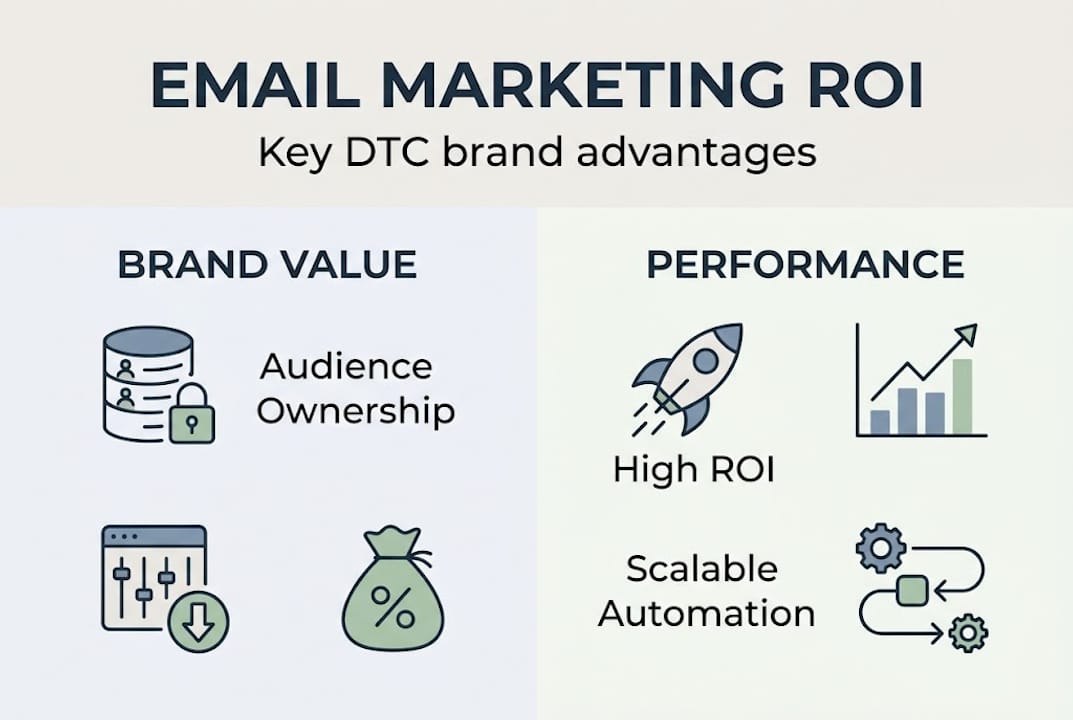
- Email marketing yields $36 to $42 return per $1 spent, outperforming social, display, and search.
- Owned email lists provide stable, high-margin, scalable revenue unaffected by platform algorithm changes.
- Automated flows like cart recovery and welcome series generate the majority of email-driven revenue and retention.
For DTC brands pouring budget into paid social, here’s a number worth stopping for: email marketing averages $36 to $42 back for every single dollar spent. That’s not a typo. While Instagram ads fight algorithm changes and rising CPMs, email sits quietly in the background, generating predictable, scalable revenue at margins that paid channels simply cannot match. The brands winning the retention game in 2026 are not the ones with the biggest ad budgets. They’re the ones who built email into a core revenue engine, and this article breaks down exactly how to do the same.
Table of Contents
- Why email marketing drives exceptional ROI for DTC brands
- The power of automation: Klaviyo flows and lifecycle revenue
- Personalization and segmentation: How to turn data into revenue
- Benchmarks, pitfalls, and strategies for sustainable email-driven growth
- What most DTC brands get wrong about email marketing ROI
- Accelerate retention and revenue with expert email strategy
- Frequently asked questions
Key Takeaways
| Point | Details |
|---|---|
| Best ROI channel | Email marketing consistently delivers the highest return on ad spend for ecommerce brands. |
| Automation multiplies revenue | Automated flows in Klaviyo drive substantial lifecycle sales from a small fraction of emails. |
| Personalization powers retention | Using real-time data for segmented, personalized journeys maximizes lifetime value and engagement. |
| Benchmarks guide growth | Tracking open, click, and order rates helps optimize strategy and outperform top brands. |
| Strategy beats discounts | Value-add content and smart segmentation prevent margin erosion and ensure long-term email-driven growth. |
Why email marketing drives exceptional ROI for DTC brands
Email consistently earns more per dollar than any other digital marketing channel available to DTC brands today. That’s not an opinion. The average return of $36 to $42 per $1 spent on email marketing puts it ahead of social ads, display, and even search in many ecommerce verticals. Paid social might generate awareness, but email closes the sale and brings customers back.
The reason email outperforms comes down to one critical concept: owned vs. rented channels. When you build a social following, you’re renting space on someone else’s platform. Algorithm shifts can cut your organic reach by 80% overnight, and there’s nothing you can do about it. Your email list is yours. No platform can take it away, and no algorithm change can suppress a well-segmented send.
Here’s how email stacks up against the competition:
| Channel | Average ROI | Cost control | Audience ownership |
|---|---|---|---|
| Email marketing | $36 to $42 per $1 | High | Full |
| Paid social | $2 to $4 per $1 | Medium | None |
| Display ads | $2 per $1 | Low | None |
| SMS marketing | $10 to $15 per $1 | High | Full |
For DTC brands specifically, email is also responsible for 20 to 47% of total ecommerce revenue when managed strategically. That’s nearly half of all sales driven through one channel that costs a fraction of paid media. Brands that treat email as a secondary channel are effectively leaving that revenue on the table every single month.
Key advantages of email as a DTC revenue channel:
- Predictable cost structure. You pay for your email platform, not per click. Sending to 10,000 subscribers or 100,000 costs roughly the same per send.
- Direct access to your audience. No bidding, no gatekeeping, no algorithmic suppression.
- Behavioral data at your fingertips. Every open, click, and purchase creates a data point you own and can act on.
- Compounding returns. A well-built flow generates revenue continuously without additional spend.
“Email is not just a communication channel. For DTC brands, it’s a revenue system that operates 24/7 without the volatility of paid ads.”
Pro Tip: If your brand generates less than 20% of revenue from email, treat that gap as untapped margin, not a secondary priority. Getting to 30 to 40% is achievable within 90 days with the right flow structure and segmentation.
The scalability argument is equally compelling. A paid social campaign requires ongoing creative refresh and budget increases to scale. An optimized email program scales through list growth and automation without proportional cost increases. For DTC brands with healthy acquisition funnels, this makes email the highest-leverage retention asset available.
The power of automation: Klaviyo flows and lifecycle revenue
Understanding the unique value of email is key, but efficiency and revenue get turbo-boosted when you embrace automation. Klaviyo flows are the backbone of any serious DTC email program, and the performance difference between automated flows and broadcast campaigns is staggering.

Automated flows in Klaviyo generate 41% of email revenue from just 5% of total email sends. Read that again. Five percent of sends, forty-one percent of revenue. The revenue per recipient (RPR) for flows averages $1.94 compared to $0.11 for standard campaigns. That’s an 18x difference in efficiency. Abandoned cart flows alone average $3.07 RPR, making them one of the single highest-returning automations in ecommerce. The math makes it non-negotiable: flows consistently outperform campaigns on every performance metric because they trigger at the right moment, for the right person, with the right message.
Here’s how to think about the core flow types and what each one contributes:
| Flow type | Primary goal | Average RPR | Timing |
|---|---|---|---|
| Welcome series | First purchase conversion | $0.80 to $2.00 | Immediate + days 3, 7 |
| Abandoned cart | Purchase recovery | $3.07 | 1 hour, 24 hours, 72 hours |
| Post-purchase | LTV, review, upsell | $0.50 to $1.50 | Day 3, 7, 30 |
| Win-back | Reactivation | $0.40 to $1.20 | 60, 90, 120 days lapsed |
Let’s look at what each flow actually does for your retention strategy:
- Welcome series. This is your brand’s first impression at scale. A three to five email sequence that introduces your story, sets expectations, and drives that critical first purchase. Brands with strong welcome sequences consistently see first-purchase conversion rates 2x higher than those with single welcome emails.
- Abandoned cart flow. The most direct revenue recovery tool in email. A shopper who added to cart already showed buying intent. A well-timed sequence (one hour, 24 hours, 72 hours) recovers 5 to 15% of abandoned carts on average. At $3.07 RPR, this flow alone can generate thousands in monthly recovered revenue.
- Post-purchase flow. Most brands stop emailing after the sale. Big mistake. Post-purchase flows build loyalty, generate reviews, introduce complementary products, and set the stage for repeat buying. This is where customer lifetime value (CLTV) gets built.
- Win-back flow. Customers who haven’t purchased in 60 to 120 days are drifting. A targeted win-back sequence with a personalized offer or value message reactivates a meaningful percentage before they’re lost for good.
You can find more real-world examples of how these sequences work in practice by reviewing automated workflows examples from brands that have built them at scale. For choosing the right platform, a detailed automation tools comparison can also help narrow your decision.
Pro Tip: Start with abandoned cart and welcome flows first. These two alone typically account for 60 to 70% of flow-driven revenue. Build and optimize them before layering on post-purchase and win-back sequences.
Personalization and segmentation: How to turn data into revenue
Automation supercharges results, but precision targeting creates even more value. Here’s how personalization and smart segmentation elevate your email game. Generic email blasts are a thing of the past. Modern DTC brands using Klaviyo have access to a level of personalization that was previously reserved for enterprise retailers with seven-figure tech stacks.
Klaviyo’s native integration with Shopify enables real-time behavioral segmentation that powers truly 1:1 customer journeys at scale. Every browse event, purchase, cart action, and product view flows into Klaviyo automatically. This means you can send a “you viewed this but didn’t buy” email within an hour, or trigger a product replenishment reminder based on average days-to-reorder from a customer’s purchase history.
Here’s a practical breakdown of how segmentation improves key metrics:
| Segment type | Example | Impact on open rate | Impact on conversion |
|---|---|---|---|
| Purchase history | Repeat buyers vs. first-time | +12 to 18% | +20 to 35% |
| Browse behavior | Viewed category X, no purchase | +15 to 25% | High intent conversion |
| RFM scoring | High-value recent buyers | +20% | Upsell and cross-sell lift |
| Zero-party data | Quiz results or preferences | +18 to 30% | +25% CLTV improvement |
Zero-party data deserves special attention here. Unlike behavioral data that you infer from actions, zero-party data is information customers actively give you, like quiz results, preference surveys, or profile questions. Brands that integrate quiz-based segmentation see significant returns: combining real-time behavioral targeting with zero-party data boosts customer lifetime value by 25%. That’s not a marginal improvement. That’s compounding revenue from every customer over their full lifetime with your brand.
Practical segmentation strategies to implement in Klaviyo right now:
- VIP buyers. Anyone who has purchased 3 or more times or spent above a dollar threshold. These customers deserve early access, exclusive offers, and loyalty recognition.
- Category browsers. Segment by the product categories someone has viewed but not purchased. Send relevant content and offers around those specific interests.
- Lapsed high-value customers. Someone who spent a lot but hasn’t returned in 90 days is a high-priority win-back target. They’re worth more effort than a first-time visitor.
- Engaged non-purchasers. Subscribers who open and click but haven’t bought yet are warm leads. A targeted incentive or proof-based campaign often converts them.
For a deeper look at how to execute these Klaviyo personalization strategies in 2026, the specific segmentation logic and conditional splits inside Klaviyo make it the most powerful tool available to DTC brands at any stage.
Pro Tip: Run a list cleaning cycle every quarter. Remove or suppress unengaged subscribers who haven’t opened in 180 days. A smaller, more engaged list will always outperform a large, stale one on every metric that matters.
Benchmarks, pitfalls, and strategies for sustainable email-driven growth
Personalization maximizes impact, but sustainable growth means learning from data, avoiding pitfalls, and applying a proven strategy for your email program. Knowing your numbers is the foundation of every successful email program. Without benchmarks, you’re flying blind.
Here’s what Klaviyo data shows for ecommerce email performance across campaigns and flows:
| Metric | Campaigns (avg) | Flows (avg) | Top 10% flows |
|---|---|---|---|
| Open rate | 31% | 38 to 42% | 50%+ |
| Click rate | 1.69% | 5.58% | 8 to 12% |
| Order rate | 0.16% | 2.11% | 4%+ |
| RPR | $0.11 | $1.94 | $0.97 to $7.79 |
These Klaviyo benchmarks make it clear: flows are not a “nice to have” alongside campaigns. They’re the primary revenue driver. Top-performing brands use campaigns for culture, content, and brand building, while letting flows do the heavy lifting on conversion and retention.
What do the top brands actually do differently? A few patterns stand out:
- They mix promotional offers with educational and entertainment content. Not every email is a sale.
- They segment aggressively. Different messages go to VIPs, first-time buyers, and lapsed customers simultaneously.
- They A/B test subject lines, send times, and offer types consistently, not just once.
- They track RPR as their north star metric, not open rate. Opens are vanity. Revenue per recipient is reality.
The biggest pitfall we see across DTC brands is over-discounting. Running a 20% off promotion every week does three damaging things: it trains customers to wait for sales, it erodes your margins, and it devalues your brand positioning. Experts recommend leading with value-adds like helpful tips, free shipping, or loyalty recognition before reaching for the discount lever. Reserve percentage-off offers for specific win-back or reactivation scenarios where the math justifies it.
“The brands that win at email long-term are not the most generous with discounts. They’re the most consistent with relevance and timing.”
A practical framework for sustainable email growth:
- Set up your core flows first. Welcome, abandoned cart, post-purchase. These three generate the majority of automated revenue.
- Segment before you broadcast. Every campaign should have a clearly defined audience based on building an email list and behavior, not just “everyone.”
- A/B test your incentives. Free shipping vs. percentage off, content-first vs. offer-first. Let data decide.
- Track RPR above all else. This single metric from the agency methodology for evaluating email programs tells you exactly which flows and segments are generating real business value.
- Review and iterate monthly. Email is not set and forget. Monthly performance reviews catch declining flows before they cost you.
Pro Tip: If your abandoned cart flow RPR drops below $1.50, it’s a signal to test your copy, offer, or timing. A well-maintained cart recovery flow should consistently sit above $2.00.
What most DTC brands get wrong about email marketing ROI
Here’s the uncomfortable truth: most DTC brands treat email like a bulletin board. They set up a basic flow, send a weekly promotion to their whole list, and call it a retention strategy. Then they wonder why email only generates 10 to 15% of revenue while competitors are hitting 35 to 40%.
The misconception is that email is passive. That once the flows are live and the welcome series is sending, the work is done. In reality, the brands generating the highest email revenue are running continuous optimization cycles: testing subject lines, refining segments, updating flow content seasonally, and analyzing RPR by audience cohort every single month. Email outperforms social and SMS not just because of cost structure, but because of how much behavioral data it generates for you to act on.
List maintenance is another area where most brands fall short. A bloated list full of unengaged subscribers suppresses deliverability and inflates your platform costs. Sophisticated personalization strategies always start with a clean, segmented list where every send is intentional. The brands that see the highest ROI from email are not the ones with the biggest lists. They’re the ones with the most engaged ones. Sustainable email revenue comes from relentless optimization, not from flipping on Klaviyo and walking away.
Accelerate retention and revenue with expert email strategy
Building a high-performing email program takes more than a good platform and basic flows. The difference between 15% and 40% of revenue from email comes down to strategy, execution, and the kind of ongoing optimization most internal teams simply don’t have bandwidth for.
At Take Action, we specialize in building exactly that kind of email infrastructure for DTC brands. As a dedicated email marketing agency, we work inside Klaviyo every day, setting up flows, segmenting audiences, and dialing in campaigns that convert. Whether you need a full email program built from scratch or a strategic audit of what’s already running, our team of DTC retention experts brings the data-driven approach and creative execution to turn your email channel into a predictable revenue engine. If you’re ready to stop leaving retention revenue on the table, let’s talk.
Frequently asked questions
What is the average ROI of email marketing for ecommerce?
Email marketing delivers an average $36 to $42 return for every $1 spent, significantly outperforming paid social and display advertising channels.
How much ecommerce revenue comes from email?
Email typically drives 20 to 47% of DTC ecommerce revenue, with top-performing brands using Klaviyo flows consistently reaching the 30 to 40% range.
Which automated flows provide the best results in Klaviyo?
Welcome, cart recovery, and post-purchase flows drive the highest returns, with automated flows generating 41% of email revenue from only 5% of total sends.
How does personalization impact email results?
Personalized emails using behavioral and zero-party data can boost customer lifetime value by 25% or more, making segmentation one of the highest-leverage activities in your email program.