

What Is a Promotional Email? A Guide for Marketers
TL;DR:
- Promotional emails are marketing messages aimed at driving specific conversions, such as purchases or signups. Proper segmentation, a clear single CTA, and subject-line testing are critical for effective performance. Compliance with legal requirements like CAN-SPAM ensures these campaigns stay in the inbox and maintain reputation.
A promotional email is a marketing message sent to drive a specific conversion, whether that’s a purchase, a signup, a download, or an event registration. According to Campaign Monitor and ActiveCampaign, these are the workhorses of email marketing: brand-initiated, conversion-focused, and distinct from transactional emails, which are triggered by user actions like order confirmations or password resets. Transactional messages inform; promotional messages persuade.
The distinction matters more than it sounds. Mixing promotional content into a transactional email can create compliance risk under CAN-SPAM and hurt your sender reputation. What follows is a practical guide covering every type of promotional email, how to write one, what to measure, and a 7-day execution plan you can run with immediately.

Table of Contents
- What types of promotional emails should you send?
- How to write a promotional email that actually converts
- A quick checklist for subject lines, preheaders, and CTAs
- Common mistakes that kill promotional email performance
- How to measure whether your promotional email worked
- Promotional email templates you can use right now
- U.S. legal requirements for promotional emails
- A 7-day campaign playbook from Take-action
- Key Takeaways
- What actually drives promotional email results
- Useful sources for further reading
What types of promotional emails should you send?
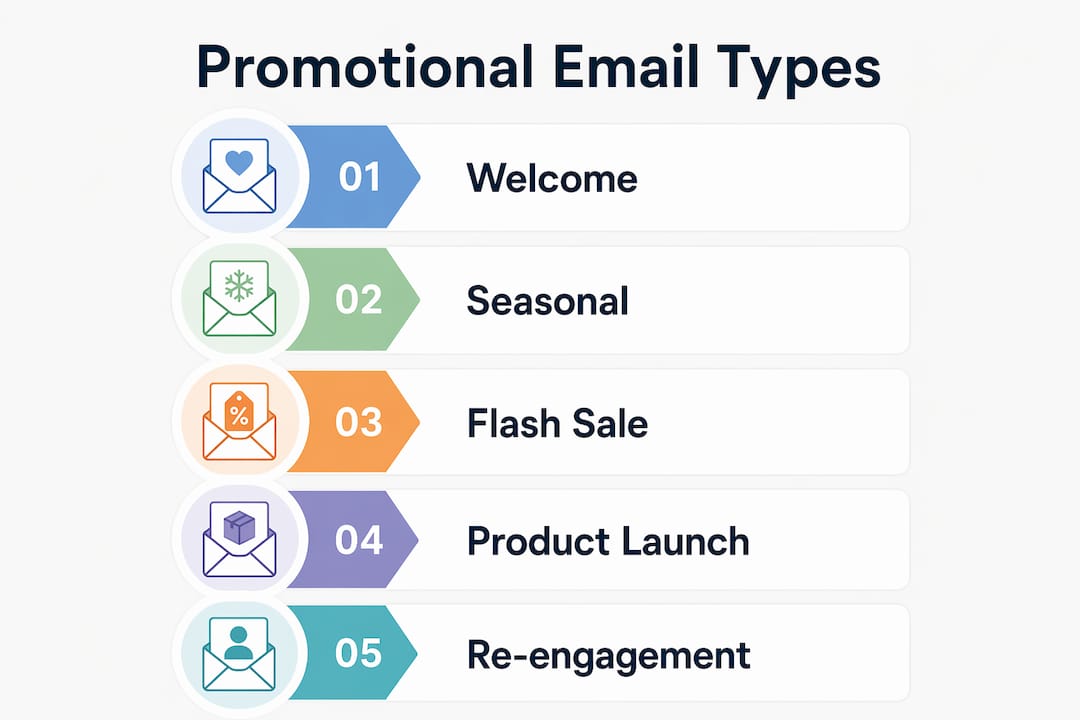
Promotional emails come in several formats, and the right one depends on where your subscriber sits in the buyer’s journey. Here are the most common types, each with a typical conversion goal:
- Discount or sale announcement. Example: a limited-time discount offer. Goal: immediate purchase. Best at the conversion stage for warm subscribers.
- Product launch. Example: “Introducing our new fall collection, available now.” Goal: first purchase or pre-order. Works at awareness and consideration stages.
- Newsletter with a promotion embedded. Example: a content-rich email that leads with a tip, then surfaces a limited offer. Goal: click-through and purchase. Useful for nurturing subscribers who aren’t ready to buy yet.
- Event or webinar invite. Example: an invitation to a live masterclass on a specific date. Goal: registration. Fits awareness and consideration stages.
- Content promotion. Example: “Our new guide to email segmentation is live, grab it free.” Goal: download or site visit. Works well for lead generation and top-of-funnel nurturing.
- Abandoned-cart reminder. Example: a reminder about an abandoned cart with an incentive to complete the purchase. Goal: recovered purchase. Conversion stage, high intent.
- Reactivation or win-back. Example: “We miss you. Here’s a reason to come back.” Goal: re-engagement or purchase from a lapsed subscriber. Retention stage.
Each of these promotional email formats serves a different moment in the customer relationship. The mistake most marketers make is defaulting to discounts when a product launch or content email would do more for long-term brand equity.
How to write a promotional email that actually converts
Writing a promotional email that performs comes down to a clear sequence. Skip a step and the whole thing falls apart.
- Define your goal first. Are you driving a purchase, a registration, or a download? One email, one goal. If you find yourself writing two CTAs, you have two emails.
- Pick your segment. Who specifically is receiving this? New subscribers, lapsed buyers, and loyal customers all need different offers and tones. Behavioral segmentation based on purchase history and browsing data consistently outperforms blanket sends.
- Craft a single-minded offer. The offer should be clear in one sentence. If you need three sentences to explain the deal, simplify the deal.
- Write the subject line. This is your gatekeeper. Drip’s research confirms that subject lines failing to communicate value or urgency kill open rates before the email gets a chance. Keep it under 50 characters for mobile, lead with the benefit, and plan an A/B test from day one.
- Write benefit-first body copy. Open with what the reader gets, not who you are. Three to four short paragraphs maximum. Use headers or short bullets to make it scannable.
- Add one primary CTA. Place it above the fold and repeat it once at the bottom. The button copy should reduce friction: “Get 20% off” beats “Click here.”
- Write the preheader. This is the second subject line. Use it to extend the offer or add urgency, not to repeat the subject line verbatim.
Pro Tip: Test your email on a mobile device before sending. Buttons should be at least 44px tall, images should have descriptive ALT text (so the message works even when images are blocked), and your most important information should appear in the first 100 pixels of the email body.
Matching the offer to where the subscriber is in their journey is what separates a promotional email that feels relevant from one that feels like spam. Constant Contact puts it well: effective campaigns tell a short, relevant story rather than just dropping a discount.
A quick checklist for subject lines, preheaders, and CTAs
Use this checklist while editing any promotional email before it goes out.
Subject lines:
- Lead with the benefit or the offer, not your brand name
- Keep it under 50 characters for mobile inboxes
- Avoid spam-trigger words: “FREE!!!”, “Act now”, “Guaranteed”
- Test at least two versions before your main send
Three high-converting subject-line formulas:
- Benefit-led: “Get 30% off your next order, today only”
- Curiosity + value: “The one thing your cart is missing”
- Urgency/limited quantity: “Only 12 left, and your discount expires tonight”
Preheader:
- Extend the subject line’s promise, don’t repeat it
- 85–100 characters is the sweet spot for most email clients
- Use it to add a secondary hook or a deadline
CTA:
- One button per email (two at most, same destination)
- Use action verbs: “Shop now,” “Claim your discount,” “Reserve my spot”
- Button color should contrast sharply with the background
- Test button copy variations: “Get 20% off” vs. “Claim my offer”
The subject line best practices that consistently lift open rates share one trait: they make a specific promise the reader can verify in 30 seconds of opening.

Common mistakes that kill promotional email performance
Most promotional email failures trace back to a short list of avoidable errors.
- Unclear offer. If a subscriber has to read twice to understand what you’re offering, the email is already losing. State the deal in the first sentence.
- Too many CTAs. Three buttons pointing to three different pages split attention and reduce total clicks. Pick one destination.
- Blast mentality. Sending the same email to your entire list ignores purchase history, engagement level, and lifecycle stage. Segmentation based on behavioral data reduces spam complaints and raises click rates.
- Ignoring deliverability signals. High unsubscribe rates and spam complaints damage your sender reputation over time. Watch these numbers after every send.
- Weak subject lines. A subject line that is vague, too long, or misleading is the single fastest way to tank an open rate.
- Sending too frequently. Emailing your full list every day trains subscribers to ignore you or unsubscribe. Frequency should match engagement level.
- Heavy HTML and image-only emails. Emails that are mostly images often land in spam and render poorly on some clients. Balance images with live text.
Pro Tip: Before your next send, pull your list into at least three segments: active buyers (purchased in the last 90 days), engaged non-buyers (opened but never purchased), and lapsed subscribers (no opens in 90+ days). Each group should get a different message, or at minimum a different subject line. This one change typically reduces unsubscribes and improves relevance scores.
How to measure whether your promotional email worked
Tracking the right KPIs tells you not just whether an email performed, but why it did or didn’t.
- Open rate. Measures subject line and sender reputation effectiveness. A high open rate with low clicks usually signals a messaging mismatch: the subject promised something the body didn’t deliver.
- Click-through rate (CTR). The clearest signal of body copy and CTA effectiveness. This is the metric to watch for awareness and consideration campaigns.
- Conversion rate. Percentage of recipients who completed the desired action (purchase, signup). The primary KPI for revenue-focused sends.
- Revenue per email (RPE). Total revenue divided by emails delivered. Useful for comparing campaign types and justifying list investment.
- Deliverability rate. Percentage of emails that reached the inbox. Below 95% warrants immediate investigation.
- Unsubscribe rate. A spike after a send signals frequency or relevance problems.
- Spam complaint rate. Keep this below 0.1%. Above that, inbox providers start filtering your mail.
For A/B testing, prioritize in this order: subject line first (highest leverage, fastest results), then offer framing, then CTA copy. A simple test plan: split your list 50/50, send both versions simultaneously, wait 4 hours, and declare a winner based on open rate (for subject line tests) or CTR (for body and CTA tests). The 2026 campaign best practices guide from Take-action covers testing cadence and send-window optimization in more detail.
Promotional email templates you can use right now
These four templates are starting points. Personalize the offer, adjust the tone to your brand, and run an A/B test on the subject line before your main send.
Template 1: Limited-time discount
- Subject: Your discount offer expires tonight
- Body: “We’re giving our best customers a 25% discount on everything in the store, but only until midnight tonight. No code needed, the discount applies automatically at checkout. This is the lowest price we’ll offer all season.”
- CTA: “Shop now and save 25%”
- Segment: Active buyers from the last 6 months
- A/B test idea: Test “expires at midnight” vs. “last chance today”
Template 2: New product launch
- Subject: “It’s here: [Product Name] is officially live”
- Body: “After months of development, [Product Name] is available now. It was built to solve [specific problem], and early customers are already seeing results. You’re among the first to get access.”
- CTA: “See [Product Name] now”
- Segment: Engaged subscribers who haven’t purchased recently
- A/B test idea: Test curiosity-led subject (“Something new just dropped”) vs. direct announcement
Template 3: Abandoned-cart reminder
- Subject: “You left something behind”
- Body: “Your cart is still waiting. The items you picked are popular and stock is limited. Complete your order in the next 24 hours and we’ll cover standard shipping.”
- CTA: “Complete my order”
- Segment: Subscribers who added to cart but didn’t purchase within 2 hours
- A/B test idea: Test free shipping offer vs. 10% discount as the incentive
Template 4: Win-back / reactivation
- Subject: “We haven’t heard from you in a while”
- Body: “It’s been a few months since your last visit, and we want to change that. Here’s a personal offer just for you: 15% off your next order, valid for the next 7 days. No strings attached.”
- CTA: Claim my exclusive discount
- Segment: Subscribers with no opens or purchases in 90+ days
- A/B test idea: Test discount offer vs. “what did we miss?” curiosity subject line
For ecommerce newsletter ideas that blend content with promotion, Take-action’s blog has a dedicated breakdown worth bookmarking.
U.S. legal requirements for promotional emails
Every promotional email sent to a U.S. audience must comply with the CAN-SPAM Act. The requirements are straightforward, but violations carry significant penalties per email.
- No deceptive headers or subject lines. The “From” name, reply-to address, and subject line must accurately represent who is sending the email and what it contains.
- Identify the message as an advertisement when required. If the recipient hasn’t explicitly opted in to receive marketing from you, the email must be clearly identified as an ad.
- Include a valid physical postal address. A P.O. box is acceptable; a fake or missing address is not.
- Include a clear, working unsubscribe mechanism. The opt-out link must function for at least 30 days after sending, and you must honor unsubscribe requests within 10 business days.
- Do not embed promotional content in transactional emails. A message that is primarily promotional must follow promotional email rules, even if it contains some transactional information.
CAN-SPAM compliance is not optional, and it is not complicated. The FTC’s official compliance guide covers every requirement in plain language. The most common violation is a missing or broken unsubscribe link. Check it every time before you send.
The transactional vs. promotional distinction matters for compliance. A shipping confirmation is transactional; adding a discount code to that same email can shift its classification to promotional under CAN-SPAM, which changes the rules that apply. When in doubt, keep them separate. For a deeper look at ethical email marketing practices, Take-action’s guide covers permission-based list building and subscriber respect in detail.
A 7-day campaign playbook from Take-action
This is the execution plan Take-action uses with clients launching a new promotional campaign from scratch.
Campaign checklist (complete before Day 1):
- Define the single conversion goal
- Write the offer in one sentence
- Identify the target segment
- Draft two subject line variations
- Write the preheader
- Build or select the creative template
- Set up the A/B test parameters
- Confirm send window (day of week, time of day)
- Run deliverability checks (SPF, DKIM, DMARC)
- Schedule post-send analysis for 48 hours after send
7-day timeline:
- Day 1 — Strategy. Lock the goal, offer, and segment. Write the creative brief.
- Day 2 — Copy and design. Write body copy, subject lines, preheader, and CTA. Build the email in your platform.
- Day 3 — QA and accessibility. Check rendering on mobile and desktop. Verify all links. Confirm ALT text on every image.
- Day 4 — Seed testing. Send to internal seed addresses across major email clients (Gmail, Outlook, Apple Mail). Fix any rendering issues.
- Day 5 — Audience segmentation. Finalize the send list. Suppress recent purchasers if the offer doesn’t apply to them.
- Day 6 — Send. Launch the A/B test to 20% of the list. After 4 hours, send the winning version to the remaining 80%.
- Day 7 — Post-send analysis. Review open rate, CTR, conversion rate, and unsubscribes. Document findings for the next campaign.
Troubleshooting quick fixes:
- Low opens: Test a new subject line; check sender reputation and list hygiene
- Low clicks: Revisit the offer clarity and CTA placement; reduce competing links
- Deliverability problems: Audit authentication records (SPF/DKIM/DMARC); reduce send volume temporarily and re-engage only active subscribers first
Key Takeaways
A promotional email is a brand-initiated marketing message designed to drive a specific conversion, and its performance depends on segmentation, a single clear CTA, and subject-line testing above all else.
| Point | Details |
|---|---|
| Core definition | A promotional email drives a conversion (purchase, signup, download) and differs from transactional emails, which are triggered by user actions. |
| Segmentation first | Behavioral segments based on purchase history and engagement outperform blanket sends and reduce spam complaints. |
| One CTA per email | Multiple CTAs split attention and reduce total clicks; pick one destination and repeat the button twice at most. |
| Test subject lines early | Subject lines are the primary gatekeeper; A/B test two versions on every send to build a performance baseline. |
| Watch CTR and conversion rate | After every campaign, CTR reveals body copy effectiveness; conversion rate reveals whether the offer landed. |
What actually drives promotional email results
The conventional wisdom says promotional emails are about the offer. Get the discount right, and the rest follows. That framing misses the bigger lever.
The brands that consistently outperform on email are not the ones with the deepest discounts. They are the ones who send the right message to the right segment at the right moment. A 10% discount sent to a subscriber who bought yesterday is noise. The same 10% sent to someone who abandoned a cart three hours ago is revenue. The difference is not the offer; it is the targeting.
There is also a long-term cost to over-discounting that most marketers underestimate. Training your list to wait for sales erodes full-price purchase behavior over time. The better play is to use promotional emails to tell a short, relevant story, as Constant Contact frames it, and reserve the discount for moments when it genuinely accelerates a decision rather than replacing one.
Take-action works with ecommerce brands on exactly this problem: building email marketing systems that use segmentation and automation to make every promotional send feel personal rather than broadcast. The results clients see most consistently are not from one great campaign but from the compounding effect of better segmentation, tighter subject lines, and a disciplined single-CTA approach applied consistently over months.
Permission-based lists and genuine respect for subscriber preferences are not just ethical choices. They are the foundation of a sender reputation that keeps your emails in the inbox rather than the spam folder.
Useful sources for further reading
- Campaign Monitor Glossary: Promotional Email — Clean one-sentence definition and contrast with transactional emails; good starting reference.
- ActiveCampaign Glossary: Promotional Email — Covers marketing intent and the role of promotional emails in the broader email program.
- Drip Blog: Promotional Email Best Practices — Practical subject-line guidance, templates, and A/B test ideas.
- Constant Contact: Promotional Email Strategy and Examples — Strong on buyer-journey framing and campaign storytelling.
- Klaviyo Blog: Email Segmentation Examples — Best resource for behavioral segmentation tactics and lifecycle management.
- FTC: CAN-SPAM Act Compliance Guide — The official U.S. legal reference; read this before sending to any U.S. list.
- Take-action Blog: Email Campaign Best Practices for 2026 — Practitioner-level guidance on send cadence, testing, and lifecycle flows.
This article is general marketing information, not legal advice. Confirm current CAN-SPAM requirements with the FTC’s official guidance or a qualified attorney for your specific situation.