

What is branded content marketing: ecommerce retention guide
Ecommerce marketers often confuse branded content marketing with traditional content marketing, missing its unique power to build emotional connections and drive retention. While most content aims to generate leads or educate buyers, branded content marketing focuses on subtle storytelling that reinforces your brand identity without overt selling. This guide clarifies what branded content marketing truly is, how it differs from conventional approaches, and how you can leverage it in email flows to boost customer lifetime value and revenue for your direct to consumer brand.
Table of Contents
- Key takeaways
- Understanding branded content marketing: definition and core principles
- How branded content marketing differs from traditional content marketing
- Applying branded content marketing in ecommerce email strategies
- Challenges and expert nuances in branded content marketing
- Unlock the power of branded content with expert email marketing help
- Frequently asked questions
Key Takeaways
| Point | Details |
|---|---|
| Branded content defined | Branded content is content created or funded by a brand that educates, entertains, or provides utility while subtly reinforcing the brand identity. |
| Core mechanics | It rests on three mechanics: consistent brand alignment, non interruptive audience first storytelling, and native feeling in placement. |
| Email use cases | In ecommerce, post purchase emails together with videos and guides should teach value and help customers maximize product benefits to boost retention and revenue. |
| Differences from traditional | Branded content builds emotional connection through value while traditional content marketing focuses on lead generation and overt promotions. |
Understanding branded content marketing: definition and core principles
Branded content marketing is content created or funded by a brand that delivers value through education, entertainment, or utility while subtly reinforcing the brand’s identity. Unlike interruptive ads that scream for attention, branded content earns engagement by prioritizing audience benefit first. The brand becomes part of the story rather than the entire message.
Three fundamental mechanics define effective branded content. First, consistent brand alignment ensures every piece reflects your visual identity, tone, and messaging without deviation. Second, non-interruptive delivery and audience-first storytelling formats keep the focus on what readers or viewers gain. Third, the content must feel native to where it appears, whether that’s an article, video, podcast, short film, or interactive tool.
For ecommerce brands, this translates to emails that teach customers how to get more from their purchases, videos showcasing real customer stories, or guides that solve problems related to your product category. The key is making your brand presence feel natural and earned rather than forced. When a customer reads your post-purchase email about maximizing product benefits, they should feel helped, not sold to.
“Branded content succeeds when it creates emotional resonance and builds trust through value delivery, not when it interrupts with sales pitches.”
Common formats for branded content include how-to articles that feature your products as solutions, behind-the-scenes videos that humanize your brand story, customer spotlight features that celebrate your community, educational webinars that establish thought leadership, and interactive quizzes or tools that engage while subtly showcasing brand values. Each format serves the audience first while naturally reinforcing who you are as a brand.
Pro Tip: The moment your branded content feels like a sales pitch, you’ve lost the magic. Focus on genuine value and let brand affinity grow organically through repeated positive experiences. Your content marketing ecommerce growth strategy should blend educational content with subtle brand storytelling for maximum retention impact.
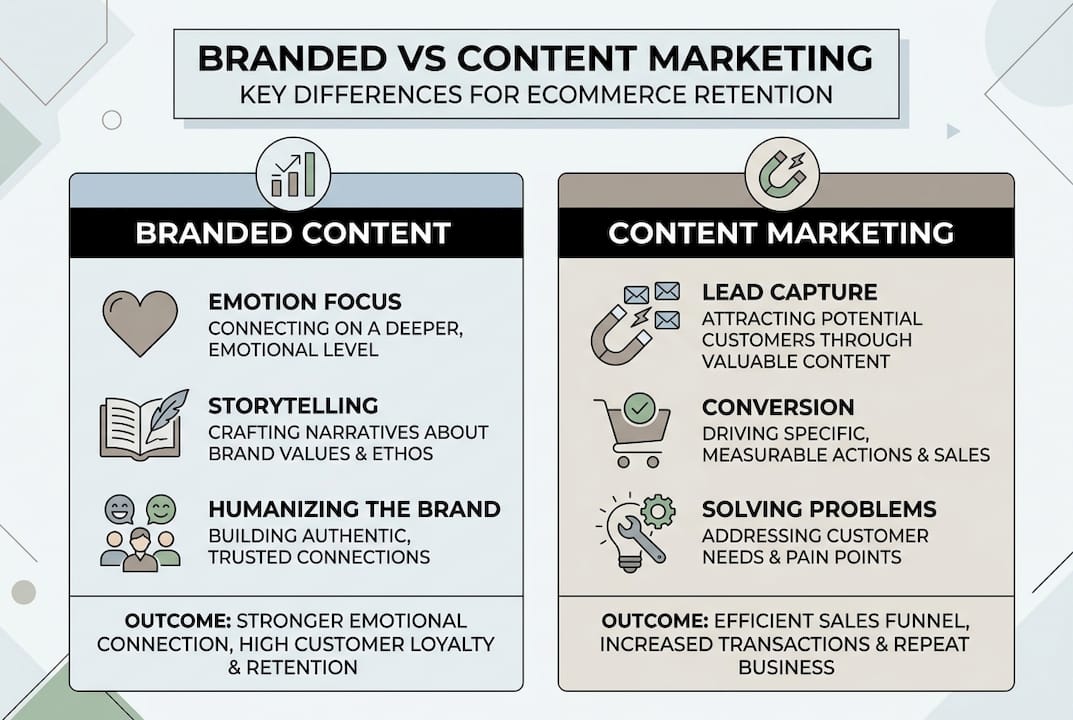
Understanding the distinction between branded content and content marketing helps you deploy each strategically. Branded content builds the emotional foundation that makes all other marketing more effective.
How branded content marketing differs from traditional content marketing
The confusion between branded content and traditional content marketing costs ecommerce brands real retention opportunities. Branded content builds affinity through subtle presence and storytelling, while content marketing drives demand with helpful but clearly promotional brand information. Both have value, but they serve different strategic purposes in your customer journey.
Traditional content marketing prioritizes lead generation and conversion. Blog posts answer search queries to capture prospects, guides offer solutions in exchange for email addresses, and case studies showcase product benefits to move buyers toward purchase. The brand presence is overt and intentional. You want readers to know exactly who you are and what you offer.
Branded content takes a different path. It builds thought leadership and emotional connection by entertaining or educating without obvious selling. A skincare brand might produce a documentary about self-care routines without mentioning products until subtle end credits. An outdoor gear company could create adventure guides that inspire travel while naturally featuring their equipment in use.

| Aspect | Branded Content Marketing | Traditional Content Marketing |
|---|---|---|
| Primary purpose | Build brand affinity and trust | Generate leads and drive conversions |
| Brand presence | Subtle, integrated naturally | Overt, clearly promotional |
| Tone and style | Storytelling, entertainment-focused | Educational, solution-focused |
| Typical formats | Videos, podcasts, short films, native articles | Blog posts, whitepapers, case studies, guides |
| Buyer journey stage | Full funnel, especially retention and advocacy | Awareness through consideration |
| Success metrics | Engagement, brand lift, retention rates | Leads, conversions, revenue attribution |
The strategic difference matters for your email program. Content marketing emails promote new blog posts, announce product launches, or share educational resources with clear calls to action. Branded content emails tell customer stories, share brand values through narrative, or provide lifestyle content that happens to align with your products.
Both approaches support different stages of the customer relationship. Use content marketing to attract and convert new customers. Deploy branded content to deepen relationships with existing customers, turning them into advocates who stay longer and spend more. Your content strategy agency ecommerce approach should integrate both for comprehensive growth.
Pro Tip: Don’t force a choice between branded content and content marketing. Use content marketing for demand creation and branded content for retention and advocacy. The combination creates a complete customer experience that attracts, converts, and keeps valuable buyers.
The real power emerges when you understand which tool serves which goal. Branded content excels at the emotional work that keeps customers coming back, while content marketing drives the rational decision-making that brings them in initially.
Applying branded content marketing in ecommerce email strategies
Email remains your most direct channel for deploying branded content that builds retention and revenue. Branded content in post-purchase and nurture flows boosts repeat purchases and can drive 25 to 45% of total revenue when executed strategically. The key is matching content type to customer lifecycle stage.
Post-purchase emails offer prime real estate for branded content. Instead of immediately pushing the next sale, share stories about how other customers use the product, offer styling or usage tips that enhance satisfaction, or provide educational content that deepens product knowledge. This builds affinity when customers are most receptive, right after they’ve invested in your brand.
Where branded content excels in email sequences:
- Post-purchase education flows that teach customers to maximize product value, featuring real user stories and creative applications
- Win-back campaigns that reconnect lapsed customers through brand story updates, community highlights, or values-based content rather than discount desperation
- Nurture sequences that build relationship depth with lifestyle content, behind-the-scenes access, or thought leadership that positions your brand as a trusted advisor
- Anniversary or milestone emails that celebrate customer relationships with personalized stories and exclusive content access
- Community spotlight series that feature customer stories, user-generated content, or brand ambassador profiles to strengthen belonging
The numbers prove the approach works. Automated email flows generate over 30% revenue from about 2% of total email volume, illustrating exceptional efficiency when content resonates. Email marketing delivers $36 to $45 for every dollar spent, making it the highest ROI channel for most ecommerce brands.
Best practices for integrating branded content without sounding forced:
- Lead with genuine value in subject lines and preview text, avoiding sales language
- Use storytelling frameworks that feature customers as heroes, not your products
- Include visual content like photos or videos that show rather than tell your brand story
- Maintain consistent brand voice and aesthetic across all touchpoints
- Test content themes to identify what resonates most with your specific audience segments
- Balance branded content with transactional emails to avoid overwhelming subscribers
Pro Tip: Map branded content themes to customer lifecycle stages for maximum impact. New customers need education and reassurance, engaged customers want community and insider access, and at-risk customers respond to reconnection through shared values. Your ecommerce newsletter ideas for higher retention should reflect these different needs.
The strategic advantage comes from using automation to deliver personalized branded content at scale. Segment your audience by purchase history, engagement level, and preferences, then serve relevant content that feels handcrafted. This combination of human storytelling and automated delivery creates efficiency without sacrificing authenticity.
Effective content creation in marketing requires understanding both what to say and when to say it. Branded content in email works because it meets customers where they are, building the emotional foundation that drives long-term value.
Challenges and expert nuances in branded content marketing
Branded content marketing fails when executed inauthentically or forced into contexts where it doesn’t belong. Loss of authenticity breaks immersion and erodes the trust you’re trying to build. The biggest risk comes from treating branded content as just another promotional channel rather than a relationship-building tool.
Common pitfalls undermine even well-intentioned branded content programs. Over-reliance on AI to generate content strips away the human voice and authentic perspective that makes branded content work. Generic storytelling that could apply to any brand in your category fails to differentiate or create meaningful connection. Neglecting FTC disclosure requirements when content involves partnerships or sponsorships creates legal and trust issues.
Operational challenges compound creative ones. Fragmented content creation across teams leads to inconsistent brand voice and visual identity. Without centralized systems, branded content can contradict other marketing messages or fail to align with current brand positioning. Digital asset management and operational consistency become critical for maintaining quality at scale.
Key pitfalls to avoid:
- Forcing product mentions into stories where they don’t naturally fit
- Using branded content as thinly veiled advertising rather than genuine value delivery
- Ignoring audience feedback and engagement signals that reveal content preferences
- Failing to disclose brand relationships or sponsored elements transparently
- Letting AI generate content without substantial human editing and authentic voice injection
- Creating branded content without clear strategic alignment to business goals
- Neglecting measurement and optimization based on retention and engagement metrics
“Authenticity is the cornerstone of branded content success. The moment your audience detects manipulation or forced selling, you’ve destroyed the very trust you aimed to build.”
Expert nuances separate effective branded content from wasted effort. First, recognize that branded content works across the full funnel, not just top-of-funnel awareness. Post-purchase branded content often delivers higher ROI than acquisition-focused content because it targets customers already invested in your brand. Second, consistency matters more than frequency. Better to send one exceptional branded content piece monthly than weekly mediocre attempts.
Third, personalization amplifies branded content effectiveness. Segment your audience and tailor content themes to different customer groups rather than broadcasting generic stories. A customer who bought running shoes wants different branded content than someone who purchased hiking boots, even from the same outdoor brand. Fourth, measure the right metrics. Branded content success shows up in retention rates, repeat purchase behavior, and customer lifetime value, not just opens and clicks.
Your content creation agencies retention growth strategy must balance creativity with operational discipline. Establish clear brand guidelines, invest in quality production, and maintain authentic voice while leveraging automation for distribution efficiency.
Pro Tip: Build a content review process that evaluates every piece against two questions: Does this deliver genuine value to our audience? Does this feel authentically aligned with our brand? If either answer is no, revise or scrap it.
The brands that win with branded content treat it as a long-term relationship investment, not a short-term conversion tactic. They understand that emotional affinity compounds over time, creating customer loyalty that withstands competitive pressure and drives sustainable revenue growth.
Unlock the power of branded content with expert email marketing help
Implementing branded content that actually drives retention and revenue requires strategic expertise and operational excellence. Professional email marketing and retention agencies specialize in crafting storytelling that builds customer relationships while automating delivery for maximum efficiency. They combine human creativity with data-driven optimization to ensure every email strengthens brand affinity.
Expert agencies help you identify the right branded content themes for your audience segments, develop consistent brand voice across all touchpoints, and integrate storytelling seamlessly into automated flows. They bring experience from hundreds of brands, knowing which approaches drive retention and which fall flat. For direct to consumer brands focused on growth, partnering with specialists who understand both creative storytelling and technical execution accelerates results while freeing your team to focus on product and customer experience.
Pro Tip: The ROI from expert email marketing agency services often exceeds the cost within the first quarter through improved retention rates, higher customer lifetime value, and automated revenue generation. Look for partners who combine strategic thinking with hands-on execution and transparent performance tracking.
Frequently asked questions
What is branded content marketing?
Branded content marketing creates valuable education or entertainment that subtly reinforces brand identity without overt selling. It prioritizes audience benefit first, building emotional affinity through storytelling rather than interrupting with promotional messages.
What are the main benefits of branded content marketing for ecommerce?
Branded content builds customer loyalty and retention by creating emotional connections beyond transactional relationships. It increases customer lifetime value, generates word-of-mouth advocacy, and differentiates your brand in crowded markets through authentic storytelling that resonates with your audience’s values and interests.
How is branded content integrated in email marketing campaigns?
Branded content fits naturally into post-purchase education flows, win-back sequences, and nurture campaigns. Use customer stories, lifestyle content, and value-based narratives in automated emails to deepen relationships. The key is delivering genuine value while maintaining subtle brand presence rather than pushing immediate sales.
What mistakes should be avoided with branded content marketing?
Avoid forcing product mentions where they don’t fit naturally, over-relying on AI without human editing, and neglecting FTC disclosure requirements. Don’t treat branded content as thinly veiled advertising or create generic stories that could apply to any brand. Maintain authenticity and consistent brand voice across all content.
How does branded content marketing differ from influencer marketing?
Branded content is created or funded directly by the brand to tell its own story, while influencer marketing leverages third-party voices to reach their established audiences. Branded content offers more control over messaging and brand alignment, whereas influencer marketing provides social proof and access to new communities through trusted personalities.
Can AI help create branded content effectively without losing authenticity?
AI can assist with research, drafting, and optimization, but human oversight remains essential for authentic branded content. Use AI to scale production efficiency while ensuring substantial human editing maintains genuine voice and emotional resonance. The best approach combines AI capabilities with human creativity and strategic judgment to preserve authenticity at scale.
Recommended
- Content Marketing: Driving Ecommerce Growth Globally | Take Action Blog | Take Action
- Content Creation Agencies: Driving Retention Growth | Take Action Blog | Take Action
- Online Marketing Strategy: Driving Ecommerce Retention | Take Action Blog | Take Action
- Customer Retention: Key Driver of Ecommerce Growth | Take Action Blog | Take Action