

30–90 Day Community Driven Email: Reply/Forward Rates + Klaviyo Flows
Community-driven email is a strategy that treats your subscriber list as a relationship, not a sales funnel, using two-way conversations, insider content, and reply-based feedback loops to build loyalty that outlasts any single campaign. The payoff is retention and word-of-mouth advocacy you can’t buy with ad spend. Two numbers tell you if it’s working: reply rate and forward rate.
TL;DR:
- Reply rate and forward rate are key indicators of community health, with positive signals including high reply engagement and voluntary sharing.
- Segmenting subscribers by behavior and engagement levels helps tailor messaging and reduces churn, improving loyalty over time.
- Combining automated sequences with human reply management nurtures relationships, turning subscribers into active community members.
- Building trust through insider content, consistent voice, and participation loops encourages replies and sharing, strengthening community bonds.
- Focusing on long-term loyalty through community-driven email creates more sustainable growth than immediate transactional campaigns.
Table of Contents
- What Is Community-Driven Email, Really?
- Building the Playbook: Sequences, Digests, and Replies
- Measuring Community Health: Beyond Open Rate
- Templates and Use Cases You Can Copy
- Your 30-90 Day Rollout Checklist
- How Take-Action Builds Community Into Email Programs
- Why Community-First Email Outperforms Broadcast Marketing
- Sources
What Is Community-Driven Email, Really?
Most brands send email to move product. Community-driven email flips the goal: the inbox becomes a relationship channel first, and revenue follows as a byproduct. That distinction shapes everything from subject lines to send frequency.
A transactional email confirms an order. A promotional email pushes a discount. Community-focused email does neither directly. It shares a member milestone, asks a genuine question, or gives subscribers something they can’t get anywhere else, like early access to a decision the brand hasn’t made public yet. The tone shifts from “buy now” to “you’re one of us.”
Foundr’s analysis of community-building email programs frames this well: brands that succeed at community email treat it as a relationship channel first and a revenue channel second. That ordering matters because it changes what you optimize for. You’re not chasing click-through rate. You’re chasing reply rate, forward rate, and whether people stick around six months later.
A few principles separate community-focused email from standard marketing sends:
- Two-way communication. The email invites a reply instead of just delivering a message.
- Insider access. Subscribers get behind-the-scenes context, early information, or a look at decisions before they go public.
- Consistent voice. The same person or personality shows up issue after issue, so the list feels like it’s hearing from someone, not a department.
- Participation loops. Each email creates an opening for the next one, whether that’s a poll result mentioned in the following digest or a shoutout to a member who replied last week.
Why build this on email instead of a social platform or a community forum? Amazon email marketing strategies emphasize ownership and direct control over audience relationships. Email lists don’t get throttled by an algorithm update, and you’re not renting attention from a platform that can change its rules overnight. A Lite14 analysis of email’s role in brand communities points to the same conclusion: storytelling and behind-the-scenes content in email consistently drive belonging in ways that feed-based platforms struggle to replicate, because the inbox is a direct, unmediated line to every subscriber.
Building the Playbook: Sequences, Digests, and Replies
Turning the concept into a working program comes down to five moving parts: onboarding, digests, reply campaigns, segmentation, and lifecycle automation. Get these right and the rest tends to follow.
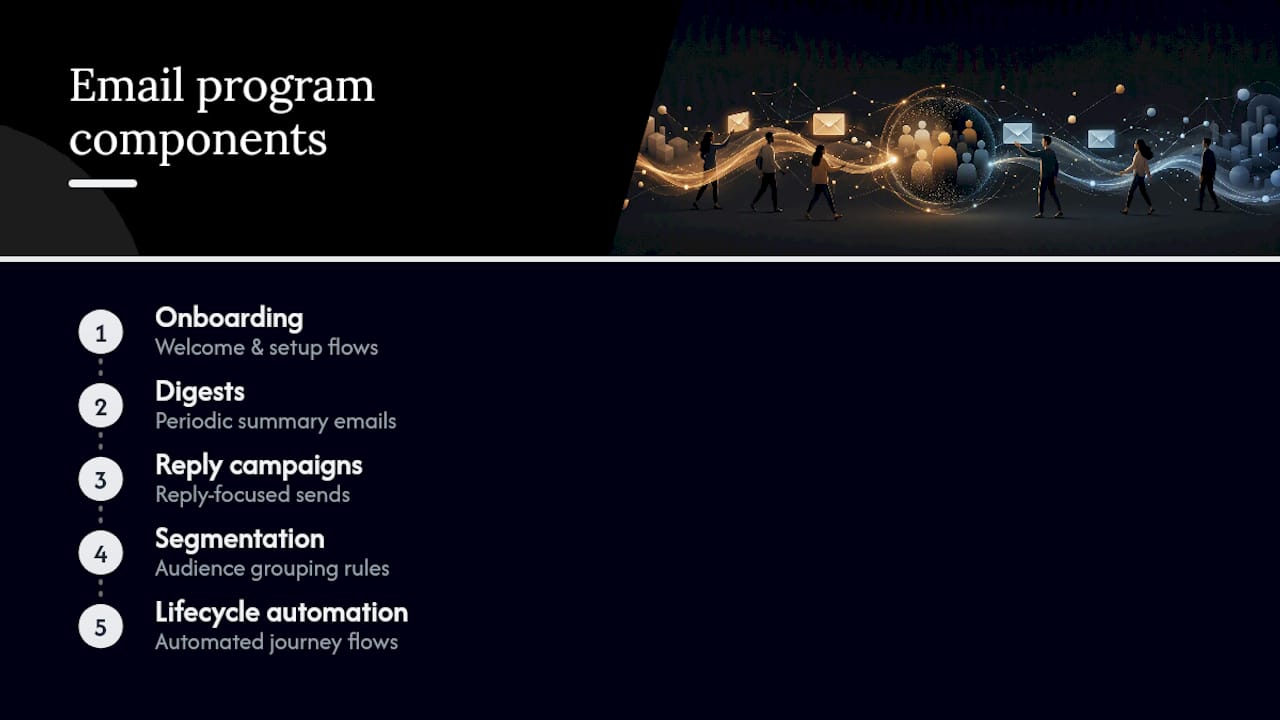
1. Design a welcome sequence that sets expectations early
The first email a new subscriber gets does more work than any other message you’ll send them. According to Social Media Examiner’s research on email communities, telling subscribers upfront what to expect, how often you’ll email, and what kind of content is coming significantly boosts completion rates for the rest of the sequence and builds trust from message one.
A workable welcome sequence runs three to five emails over one to two weeks:
- Welcome and expectation-setting. State the sending cadence, the type of content, and one thing that makes this list different from a typical newsletter.
- Insider story or origin content. Give new members context that isn’t on the website.
- Invitation to reply. Ask one direct question, something like what brought them here or what they hope to get out of joining.
- Community proof. Show them what active participation looks like, quoting a real member reply (with permission) or highlighting a recent discussion.
- Soft call to engage further. Point them toward the next digest or an upcoming event.
2. Know when to send a digest versus a single notification
Digests and individual notifications serve different jobs, and mixing them up is a common failure point. A digest batches multiple updates into one scheduled email, weekly or biweekly, and works best for keeping casual members and lurkers connected without overwhelming their inbox. A single notification interrupts for something time-sensitive: an event starting soon, a direct reply to something the subscriber posted, or a milestone that involves them specifically.
The rule of thumb: if it can wait a few days, it belongs in the digest. If it loses value by waiting, send it alone.
3. Write reply-driven emails that actually generate replies
Open-ended questions outperform closed ones almost every time. “What’s the biggest challenge you’re facing with X right now?” gets a real answer. “Did you like this week’s update?” gets a one-word reply or nothing at all.
There’s a deliverability angle here too. When subscribers reply to your emails, inbox providers read that as a signal the message is wanted, which supports better placement over time. Reply-driven design isn’t just good for connection. It’s good for making sure your future emails land in the inbox instead of the promotions tab.
Pro Tip: Reply personally to even five or ten genuine subscriber replies each week. Foundr’s practitioner research found that manual responses to a small number of replies have an outsized effect on connection and word-of-mouth growth, far beyond what the volume would suggest.
4. Segment by behavior, not just demographics
A preference center that lets subscribers choose topics, frequency, and content type reduces churn because people self-select into what they actually want. Segmentation by engagement level (highly active, occasional, dormant) lets you send different messages to each group instead of blasting everyone with the same digest. Practitioner guidance from Social Media Examiner backs this up: behavioral tags and interest-based preferences consistently lower unsubscribe rates compared to one-size-fits-all sending.
5. Automate the lifecycle without losing the human touch
Three automation types matter most for community programs:
- Milestone sequences that trigger on anniversaries, participation streaks, or contribution counts.
- Re-engagement flows that reach out to dormant members with a lower-pressure ask, like a single question, rather than a generic “we miss you.”
- Habit-building sequences that nudge new members toward a recurring action, such as replying to their second digest or attending a first event.
Automation handles the timing. Humans still need to handle the replies that come back.
Measuring Community Health: Beyond Open Rate
Open rate and click rate tell you whether people looked. They don’t tell you whether your list feels like a community. For that, watch reply rate and forward rate.
Reply rate is the percentage of recipients who write back, comment, or respond to a call to reply. It’s a direct measure of two-way communication. Forward rate tracks how often subscribers send your email to someone else, which functions as a high-trust endorsement: nobody forwards an email they think is spammy. Foundr’s community email framework treats these two metrics as stronger indicators of community health than conversion rate alone, because conversion measures a transaction while reply and forward rates measure trust.
Statistic Callout: Community-focused email programs treat forward rate as a trust signal precisely because it’s voluntary and unpaid. A subscriber forwarding your email is doing your marketing for you, for free, and that behavior tends to correlate with the kind of loyalty that shows up later as retention.
Set up cohort tracking to separate your engaged core from the broader list. Track open, reply, and forward rates separately for subscribers who’ve replied at least once in the past 90 days versus everyone else. The gap between those two cohorts tells you how much of your list is genuinely participating versus passively subscribed.
A few practical signals to watch for:
- A sudden unsubscribe spike after a specific send usually points to a mismatch between what you promised in onboarding and what you delivered. Check the welcome sequence first.
- A slow, steady unsubscribe drip is normal list decay and rarely worth panicking over.
- A complaint spike tied to frequency suggests your digest cadence or notification volume needs a preference-center adjustment, not a content rewrite.
- A flat or declining reply rate over several sends means your prompts have gone stale. Test a more specific, more personal open-ended question.
Tie every metric back to an action. Low reply rate: test open-ended prompts instead of statements. Low forward rate: add content genuinely worth sharing, like an exclusive stat or a member story, rather than routine updates.
Templates and Use Cases You Can Copy
Seeing the structure in action makes it easier to adapt than reading principles alone. Here are four formats worth building first.
-
Weekly digest. Structure it around three to five highlights from the past week, two unanswered questions from the community pulled forward for more visibility, a one-line welcome to new members, and a short pulse stat (member count, a milestone, a participation number). BP Custom Dev’s digest guide recommends keeping the whole thing scannable in under 60 seconds, since digest readers are usually catching up, not settling in for a long read.
-
Welcome sequence. Five emails across two weeks: expectation-setting on day one, an insider story on day three, a direct reply-invitation question on day five, community proof around day eight, and a soft engagement nudge by day fourteen. Each message has one job. Don’t stack multiple asks into a single email.
-
Reply-campaign prompt. Send a single, specific question with nothing else in the email. “What’s one thing you wish someone told you before you started?” scales better as a qualitative feedback tool than a survey link, because replying feels conversational rather than like filling out a form.
-
Event or milestone invite. Frame the email around participation, not just attendance. Instead of “Join us Thursday at 3pm,” try “We’re opening the floor Thursday for member questions. Send us yours now and we’ll answer live.” The second version invites contribution before the event even starts.
For brands running these formats inside Klaviyo, adapting newsletter content ideas built for higher retention into a digest structure is often the fastest path from a standard campaign calendar to something that reads like a community update.
Your 30-90 Day Rollout Checklist
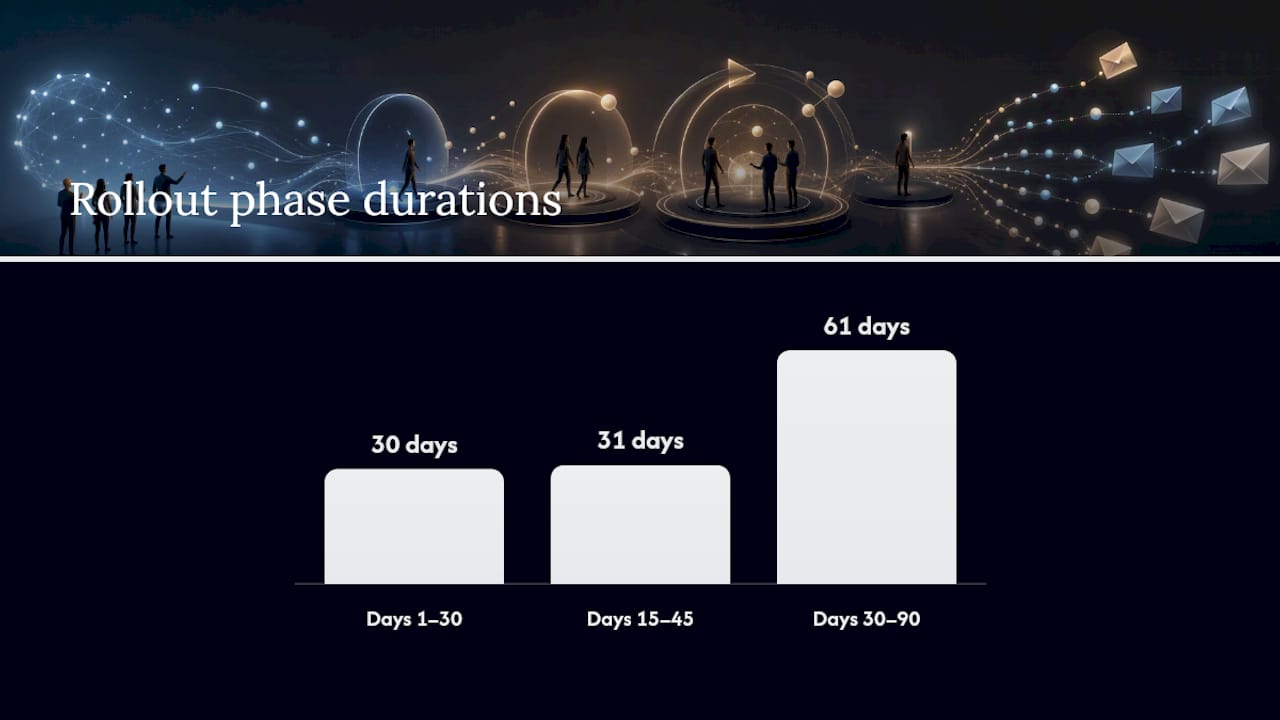
Start with the technical foundation, then layer in sequences, then staff for replies.
Days 1 to 30, technical setup:
- Configure a monitored reply-to address instead of a no-reply inbox.
- Build a preference center covering topic interest and send frequency.
- Set up tagging and segments for engagement level (active, occasional, dormant).
- Confirm reply-by-email is enabled and routes to a real person, not a ticket queue.
Days 15 to 45, sequence priorities:
- Launch or rebuild the welcome sequence first, since it sets the tone for everything after.
- Stand up the weekly digest second.
- Introduce one reply-prompt campaign before adding re-engagement automation.
Ongoing, operational routines:
- Assign someone specific to triage replies daily, with clear escalation rules for anything that needs a product or ops answer.
- Decide upfront who responds to what, so replies don’t sit unanswered for days.
Days 30 to 90, testing:
- Run A/B tests on subject lines, CTA placement, and reply-prompt phrasing.
- Test digest cadence (weekly versus biweekly) against reply and forward rate, not just opens.
Pro Tip: Platforms like HigherLogic build in permission controls for who can send community emails, letting you scope sends to subsets of members and preview templates before they go out. If you’re managing this in Klaviyo instead, replicate that discipline with flow-level permissions and a mandatory preview step, so a broad send never goes out unreviewed.
How Take-Action Builds Community Into Email Programs
Take-action treats community and transaction as two threads that should run through the same flows, not separate programs competing for send slots. A well-built welcome flow, for example, still recovers abandoned interest and drives a first purchase, but it also plants the expectation-setting and insider-access elements that turn a one-time buyer into someone who opens the next digest too.
Klaviyo’s segmentation tools make the cohort tracking described earlier practical at scale. Engaged-versus-broader-list splits, reply-triggered tags, and AI-assisted send-time optimization let a small team run a program that would otherwise require manual list management.
In practice, this looks like:
- Layering reply-prompt campaigns into an existing post-purchase flow instead of treating them as a separate initiative.
- Using segmentation to route highly engaged subscribers into a different cadence than dormant ones.
- Building preference centers that double as low-friction feedback tools, since the choices subscribers make often reveal what they’d otherwise never say in a reply.
Whether to build this internally or bring in outside help usually comes down to bandwidth. A brand with someone who can dedicate real hours weekly to replies, segmentation, and flow maintenance can run this in-house. A brand stretched across product, ops, and marketing with no one owning the inbox relationship tends to see the program stall within a few months, which is where a dedicated retention partner earns its cost.
Why Community-First Email Outperforms Broadcast Marketing
Broadcast email optimizes for the next transaction. Community-driven email optimizes for the next ten transactions, because a subscriber who replies, forwards, and shows up for a digest is a subscriber who sticks around long enough to buy more than once. That’s the real argument for this approach: it’s slower to show results in a week-one revenue report, but it compounds in ways a discount code never will.
The clearest proof isn’t a case study, it’s the behavior itself. A subscriber who forwards your email to a friend has just done unpaid marketing on your behalf, and that only happens when the content earns it. If you’re weighing whether to shift a program this way, Take-action’s email marketing services are built around exactly this kind of relationship-first flow design inside Klaviyo.
— Take
Sources
For readers who want to go deeper, Foundr’s guide to building community through email covers the reply-and-forward-rate framework in full. Social Media Examiner’s piece on raving audiences breaks down expectation-setting and segmentation in more detail. BP Custom Dev’s digest guide is the best single reference for digest structure. For platform mechanics, HigherLogic’s support documentation shows how permission scoping works in a dedicated community platform.
- How to Use Email to Build a Community, Not Just a Customer Base - Foundr
- Building Email Communities: How to Grow a Raving Audience - Social Media Examiner
- How to Send Weekly Community Digest Emails to Keep Members Engaged - BP Custom Dev
- Email community members (HigherLogic support)