

What is a digital marketing agency? 2026 e-commerce guide
Email marketing generates 20 to 40% of total e-commerce revenue, with automated flows driving 30 to 60% of email income. Yet many e-commerce brand owners still think digital marketing agencies only handle social ads or SEO. The reality is far more powerful. A digital marketing agency acts as your strategic partner across multiple channels, with email marketing at the core of retention and revenue growth. This guide reveals exactly what these agencies do, how they optimize email strategies to boost customer lifetime value, and why partnering with the right agency can transform your e-commerce business in 2026.
Table of Contents
- What Is A Digital Marketing Agency And How Do They Help E-Commerce Brands?
- How Digital Marketing Agencies Optimize E-Commerce Email Marketing For Retention And Revenue
- The Measurable Impact Of Agency-Led Email Marketing: Benchmarks And Case Studies
- Nuances And Best Practices For Successful Agency Partnerships In Email Marketing
- Partner With A Leading Email Marketing Agency To Grow Your E-Commerce Revenue
- Frequently Asked Questions
Key takeaways
| Point | Details |
|---|---|
| Multi-channel expertise | Digital marketing agencies manage SEO, paid ads, email marketing, social media, and content to maximize e-commerce visibility and revenue. |
| Email automation drives revenue | Automated email flows outperform one-off campaigns, generating higher repeat purchase rates and revenue per message sent. |
| Segmentation is critical | Agencies divide customers into new, active, lapsed, and VIP groups to deliver personalized messaging that converts. |
| Proven ROI results | Top agencies achieve email marketing ROI ratios of 36 to 45 times investment with measurable revenue lifts. |
| Strategic optimization | Frequency control, deliverability testing, and AI-driven timing maximize engagement and protect sender reputation. |
What is a digital marketing agency and how do they help e-commerce brands?
A digital marketing agency provides online marketing services like SEO, paid ads, email marketing, social media, and content to improve leads and revenue. These agencies function as outsourced marketing departments for e-commerce brands, bringing specialized expertise across multiple channels. Rather than juggling fragmented tactics internally, you gain access to a team that coordinates strategy, execution, and optimization under one roof.
For e-commerce businesses, agencies focus on increasing visibility, generating qualified traffic, converting visitors into customers, and retaining those customers over time. Email marketing stands out as a key specialty because of its exceptional ROI and direct impact on customer lifetime value. Agencies combine technical skills like platform integration and automation setup with creative capabilities such as copywriting and design to build campaigns that resonate with your audience.
The scope of services typically includes:
- Search engine optimization to improve organic rankings and drive sustainable traffic
- Paid advertising across Google, Facebook, and other platforms for rapid customer acquisition
- Email marketing strategy, automation flows, and campaign execution to maximize retention
- Social media management to build brand awareness and community engagement
- Content marketing including blog posts, videos, and guides that educate and convert
Agencies act as strategic partners who understand your business goals and translate them into measurable marketing outcomes. They bring proven frameworks, industry benchmarks, and hands-on experience from working with multiple brands. This means you avoid costly trial and error while accelerating growth through tactics that already work. For e-commerce brands seeking to scale beyond paid ads alone, agencies provide the expertise to diversify revenue streams and build sustainable customer relationships.
Explore more email marketing insights or learn about comprehensive digital media strategy for e-commerce to see how integrated approaches drive results.
How digital marketing agencies optimize e-commerce email marketing for retention and revenue
Agencies transform email marketing from a sporadic newsletter into a revenue-generating engine through systematic optimization. The process starts with auditing email lists and setting automation flows that target specific customer behaviors. Rather than blasting the same message to everyone, agencies segment your audience into four core groups: new subscribers, active buyers, lapsed customers, and VIP repeat purchasers. Each segment receives tailored messaging that matches their relationship with your brand.

Behavioral automation flows form the foundation of this strategy. Welcome series nurture new subscribers, abandoned cart sequences recover lost sales, post-purchase flows drive repeat orders, and win-back campaigns re-engage dormant customers. These automated touchpoints work around the clock, generating consistent revenue without manual effort. Agencies configure triggers based on actions like browsing specific products, adding items to cart, or reaching spending thresholds.
Optimization happens through rigorous A/B testing of subject lines, preview text, call-to-action buttons, and send times. Agencies run controlled experiments to identify what resonates with your audience, then scale winning variations. They also focus on technical factors that impact deliverability: authenticating your domain with SPF and DKIM records, maintaining list hygiene by removing inactive addresses, and monitoring sender reputation scores. Poor deliverability means your emails land in spam folders, wasting all creative effort.
Platform integration streamlines data flow between your e-commerce store and email marketing system. Agencies connect Shopify, WooCommerce, or other platforms with tools like Klaviyo to sync customer data, purchase history, and browsing behavior in real time. This enables dynamic content like personalized product recommendations and triggered messages based on actual customer actions.
Here’s how agencies structure customer segments and corresponding flows:
| Segment | Characteristics | Primary Flows |
|---|---|---|
| New subscribers | Just joined list, no purchase | Welcome series, educational content, first-purchase incentive |
| Active buyers | Recent purchase within 60-90 days | Post-purchase thank you, cross-sell, review request |
| Lapsed customers | No purchase in 90+ days | Win-back campaign, special offers, product updates |
| VIP repeat purchasers | Multiple purchases, high lifetime value | Exclusive previews, loyalty rewards, personalized recommendations |
Pro Tip: Focus on flow revenue per recipient rather than open rates. A flow generating $2 per recipient with a 25% open rate outperforms one generating $0.50 per recipient at 40% opens. Revenue is the metric that matters.
Discover advanced list segmentation techniques for e-commerce email or explore email segmentation strategies that drive e-commerce growth for deeper tactical insights.
The measurable impact of agency-led email marketing: benchmarks and case studies
The numbers tell a compelling story about agency effectiveness. Email drives 20 to 40% of e-commerce revenue, with flows generating 30 to 60% of total email income. More striking, the repeat purchase rate from flows runs 2 to 75 times higher than campaigns. This means automated sequences not only generate more revenue per message but also build stronger customer relationships that compound over time.
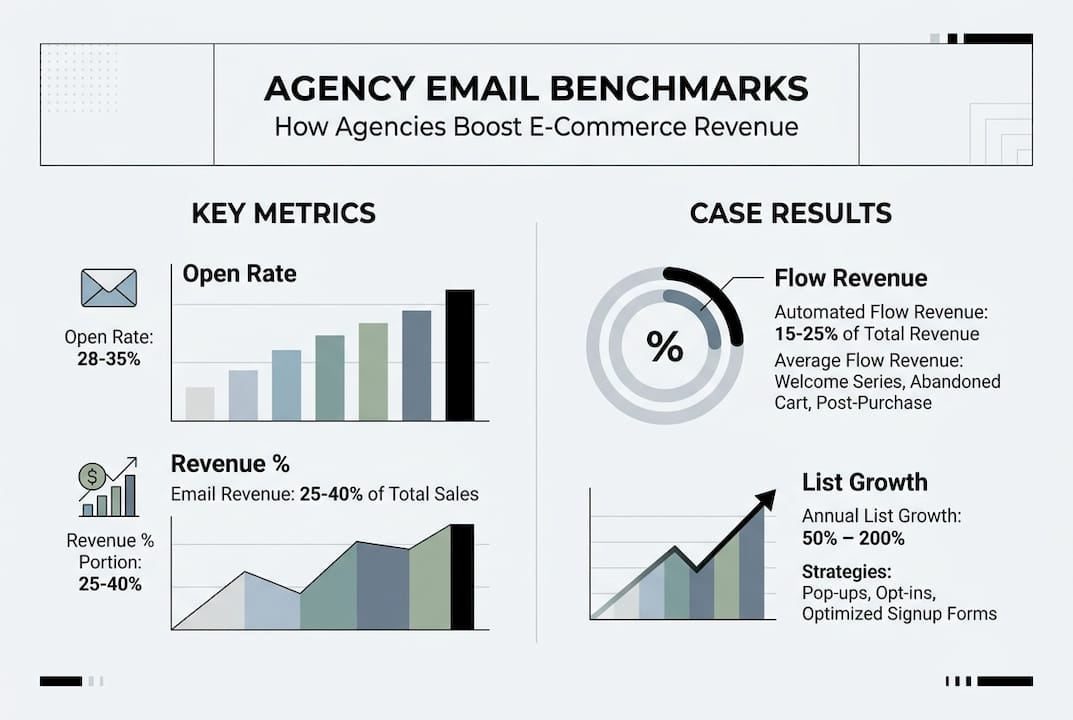
Real client results demonstrate this impact. One agency partnership delivered $214,000 in revenue with an 89% lift in open rates and 17% improvement in click rates. Another e-commerce brand saw flows contribute 59% of email revenue totaling $106,000 in a single quarter. During the critical Black Friday Cyber Monday period, strategic agency execution generated $6.5 million in revenue through coordinated email campaigns and flows.
These results stem from consistent optimization across multiple dimensions. Agencies don’t just set up flows and walk away. They continuously refine segmentation rules, test new messaging angles, adjust send frequency based on engagement patterns, and optimize for deliverability. This ongoing attention compounds results month over month.
Compare typical performance metrics between DIY email marketing and agency-managed programs:
| Metric | DIY Average | Agency-Managed |
|---|---|---|
| Revenue from email | 10-15% of total | 20-40% of total |
| Flow contribution | 20-30% of email revenue | 30-60% of email revenue |
| Repeat purchase rate | 1-2x campaign rate | 5-15x campaign rate |
| Email marketing ROI | 15-25:1 | 36-45:1 |
The strategic advantage extends beyond immediate revenue. Agencies help you build a sustainable marketing channel that reduces dependence on paid advertising. As acquisition costs rise across Facebook and Google, email provides a owned audience you can reach without paying for each impression. This diversification protects your business from platform algorithm changes and ad cost inflation.
“Email marketing isn’t just another channel. It’s the foundation of customer retention and the most reliable revenue driver we control. When optimized properly, it transforms one-time buyers into loyal repeat customers who generate predictable income month after month.”
Key factors driving these results include:
- Sophisticated segmentation that delivers relevant messages to each customer group
- Behavioral triggers that reach customers at high-intent moments
- Rigorous testing that identifies and scales winning approaches
- Technical optimization that ensures messages reach inboxes, not spam folders
- Strategic frequency management that maximizes engagement without causing fatigue
Learn more about e-commerce newsletter ideas that boost retention to see specific tactics agencies use to keep customers engaged.
Nuances and best practices for successful agency partnerships in email marketing
Successful agency partnerships require understanding subtle but critical factors that separate good results from exceptional ones. The first priority is emphasizing flows over campaigns. While one-off promotional blasts have their place, automated flows generate steady baseline revenue that compounds over time. Agencies structure your email program so flows handle the heavy lifting while campaigns provide incremental lifts during promotions or product launches.
Frequency management prevents list fatigue and protects your sender reputation. Bombarding subscribers with daily emails might boost short-term revenue but destroys long-term engagement. Agencies cap email frequency based on segment behavior, reducing sends to less engaged subscribers while maintaining higher frequency for active buyers. This nuanced approach keeps your list healthy and responsive.
Metric selection matters more than most brands realize. Open rates have become unreliable due to privacy changes in iOS and other platforms. Smart agencies focus on repeat purchase rate and click-through rate as primary success indicators. RPR directly measures whether emails drive actual buying behavior, while CTR shows genuine engagement beyond automated opens. Revenue per recipient provides the ultimate accountability metric, connecting email activity to business outcomes.
AI tools now optimize subject lines and send times with precision impossible through manual testing. Agencies leverage these technologies to predict which subject lines will resonate with specific segments and identify optimal send windows for each subscriber. This personalization at scale drives meaningful improvements in engagement and conversion rates.
List hygiene and authentication form the technical foundation that makes everything else possible. Agencies maintain clean lists by removing inactive subscribers, implementing double opt-in processes, and monitoring engagement patterns. They also ensure proper authentication through SPF, DKIM, and DMARC records that verify your sending domain. These technical details might seem boring, but they determine whether your emails reach inboxes or get filtered as spam.
Pro Tip: Monitor your sender reputation score monthly through tools like Google Postmaster or Microsoft SNDS. A declining score signals deliverability problems before they crater your results. Agencies catch these issues early and implement fixes that protect your email channel.
Strategic considerations for maximizing agency partnerships:
- Establish clear revenue and retention goals upfront so the agency can optimize toward specific outcomes
- Provide access to customer data, purchase history, and product catalogs for accurate segmentation
- Collaborate on brand voice and creative direction to ensure emails reflect your identity
- Review performance monthly, focusing on trends rather than week-to-week fluctuations
- Test incrementally rather than making massive changes that muddy attribution
The best agency relationships function as true partnerships where both sides bring expertise to the table. You provide deep knowledge of your products, customers, and brand positioning. The agency contributes technical skills, strategic frameworks, and experience from optimizing dozens of similar programs. This combination produces results neither could achieve alone.
Explore comprehensive online marketing strategy for e-commerce to understand how email fits within your broader marketing ecosystem.
Partner with a leading email marketing agency to grow your e-commerce revenue
Transforming email into your primary growth channel requires specialized expertise that most e-commerce teams lack internally. A dedicated email marketing agency brings proven frameworks, technical skills, and strategic insights that accelerate results while you focus on product development and operations. The right partnership provides access to advanced segmentation, behavioral automation, and continuous optimization that compounds revenue month after month.
Take Action specializes in email marketing and retention for e-commerce brands using data-driven strategies and Klaviyo automation. We’ve helped dozens of brands achieve measurable revenue lifts through sophisticated flow architecture, strategic segmentation, and relentless testing. Our approach combines human creativity with AI-driven optimization to maximize engagement and customer lifetime value. Explore Take Action’s email marketing services or dive into our email marketing blog for actionable insights you can implement today. Partner with Take Action agency to turn email into your most reliable revenue channel.
Frequently asked questions
What services do digital marketing agencies typically offer?
Digital marketing agencies provide SEO, paid advertising, email marketing, social media management, and content marketing services designed to increase online visibility and revenue. Many agencies specialize in specific areas like e-commerce email marketing to deliver deeper expertise and better results. They function as outsourced marketing departments, coordinating strategy and execution across multiple channels. Explore digital marketing services to see how integrated approaches drive growth.
How do agencies improve email marketing results for e-commerce?
Agencies segment customers into groups like new subscribers, active buyers, lapsed customers, and VIPs, then create behavioral automation flows targeting each segment. They perform A/B testing on subject lines and calls to action, optimize deliverability through authentication and list hygiene, and integrate platforms like Shopify and Klaviyo for seamless data flow. This systematic approach generates higher engagement, improved conversion rates, and measurable revenue growth. Learn specific email segmentation techniques that agencies use to maximize results.
What is the typical ROI from agency-led email marketing?
Top agencies achieve email marketing ROI ratios as high as 36 to 45 times the investment, significantly outperforming most other marketing channels. Success depends on implementing automated flows, sophisticated segmentation, rigorous testing, and technical optimization that maximizes deliverability. Results vary based on industry, list size, and existing email maturity, but most e-commerce brands see email contribute 20 to 40% of total revenue when properly optimized.
How can I choose the right digital marketing agency for my e-commerce brand?
Look for agencies with specific experience in e-commerce email marketing and documented case studies showing measurable retention and revenue improvements. Evaluate their technical capabilities with platforms like Klaviyo, their approach to segmentation and automation, and their process for ongoing optimization. Strong agencies provide transparent reporting, collaborative strategy development, and clear communication about what drives results. Review their online marketing strategy approach to ensure alignment with your business goals and growth stage.
Recommended
- Digital Media Buying Agency Impact on Ecommerce | Take Action Blog | Take Action
- SEO Digital Marketing Agency: Impact on Ecommerce | Take Action Blog | Take Action
- Digital Marketing Agency Content That Drives Ecommerce Growth | Take Action Blog | Take Action
- What Is an Online Marketing Agency—Growth for Ecommerce Brands | Take Action Blog | Take Action