

Klaviyo CDP Explained for Ecommerce Brands
TL;DR:
- Klaviyo Data Platform is a built-in customer data platform that supports identity resolution, profiles, segmentation, and analytics for all Klaviyo users. Upgrading to Advanced KDP is necessary only for brands with complex data sources, warehouse needs, or advanced RFM analysis. Implementation times vary from a few weeks for standard setup to over twelve weeks for warehouse synchronization.
The Klaviyo Data Platform (KDP) is a customer data platform built directly into Klaviyo’s marketing suite. Every Klaviyo Marketing and Service customer gets it automatically. No separate subscription, no extra setup. Standard KDP covers identity resolution, lifetime customer profiles, segmentation, and predictive analytics out of the box.
The real question is whether you need Advanced KDP, which Klaviyo labels as “CDP” in its billing interface and sells as an add-on subscription. It is generally aimed at brands with complex data needs. You likely do if any of these apply:
- You need to sync customer data directly to a warehouse like Snowflake, BigQuery, Amazon S3, or Redshift
- Your data arrives from multiple systems (ERP, POS, offline) and requires transformation before it is usable
- Your analytics team runs RFM models or advanced segmentation that standard Klaviyo profiles cannot support without engineering effort
If none of those fit your situation, standard KDP is almost certainly enough to run sophisticated retention and email automation programs.
Table of Contents
- What Klaviyo CDP actually does for your ecommerce brand
- Standard KDP vs. Advanced KDP: what you actually get
- How Klaviyo CDP fits into your ecommerce tech stack
- Do you actually need a CDP or Advanced KDP?
- Implementation checklist, timeline, and cost expectations
- Key Takeaways
- What Take-action has learned from real ecommerce implementations
- Ready to get more from your Klaviyo data?
- Useful sources
What Klaviyo CDP actually does for your ecommerce brand
The core of KDP is identity resolution. When a shopper browses on mobile, abandons a cart on desktop, and then purchases through an email link, Klaviyo stitches those touchpoints into one unified profile. That profile persists for the customer’s lifetime, not just the current session or campaign window.
Standard KDP features available to every Klaviyo customer include:
- Identity resolution: Merges anonymous and known profiles across devices and channels
- Lifetime profiles: Stores every event, purchase, and engagement permanently
- Segmentation: Filters audiences by behavior, purchase history, predicted traits, and custom properties
- Predictive analytics: Built-in AI forecasts churn risk, lifetime value, and next purchase date
- Activation: Profiles feed directly into flows, campaigns, and ad audiences without any export step
The embedded design matters more than it sounds. Because KDP eliminates the need for a standalone CDP, there is no reverse-ETL step between insight and action. A customer who triggers a browse-abandonment event can enter a flow within minutes, not hours. For time-sensitive automations, that latency difference is real money.
Klaviyo also connects to 350+ pre-built integrations, so most ecommerce stacks plug in without custom engineering. Shopify, WooCommerce, Recharge, Gorgias, and most major ad platforms connect natively.
Pro Tip: Build a predictive churn segment on day one. Klaviyo’s churn-risk score updates automatically, so you can set a flow that triggers a win-back offer the moment a customer’s predicted churn probability crosses your threshold. No manual list pulls, no scheduled exports.
Standard KDP vs. Advanced KDP: what you actually get
| Feature | Standard KDP | Advanced KDP |
|---|---|---|
| Identity resolution | ✓ | ✓ |
| Lifetime profiles | ✓ | ✓ |
| Segmentation | ✓ | ✓ |
| Predictive analytics (LTV, churn) | ✓ | ✓ |
| Identity Explorer | ✗ | ✓ |
| No-code data transforms | ✗ | ✓ |
| RFM analysis | ✗ | ✓ |
| Hosted code functions | ✗ | ✓ |
| Warehouse sync (S3, Redshift, BigQuery, Snowflake) | ✗ | ✓ |
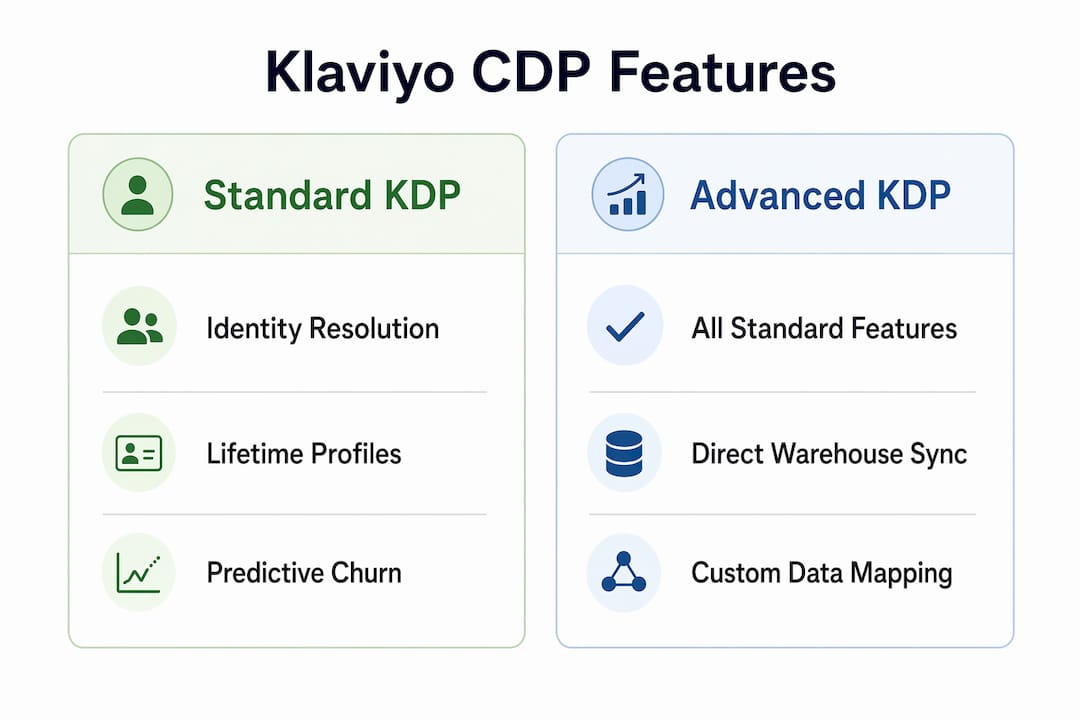
Advanced KDP is built for brands that maintain large, diverse data sources and need to move data in and out of analytics warehouses without building custom middleware. The Identity Explorer deserves a specific mention: it lets non-technical marketers manually explore, link, and unlink profiles that share identifiers. For brands with messy historical data, that controllable approach is often faster and less risky than an engineering-led identity rewrite.
Signals that you should upgrade to Advanced KDP:
- Your analytics team queries customer data in Snowflake or BigQuery and needs Klaviyo data there too
- You have offline purchase data in an ERP or POS that needs transformation before it can enrich profiles
- You run RFM segmentation and your current setup requires manual exports or custom SQL
- You manage multiple brands or storefronts and need to unify data across them
- Engineering is spending time building or maintaining ETL pipelines between Klaviyo and other systems
Cost and timeline expectations vary. Standard KDP onboarding for a new Klaviyo account typically takes two to four weeks to get flows live and segments dialed in. Advanced KDP onboarding runs six to twelve weeks when warehouse sync and data transformations are in scope. Budget for the subscription cost, professional services (agency or internal analyst time), and any data storage or egress fees from your warehouse provider.
How Klaviyo CDP fits into your ecommerce tech stack
Data flows into KDP from your storefront events (page views, add-to-cart, purchases), your integrations (email, SMS, ads, support), and any warehouse or SFTP exports you configure. KDP resolves identities, builds profiles, and makes those profiles immediately available for segmentation and activation. No waiting for a nightly sync.

For brands on Advanced KDP, the direct warehouse sync to destinations like Snowflake, BigQuery, Redshift, and S3 removes the need for reverse-ETL in most use cases. Your analytics team can query Klaviyo engagement data alongside transaction data in the warehouse without building custom connectors.
Klaviyo also announced a guided SFTP experience for pulling warehouse data into KDP, which lets brands combine historical ERP or POS purchase records with real-time engagement data. That combination is what makes truly personalized retention campaigns possible for brands with long customer histories.
Pro Tip: Before building any warehouse sync, map your customer identifiers first. Email address, phone number, customer ID, and device ID all need consistent formatting across systems. Mismatched identifiers are the single most common reason warehouse syncs produce duplicate profiles instead of unified ones.
Do you actually need a CDP or Advanced KDP?
Run through this checklist before committing to an upgrade:
- Count your data sources. If all your customer data lives in Shopify and Klaviyo already, standard KDP handles it.
- Check for multi-device identity gaps. Are you seeing duplicate profiles or broken attribution? Standard identity resolution may fix it; if not, Identity Explorer in Advanced KDP is the next step.
- Assess your analytics workflow. Does your team query customer data in a warehouse? If yes, Advanced KDP’s direct sync pays for itself quickly.
- Evaluate your RFM needs. Running RFM manually in spreadsheets or a BI tool? Advanced KDP brings that natively into Klaviyo.
- Measure engineering time on pipelines. If developers are maintaining custom ETL between Klaviyo and other systems, Advanced KDP likely costs less than that ongoing work.
Small DTC brands with a single Shopify store and clean data almost never need Advanced KDP. Scaling omnichannel retailers with offline sales, multiple data sources, and an analytics team querying a warehouse are the clearest upgrade candidates.
Implementation checklist, timeline, and cost expectations
Getting KDP set up correctly from the start saves significant rework later. Work through these steps in order:
- Audit your data sources. List every system that holds customer data: storefront, POS, ERP, support desk, loyalty platform.
- Map your key customer identifiers. Standardize email, phone, and customer ID formats across all systems before any sync.
- Decide on warehouse sync needs. If Advanced KDP is in scope, confirm which destinations (S3, Redshift, BigQuery, Snowflake) and what data needs to flow there.
- Configure identity rules. Set merge rules in Klaviyo to handle duplicate profiles before they accumulate.
- Build and test your core segments. Validate that predictive segments (churn risk, high LTV) are populating correctly before launching flows.
- Launch retention flows in priority order. Welcome series, abandoned cart, and post-purchase flows first. Win-back and browse abandonment next.
Questions to ask your agency or vendor during scoping: What data transformation is required before profiles are usable? Who owns ongoing data hygiene? What does a profile audit look like at 90 days?
Key Takeaways
Klaviyo Data Platform gives every Klaviyo customer a built-in CDP; Advanced KDP is the right upgrade only when warehouse sync, RFM analysis, or complex data transformation is genuinely in scope.
| Point | Details |
|---|---|
| Standard KDP is included | Every Klaviyo Marketing customer gets identity resolution, profiles, segmentation, and predictive analytics at no extra cost. |
| Advanced KDP has clear triggers | Upgrade when you need direct sync to Snowflake, BigQuery, Redshift, or S3, or when RFM and no-code transforms are required. |
| Implementation timeline varies | Standard setup runs two to four weeks; Advanced KDP onboarding with warehouse sync typically takes six to twelve weeks. |
| Embedded CDP cuts latency | Because KDP is built into Klaviyo, customer events reach flows in minutes, not hours, which directly improves time-sensitive automations. |
| Take-action handles the setup | Take-action specializes in Klaviyo onboarding, Advanced KDP configuration, and retention flow setup for ecommerce brands. |
What Take-action has learned from real ecommerce implementations
The most common mistake brands make is skipping the identifier audit. They connect Klaviyo to Shopify, import a historical list, and end up with thousands of duplicate profiles because email addresses are formatted differently across systems. Fixing that after the fact takes far longer than doing it before the first sync.
The first automations that consistently produce measurable retention lift are the same three every time: abandoned cart, post-purchase follow-up, and a churn-risk win-back triggered by Klaviyo’s predictive score. Brands that get those three flows live and properly segmented before adding complexity see better results than brands that build ten flows with poor data underneath them.
On Advanced KDP rollouts specifically: scope the warehouse sync destinations before the contract is signed. Teams often discover mid-project that their Snowflake schema needs transformation before Klaviyo data is usable there. That discovery adds weeks and cost. A one-hour schema review at the start prevents it.
Pro Tip: Run a segmentation audit before your Advanced KDP go-live. Check that your highest-value predictive segments are populated with the right profiles. If they are not, the issue is almost always an identifier mismatch, not a Klaviyo configuration problem.
Ready to get more from your Klaviyo data?
Most ecommerce brands are sitting on customer data that their email program is not fully using. Take-action helps brands close that gap, whether that means getting standard KDP flows running correctly or scoping and building a full Advanced KDP rollout with warehouse sync.
Services include Klaviyo onboarding, Advanced KDP configuration, data mapping, RFM activation, and retention flow builds (welcome, abandoned cart, post-purchase, win-back). The engagement starts with a data audit so you know exactly what you have before anything is built.
If your team is spending time on manual exports, broken segments, or pipelines that should not exist, get in touch with Take-action to scope what a clean implementation looks like for your brand.
Useful sources
- Klaviyo Data Platform overview — Official product page covering KDP’s core value proposition, embedded CDP positioning, and integration breadth.
- Advanced KDP product page — Full feature list for the Advanced tier, including warehouse sync destinations and no-code transform capabilities.
- Getting started with Advanced KDP — Klaviyo Help Center guide covering subscription requirements and onboarding steps for Advanced KDP.
- Why a CDP matters for marketing — Klaviyo blog post explaining standard KDP features and the case for embedded CDPs in ecommerce.
- New Klaviyo CDP features update — Announcement covering Identity Explorer, SFTP warehouse ingestion, and recent Advanced KDP additions.