

What Is the Content Marketing Strategy in 2026
TL;DR:
- Content marketing is a strategic system that attracts and retains audiences through relevant, valuable content, emphasizing quality and trust. It involves diverse formats like written, video, audio, and visual content, which must align with audience needs and team strengths. Effective campaigns focus on long-term retention, ethical transparency, and consistent distribution, especially via owned channels like email.
Most marketers think they understand what is the content marketing until they watch a well-funded campaign generate thousands of clicks and zero customers. The gap between content production and content strategy is wider than most teams realize. Content marketing, done right, is not about flooding the internet with blog posts. It’s a deliberate system for attracting, educating, and retaining the people most likely to buy from you. This article breaks down the definition, what content marketing includes, how it functions as a pull strategy, and what separates campaigns that build brands from those that burn budgets.
Table of Contents
- Key Takeaways
- What is content marketing, exactly
- Content marketing trends reshaping 2026
- Key components of a content marketing framework
- Practical steps to apply content marketing effectively
- My take on what content marketing actually demands
- How Take-action helps you put this into practice
- FAQ
Key Takeaways
| Point | Details |
|---|---|
| Pull strategy, not push | Content marketing attracts audiences through value and relevance, not interruption. |
| Quality over frequency | More than 70% of marketers now prioritize relevance over publishing volume. |
| Format must fit your team | Matching content format to team strengths prevents burnout and raises output quality. |
| Ethics builds longevity | Accuracy, transparency, and disclosure protect brand trust over the long term. |
| Measure retention, not just traffic | Long-term retention metrics matter more than vanity numbers for sustainable growth. |
What is content marketing, exactly
Content marketing is the practice of creating and distributing material that is genuinely useful, entertaining, or educational to attract and retain a defined audience, with the goal of driving profitable customer action. That definition sounds broad because the practice is broad. But the word that matters most in that sentence is “retain.” Content marketing is not a one-time campaign. It’s an ongoing system.
Content marketing operates as a pull strategy, meaning it draws people toward your brand by giving them something they actually want, rather than interrupting them with something they didn’t ask for. Think about the difference between a banner ad and a genuinely useful YouTube tutorial that happens to feature your product. One is ignored. The other is bookmarked, shared, and referenced months later.
What does content marketing include? The formats are wide:
- Written content: Blog posts, white papers, case studies, email newsletters, guides
- Video: Tutorials, product demos, brand documentaries, short-form social video
- Audio: Podcasts, audio courses, branded radio-style programming
- Visual: Infographics, data visualizations, photography, interactive tools
- Social content: Platform-native posts, stories, comment engagement strategies
The thread connecting all of these is relevance and consistency. A single viral post is not content marketing. A system that consistently publishes material your audience finds useful? That is.
Content marketing trends reshaping 2026
The content marketing definition has not changed much, but what separates winning strategies from mediocre ones has shifted dramatically. The clearest signal: over 70% of marketers now prioritize quality and audience relevance over raw publishing frequency. This is a direct response to the AI content explosion, which flooded every niche with generic, interchangeable material.
“The 2026 content landscape is about authority, trust, and long-term retention, moving away from generic mass content to expert-led material.” — Programming Insider
What this means practically is that expert and research-based content now outperforms generic blog posts for backlinks, shares, and search rankings. A 2,000-word piece written by someone with real first-hand experience in a field will consistently outperform a 5,000-word AI-generated overview of the same topic. Search engines have gotten better at detecting this difference. So have readers.
AI’s role in content marketing is also forcing an ethics conversation. Transparent disclosure of AI involvement in content production has become a baseline expectation for audiences who care about accuracy. Brands that hide AI usage and publish unverified claims are accumulating a trust debt that eventually collapses their credibility. The brands winning in 2026 are the ones combining AI efficiency with human judgment and editorial oversight.
Key components of a content marketing framework
Understanding what is content marketing in theory is one thing. Building a working system is another. Successful content marketing programs share a set of structural components that marketers can use to organize their efforts.
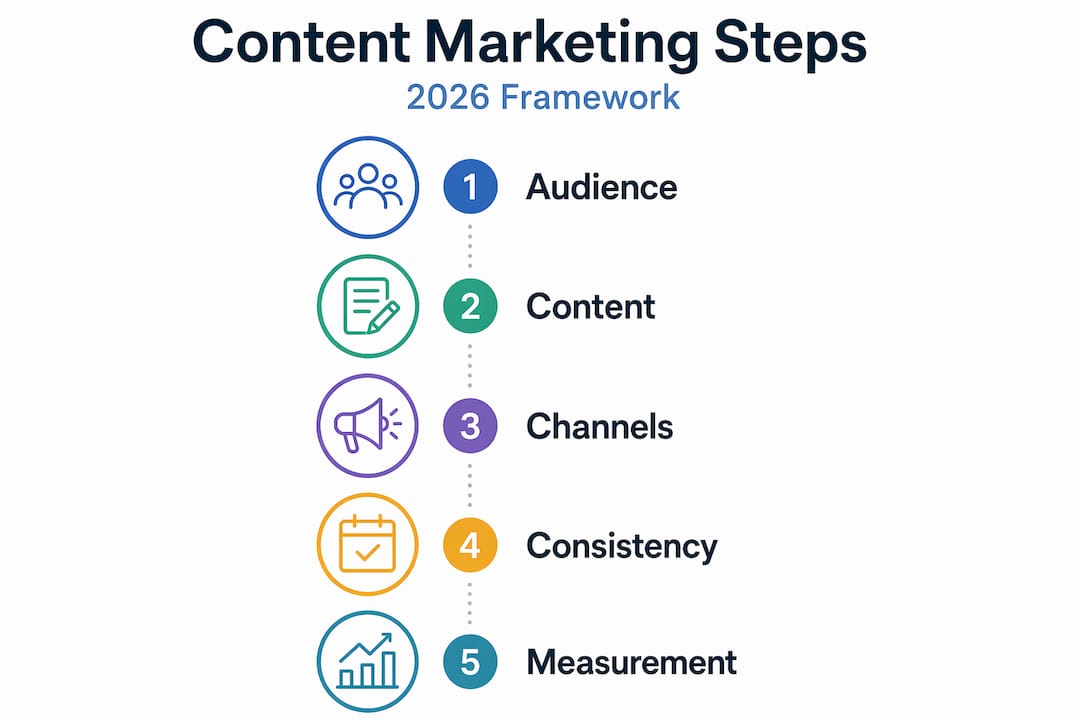
| Component | What it involves | Why it matters |
|---|---|---|
| Audience definition | Identifying who you serve, their questions, and their preferences | Content without a clear audience solves no one’s problem |
| Format selection | Choosing channels and content types that match both audience habits and team capability | Wrong format kills execution before it starts |
| Content creation | Producing material with genuine depth, accuracy, and voice | Shallow content erodes trust faster than no content |
| Distribution | Delivering content through owned, earned, and paid channels | Great content with no distribution has zero reach |
| Measurement | Tracking KPIs like time-on-page, email open rates, and customer retention | Vanity metrics mask real performance |
Two frameworks that practitioners regularly reference are the “3 C’s” (Content, Channel, Consistency) and the “4 C’s” (Content, Context, Connection, Conversion). Neither is a rigid formula. They’re mental models to check that you haven’t skipped something obvious. Most failed content programs skip “context,” meaning they publish the right information in the wrong place for the wrong person.
Matching content formats to team strengths is one of the most overlooked decisions in content planning. A team of excellent writers who force themselves to produce weekly video content will burn out and produce mediocre videos. That same team writing two long-form articles per month will produce exceptional material. Format is a resource decision, not just a channel decision.

Pro Tip: Before choosing your content format, ask which format your team has already produced something genuinely good in. Start there. Expand later.
Practical steps to apply content marketing effectively
Content marketing for beginners often starts with the same mistake: producing content before defining a strategy. Here is a sequence that actually works.
- Define your audience with specificity. Not “small business owners.” Instead: “ecommerce founders running brands between $500K and $5M in annual revenue who are scaling past paid ads.” The narrower your definition, the more useful your content becomes.
- Map their questions to buying stages. Awareness questions (“what is content marketing”) lead to different content than decision-stage questions (“best email marketing agency for Shopify brands”). Both matter, but they require different approaches.
- Choose two to three formats maximum. Spreading effort across eight channels at launch guarantees mediocrity everywhere. Own two channels before expanding.
- Create a publishing rhythm you can sustain. One genuinely useful piece per week beats four rushed ones. Consistency compounds over time. Gaps in publishing undermine audience trust.
- Build a repurposing system. Repurposing content across multiple channels extends its lifespan and reach without proportionally increasing production effort. A single research report becomes a blog post, three email newsletters, a podcast episode, and twelve social posts.
For ecommerce brands, content marketing drives brand trust and guides customers along the buying journey more effectively than paid ads alone. A brand that teaches its customers how to use its products builds loyalty that a discount code never will. You can see this in real ecommerce content ROI when brands treat their email list as a content channel, not just a promotional broadcast.
Ethical content practice deserves its own mention here. Ethical content marketing requires verifiable claims, disclosure of sponsored relationships, and accountability when errors are made. This is not just a moral position. It is a commercial one. Brands that cut corners on accuracy lose their search rankings, their audience trust, and eventually their market position. Accuracy and transparency have become non-negotiable pillars of modern content marketing in ethical brand building.
Pro Tip: When repurposing content, always update statistics and examples before redistribution. Outdated data shared confidently is worse for your credibility than no data at all.
There is also a distributional element worth thinking through. Content marketing in digital marketing works best when owned channels like email are treated as primary distribution, not afterthoughts. Social reach is rented. Email is owned. Every piece of content you produce should have a path back to your email list, because that is where sustainable audience relationships are built.
My take on what content marketing actually demands
I’ve worked with enough brands to know where content marketing most often breaks down. And it’s rarely the writing. It’s the expectation that content is a short-term play.
Marketing professionals and business owners often approach content with a 90-day ROI lens. They publish for three months, see modest traffic growth, and conclude content doesn’t work. What they’re actually seeing is the compounding effect in its early stages. Content marketing is more like a savings account than a slot machine. The returns are real, but they require patience and consistent deposits.
What I’ve found actually matters is this: content most effective at addressing specific audience needs, rather than promoting products, builds the kind of trust that eventually converts at higher rates with less friction. The brands I’ve seen win are the ones that spend more time understanding what their audience is genuinely struggling with than they spend producing the content itself.
The AI conversation is real, but it’s being handled wrong by most teams. Using AI to scale output without human editorial oversight is a way to produce more content that nobody trusts. The better approach is using AI to research, outline, and draft, then investing real human judgment and experience into the final product. That combination produces content that actually ranks, gets shared, and builds authority.
One more thing most marketers overlook: format should follow team strength, not trend. I’ve watched teams abandon perfectly effective content marketing strategies to chase short-form video because it was popular, only to produce underwhelming content that damaged their credibility. Sustainable content success comes from doubling down on what your team does well, then expanding deliberately.
— Take
How Take-action helps you put this into practice
Content marketing builds the audience. Email marketing converts and retains it. At Take-action, we specialize in making that second half work as hard as possible for ecommerce brands. If you’ve built content that drives traffic but aren’t turning that audience into repeat buyers, the problem is usually in the retention layer, not the content itself. Our team designs email flows, automation sequences, and segmented campaigns through Klaviyo that turn content-driven visitors into loyal customers. If you want to see what that looks like for your brand, explore our agency services and find out how we can help you build a revenue engine that doesn’t rely entirely on paid acquisition.
FAQ
What is content marketing in simple terms?
Content marketing is the practice of creating useful, relevant material to attract and retain a specific audience, with the goal of driving customer action. It’s a pull strategy that builds trust rather than interrupting potential buyers with ads.
What does content marketing include?
Content marketing includes blog posts, videos, podcasts, infographics, email newsletters, case studies, white papers, and social media content. The format varies, but the purpose is always to provide genuine value to a defined audience.
How does content marketing work for ecommerce brands?
Content marketing works for ecommerce by educating potential customers before they buy, building brand authority, and guiding repeat purchases through retained audience relationships. Email is typically the most effective distribution channel for turning content audiences into buyers.
What is content development in marketing?
Content development in marketing refers to the process of researching, planning, creating, and refining content assets that serve a specific audience goal. It includes ideation, writing or production, editing, optimization, and distribution planning.
How is content marketing different from advertising?
Advertising pushes a message at an audience whether they want it or not. Content marketing earns attention by offering something genuinely useful. Advertising stops working the moment you stop paying for it. Content compounds in value over time.