

Email’s Role in the Growth Stage: A Revenue Playbook
Email is the growth-stage engine that compounds revenue through automated lifecycle flows, tight segmentation, and deliverability discipline. It isn’t a nice-to-have alongside paid ads. Automated flows now generate roughly 41% of total email revenue while accounting for just 5.3% of sends, and the channel commonly returns $36 to $42 for every $1 spent in 2026 benchmarks. None of that shows up in your reporting, though, if your emails never reach the inbox. Deliverability, treated as infrastructure rather than an afterthought, decides whether the rest of your strategy even gets a chance.
Here’s what the rest of this article covers: how email’s job changes across acquisition, activation, retention, expansion, and advocacy; which tactics actually move revenue (automation, segmentation, AI personalization, deliverability); the KPIs worth tracking versus the vanity ones; and a prioritized rollout plan for teams that need results in weeks, not quarters.
Quick facts worth pinning to your dashboard:
- Automated flows drive about 41% of email revenue from just 5.3% of send volume.
- Typical email ROI lands between $36 and $42 per $1 spent.
- SPF, DKIM, and DMARC authentication is now a gating requirement, not a technical nicety.
Key Takeaways
Email drives growth-stage revenue when automated flows, segmentation, and deliverability are built in the correct sequence, not layered on randomly.
| Point | Details |
|---|---|
| Flows outperform broadcasts | Automated flows generate about 41% of email revenue from just 5.3% of sends. |
| ROI stays strong | Email typically returns $36 to $42 per $1 spent across 2026 benchmarks. |
| Deliverability comes first | SPF, DKIM, and DMARC authentication must be solid before scaling personalization. |
| Measure revenue, not opens | Track revenue per email and placed order rate over vanity engagement metrics. |
| Take-action builds the sequence | Take-action prioritizes deliverability, then core Klaviyo flows, then AI-driven segmentation for growth-stage brands. |
Table of Contents
- Understanding the Role of Email in Growth Stage Marketing
- High-Impact Email Tactics for Growth-Stage Teams
- Which Metrics Actually Prove Email’s Growth Impact
- Your Growth-Stage Email Roadmap: What to Build First
- Practical Proof: How Take-action Applies This Playbook
- Editorial Take: Why Growth-Stage Email Advice Usually Gets Sequencing Wrong
- Get a Growth-Stage Email Program Built the Right Way
- Sources
Understanding the Role of Email in Growth Stage Marketing
Growth-stage companies usually have product-market fit and a customer base that’s growing faster than their systems can personalize for. Email is the one channel that scales with that growth instead of getting more expensive as it does, which is exactly why it deserves a bigger seat at the table than most teams give it. Paid acquisition costs climb with volume. Email costs stay roughly flat while revenue per subscriber climbs, provided you build the right sequence of messages for where each customer actually sits in their relationship with your brand.
Mapping email to the customer lifecycle gives you a much clearer answer to “what should we be sending” than any generic content calendar.
1. Acquisition
At this stage, email’s job is to capture intent before it evaporates. A visitor who gives you their email address after seeing a lead magnet or a discount pop-up is telling you something a page view never could: they’re interested enough to trade contact information for value. Welcome flows should trigger within minutes, not hours. The immediate KPIs to watch are opt-in rate, welcome-email open rate, and time-to-first-click. If your welcome sequence isn’t converting at a meaningfully higher rate than your regular campaigns, something in the incentive or timing is off.
2. Activation and first conversion
Getting an email address is not the same as getting a customer. Activation flows, onboarding sequences, product education emails, and first-purchase incentives exist to close that gap. This is where segmentation starts paying off. Someone who clicked a product category in your welcome series should get a different second email than someone who just browsed and left. Track first-purchase rate and time-to-first-purchase here.
3. Retention
Once someone buys, the post-purchase sequence determines whether they buy again. Order confirmations, shipping updates, and how-to-use content build trust; a well-timed replenishment reminder or review request extends the relationship. Regular newsletters and VIP segmentation keep your most valuable customers engaged between purchases. Retention-stage email is where customer lifetime value actually gets built, not just measured.
4. Expansion
Growth-stage brands leave money on the table when they treat every subscriber the same after the first sale. Cross-sell emails based on purchase history, and upsell offers timed around typical repurchase windows, both outperform generic promotional blasts by a wide margin. A customer who bought running shoes 40 days ago is a much better candidate for a “time to restock” email than a blanket 20%-off campaign to your entire list.
5. Advocacy
Your happiest customers are an underused acquisition channel. Referral programs and review-request sequences, sent at the right moment after a positive experience, turn retention into new customer acquisition without touching your ad budget. This is also where email quietly lowers your blended customer acquisition cost, because word-of-mouth traffic converts at a higher rate and costs nothing per click.
A few things to keep in mind as you build this out:
- Each stage needs its own success metric, not a single blended open rate for the whole program.
- Flows should hand off to each other. A finished welcome series should route into activation content automatically.
- Revisit segmentation logic quarterly. Customer behavior at growth stage shifts faster than a static rule set can track.
High-Impact Email Tactics for Growth-Stage Teams
Not every tactic deserves equal investment, and growth-stage teams rarely have the bandwidth to do everything at once. Here’s where the return actually concentrates.
Automated flows outperform broadcast campaigns by a wide margin on revenue per recipient, and the math backs this up: flows generate roughly 41% of revenue from about 5.3% of sends. Welcome and abandoned-cart flows are consistently the highest-converting messages in most programs, because they reach someone at the exact moment their intent is highest. If you’re only going to build three flows this quarter, build welcome, abandoned cart, and post-purchase, in that order.
Segmentation is the second lever, and it matters more as your list grows. Three types consistently produce results:
- Behavioral segmentation — based on site activity, email engagement, or specific product views.
- Recency segmentation — separating recently active buyers from lapsed ones, so your messaging matches their actual relationship with the brand.
- Purchase-history segmentation — grouping customers by what they bought, to power relevant cross-sell and replenishment timing.
Segmentation and testing together produce measurable ROI lifts, and the pattern shows up consistently across high-performing programs: test methodically, segment deliberately, and the compounding effect on revenue is real.
AI has moved from novelty to standard toolkit here. Subject-line optimization, send-time optimization, and dynamic product recommendations are the three AI features worth prioritizing first, and AI personalization applied across the stack is projected to lift email revenue by around 41% in 2026 estimates. AI is genuinely useful here because it removes guesswork from decisions humans were making by gut feel anyway, like what time a specific segment is most likely to open an email.
None of this works without deliverability. SPF, DKIM, and DMARC authentication aren’t optional technical boxes to check. They’re the foundation everything else sits on, and skipping them can quietly tank inbox placement even while your open rates look fine in aggregate. List hygiene, removing unengaged subscribers on a regular cadence, matters just as much. A dedicated sending IP becomes worth considering once your volume is high enough that shared IP reputation issues start affecting deliverability broadly.

Pro Tip: Before you test a single subject line, confirm your SPF, DKIM, and DMARC records are all passing. A brilliant subject line sent to the spam folder produces exactly zero revenue.
For testing, start with send time and subject lines, since they’re fast to test and easy to measure. Move to offer structure and email length once you have a baseline. Measure everything in revenue per email, not just open or click rate. A high open rate on an email that generates no clicks or purchases is a vanity metric dressed up as a win.
Which Metrics Actually Prove Email’s Growth Impact
Vanity metrics get reported. Revenue metrics get budget approved. Growth-stage teams need to know the difference and report the second kind.
- Revenue per email (RPE) — total revenue generated divided by emails sent; the single clearest measure of channel efficiency.
- Click-through rate (CTR) — clicks divided by total emails sent, a broad engagement signal.
- Click-to-open rate (CTOR) — clicks divided by opens, which tells you whether your content and offer are compelling once someone’s actually reading.
- Placed order rate — the percentage of recipients who complete a purchase, the most direct tie to revenue.
- Engaged-subscriber percentage — the share of your list that’s opened or clicked recently, a proxy for list health.
- Unsubscribe and spam complaint rates — early warning signals; a spam complaint rate creeping above 0.1% deserves immediate attention.
RPE and engagement metrics remain the most defensible way to prove channel ROI to leadership and justify further investment, because they tie directly to revenue rather than engagement theater.
Attribution is where most teams get sloppy. Last-click attribution overcredits the final touchpoint and undervalues the nurture sequence that actually built trust over weeks. Time-decay models weight recent touches more heavily but still capture the broader picture. Rule-based attribution, where you assign fixed credit percentages across a customer’s journey, works well for growth-stage teams that want something more accurate than last-click without building a full multi-touch model.
Set targets relative to your own program’s history rather than chasing generic industry averages.
Your Growth-Stage Email Roadmap: What to Build First
Sequencing matters as much as tactics. Build in the wrong order and you’ll spend budget optimizing a house with no foundation.
- Fix deliverability first. Confirm SPF, DKIM, and DMARC are configured and passing. Clean your list of hard bounces and chronically unengaged addresses. Nothing downstream matters until this is solid.
- Build the welcome and abandoned-cart flows. These two alone typically produce the fastest, most visible revenue lift of anything you’ll do this quarter.
- Add the post-purchase sequence. Order confirmation, shipping updates, and a review request tied to delivery timing.
- Run subject-line and send-time tests. Fast, cheap, and immediately measurable in RPE terms.
- Layer in behavioral segmentation. Split your list by recency and purchase history, then customize flow content accordingly.
- Introduce dynamic content and AI personalization. Product recommendations and send-time optimization once your segments are stable.
- Unify your data. Connect your email platform to your CRM or a CDP so segmentation logic doesn’t live in spreadsheets.
- Build governance. Set SLAs for campaign turnaround, deliverability monitoring cadence, and vendor accountability once the program is running at scale.
Pro Tip: If your team is stretched thin, don’t try to do steps 5 through 8 simultaneously with a skeleton crew. Sequential execution beats parallel half-measures every time in email programs.
Resourcing is the honest question most articles skip. If you have someone who can own Klaviyo configuration, flow logic, and ongoing testing as a real part of their job, in-house works fine at moderate scale. The signal that it’s time to bring in a specialist agency is usually a backlog: flows that have sat half-built for months, segmentation that never got past “everyone on the list,” or deliverability issues nobody’s had time to diagnose. A good agency partnership should come with a clear measurement plan and a prioritized build order from day one, not a generic package of deliverables.
Practical Proof: How Take-action Applies This Playbook
Take-action specializes in exactly the sequence outlined above, built specifically around Klaviyo for ecommerce and online brands. The service scope covers campaign strategy, full flow setup (welcome, abandoned cart, post-purchase), ongoing automation management, behavioral segmentation, and AI-assisted personalization, all aligned to a brand’s existing voice and aesthetic rather than a generic template.
The operational approach follows a consistent order:
- Measure current program performance and identify the highest-leverage gaps first.
- Prioritize flow build-out over campaign volume, since flows carry disproportionate revenue weight.
- Optimize continuously for revenue per email rather than surface-level engagement metrics.
The teams that get the most out of email at growth stage aren’t the ones sending the most campaigns. They’re the ones who fixed deliverability, built the core flows in the right order, and then let segmentation and testing compound from there.
That sequencing, not any single clever tactic, is what separates programs that plateau from ones that keep compounding revenue quarter over quarter.
Editorial Take: Why Growth-Stage Email Advice Usually Gets Sequencing Wrong
Most email advice for growing companies leads with personalization and AI, because that’s the exciting part to write about. The research doesn’t actually support that priority order. Deliverability and flow sequencing come first, and skipping ahead to sophisticated segmentation while your SPF and DKIM records are misconfigured is like installing premium speakers in a car with no engine.
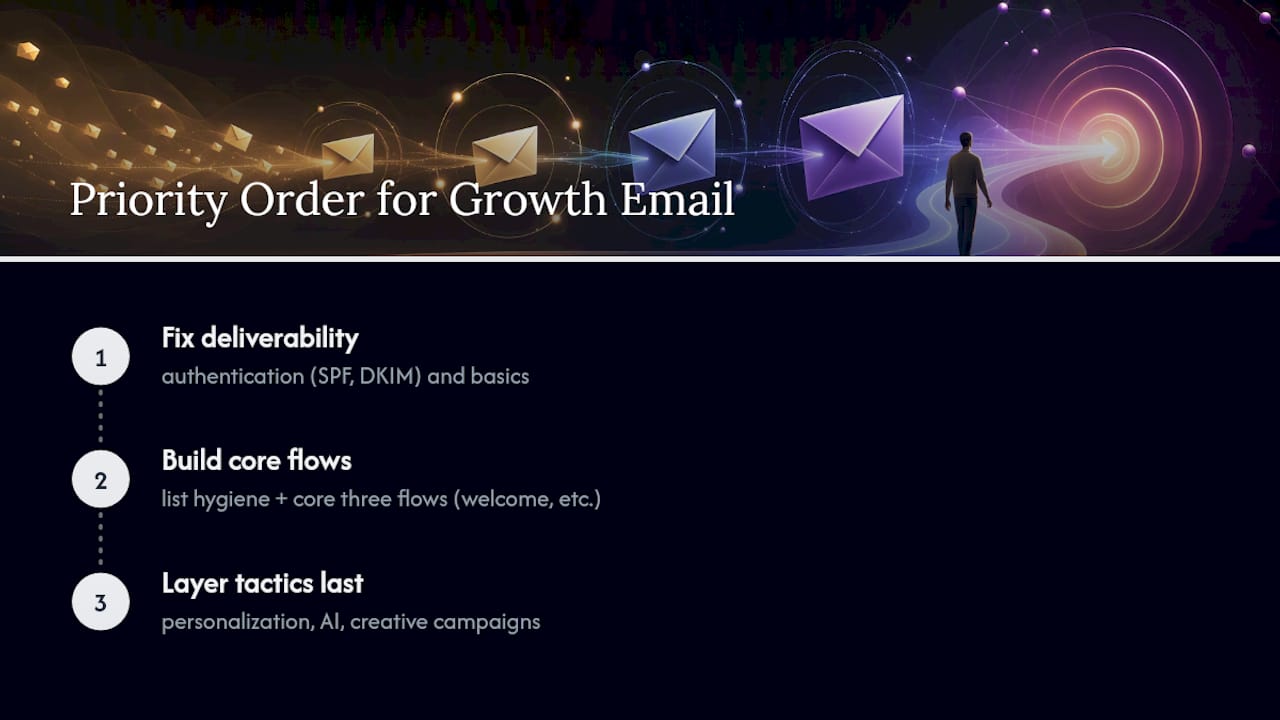
The conventional wisdom also overrates campaign creativity relative to structural fundamentals. A cleverly written newsletter sent to a list with 30% unengaged subscribers will underperform a plainly written welcome flow sent to a freshly opted-in audience, every time. Growth-stage teams chronically underinvest in the boring infrastructure work: authentication, list hygiene, and flow logic, because it doesn’t feel like “marketing” the way a campaign launch does.
If you take one thing from this article, prioritize the unglamorous work first. Fix deliverability, build your core three flows, then layer in the sophisticated tactics. The order matters more than the tactics themselves.
— Take
Get a Growth-Stage Email Program Built the Right Way
Take-action builds the exact sequence this article describes: deliverability fixed first, core flows built in the right order, then segmentation and AI personalization layered on once the foundation holds. That’s the difference from hiring a generalist marketer to “handle email” alongside five other channels, or trying to build flow logic yourself in spare hours between everything else running your business.
Take-action works specifically with ecommerce brands and online businesses already on Klaviyo or considering the switch, combining hands-on strategy with AI-driven optimization so campaigns stay aligned with your brand voice while the automation runs in the background. If your welcome flow hasn’t been touched in a year, or your abandoned-cart sequence doesn’t exist yet, that’s the fastest place to start. Reach out through the Take-action site to get a program assessment and see exactly which flows would move revenue fastest for your list.
Sources
- Email Marketing Statistics 2026: ROI, Open Rates, Automation & AI Benchmarks - Axis Intelligence
- Twilio blog: Build email marketing strategy (deliverability emphasis)
- Klaviyo blog: Build email marketing process (lifecycle flows and benchmarks)
- Stripo