

What Is a Nurture Sequence? A Practical Guide for Marketers
A nurture sequence is an automated series of emails that builds trust with opted-in prospects and moves them toward a specific action, whether that’s booking a demo, starting a trial, or making a purchase. It’s not a one-time blast or a cold outreach chain. Think of it as a structured conversation you’ve designed in advance, triggered by real behavior, that runs without you lifting a finger after setup.
A quick example: a 5-email welcome sequence that delivers a lead magnet on day 1, teaches one quick win on day 3, shares a customer result on day 5, handles the top objection on day 7, and asks for a demo on day 10. That’s a nurture sequence.
Here’s why it matters at a glance:
- Companies that excel at lead nurturing generate 50% more sales-ready leads at 33% lower cost.
- It replaces manual follow-up with consistent, relevant touchpoints that scale.
- It improves the marketing-to-sales handoff by delivering warmer, more qualified leads.
Table of Contents
- What does a nurture sequence actually do for your business?
- What types of nurture sequences should you know?
- How do you build a nurture sequence from scratch?
- Sample sequences and email templates you can use today
- How do segmentation and behavioral triggers make sequences smarter?
- Which metrics tell you if your sequence is working?
- What breaks nurture programs, and how do you fix them?
- Key Takeaways
- Why most nurture sequences underdeliver (and what actually fixes it)
- Ready to build nurture sequences that actually convert?
- Useful sources
What does a nurture sequence actually do for your business?
Most of your market isn’t ready to buy right now. Only about 3% of a market is actively buying at any moment, while roughly 40% are willing to buy but need nurturing first. Nurture sequences exist to work that 40%.
Where nurture sequences differ from standard drip campaigns comes down to intent. A drip sends emails on a fixed schedule regardless of what the recipient does. A nurture sequence responds to behavior: a pricing page visit, a clicked link, a downloaded guide. Nurture campaigns are built around customer data like site visits, cart activity, and email engagement, making them far more relevant than time-only sends.

The business outcomes are concrete. Done well, a nurture program lifts conversion rates, lowers cost-per-acquisition, and improves the MQL-to-SQL conversion rate by delivering leads to sales at the right moment rather than too early or too late. Each email in the sequence should have one measurable goal and one clear CTA. That constraint forces clarity and makes performance easy to diagnose.
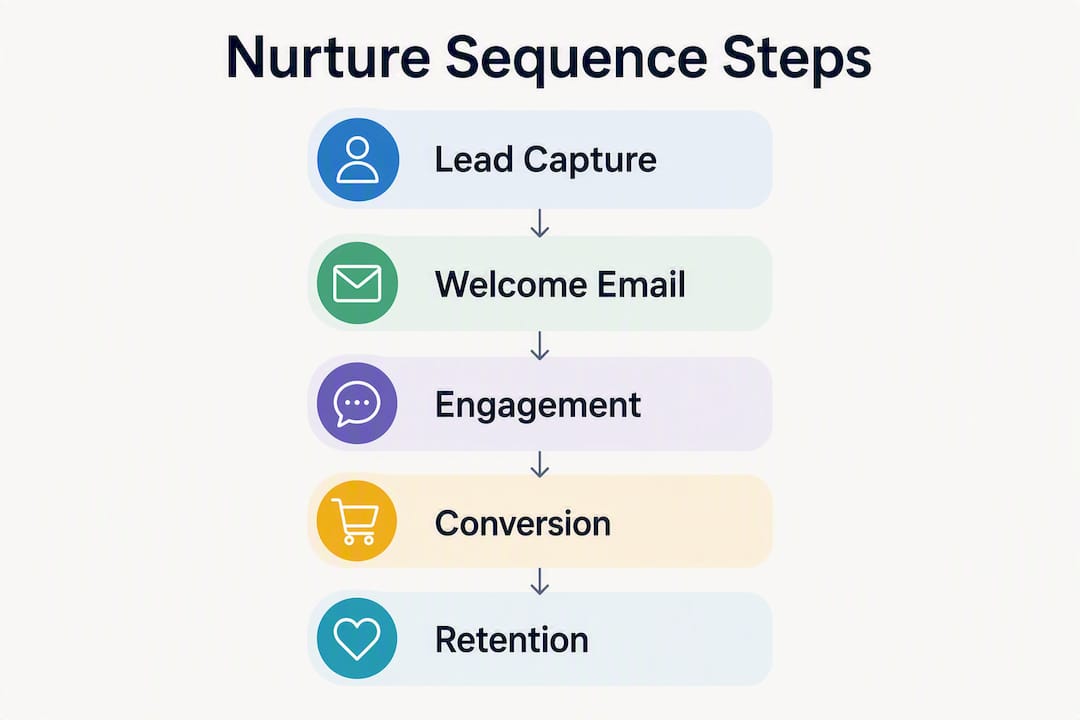
Nurture sequences belong at every stage of a funnel: top-of-funnel lead capture, post-demo follow-up, trial-to-paid conversion, and post-purchase retention. The mechanics are the same; the content and timing shift based on where the prospect sits.
What types of nurture sequences should you know?
Six sequence types cover the vast majority of business use cases. Each maps to a specific trigger and a recommended cadence.
| Sequence Type | Primary Goal | Trigger | Recommended Cadence |
|---|---|---|---|
| Welcome | Set expectations, deliver lead magnet, build credibility | Signup or opt-in | Email 1 within 1 hour; 3–5 emails over 7–10 days |
| Onboarding | Drive product activation and first value moment | Account creation or trial start | 4 emails over 2–4 weeks |
| Cart abandonment | Recover lost revenue | Cart abandoned, no purchase within 1 hour | 3 emails: 1 hr, 24 hrs, 72 hrs |
| Re-engagement | Reactivate cold subscribers | No opens or clicks after 30 days | 2–3 emails over 1–2 weeks |
| Post-purchase | Reduce buyer’s remorse, drive repeat purchase | Order confirmed | 3–5 emails over 30 days |
| Trial-to-paid | Convert free users to paying customers | Trial activated | 4 emails over trial period |
The one-sentence decision rule: match the sequence type to the action the prospect just took, not to where you wish they were in the funnel. Someone who abandoned a cart needs a recovery sequence, not an onboarding flow.
How do you build a nurture sequence from scratch?
Building a sequence that actually converts takes more than writing a few emails and scheduling them. Here’s the full process.
Pre-write checklist
Before writing a single word, confirm these five things:
- Define the entry point. Where does this lead come from? A webinar signup, a whitepaper download, and a paid ad click each carry different intent levels and need different starting content.
- Set one goal per email. Open, click, reply, demo book. One goal. One CTA. Never two.
- Check compliance basics. CAN-SPAM and GDPR require an unsubscribe link, a physical address, and honest subject lines. Build these in from the start.
- Set expected metrics. Know your baseline open rate and click-through rate before launch so you can measure improvement.
- Map the sequence length to the sales cycle. A 3-email cart-abandon sequence is right for ecommerce. A 10-email trial-to-paid sequence fits a SaaS product with a 14-day trial.
Map emails to buyer stage
Lay out each email on a simple grid: email number, buyer stage (awareness, consideration, decision), intent signal it responds to, and the one action you want the reader to take. This map prevents you from pitching too early or educating too late.

Write the copy
Subject lines drive opens. Keep them under 50 characters, avoid spam triggers, and test curiosity against clarity. Preview text is the second subject line; use it. Body copy follows the 80/20 content rule: at least 80% of your nurture content should be genuinely useful, non-sales material. The remaining 20% is where conversion asks live. Sequences that flip this ratio see engagement drop fast.
Set up automation
Configure entry triggers in your ESP (Klaviyo, ActiveCampaign, HubSpot, or similar). Tag each lead with their source on entry. Automated lead nurturing sends personalized content based on behavior, lifecycle stage, and CRM data, not just a fixed schedule. Set send windows to business hours or the time zone of your audience. Build branching rules for key behaviors: clicked pricing link, opened case study, no opens after three emails.
QA and launch checklist
- Test every link in every email.
- Verify personalization tokens render correctly (first name, company, product name).
- Send to at least two test accounts (desktop and mobile).
- Check deliverability: authenticate your domain with SPF, DKIM, and DMARC.
- Run a smoke test with a real opt-in before full launch.
Pro Tip: Set a calendar reminder for 30 days post-launch. That’s your first optimization window. Don’t wait longer.
Sample sequences and email templates you can use today
Three ready-to-adapt sequences cover the most common use cases. A 5-email sequence over about a week to 10 days consistently outperforms random drips for short B2B cycles, often converting significantly better.
5-email welcome sequence (lead magnet)
Purpose: Deliver the promised resource, build credibility, and move the lead toward a first conversation.
| Day | Goal | Subject Line Idea | |
|---|---|---|---|
| 1 | 0 | Deliver lead magnet + set expectations | “Here’s your [resource] — plus what’s next” |
| 2 | 2 | Teach one quick win | “The one thing most [role] get wrong about [topic]” |
| 3 | 4 | Share social proof | “How [Company X] got [result] in [timeframe]” |
| 4 | 5 | Handle the top objection | “The real reason [common objection]” |
| 5 | 9 | Ask for the demo or call | “Ready to talk? Here’s how to book a demo” |
Sample email body (Email 2):
Subject: The one thing most marketers get wrong about email timing
Hey [First Name],
Most teams send emails when it’s convenient for them, not when their subscribers are most likely to open. The fix is simpler than you’d think: check your ESP’s send-time optimization data for your list specifically, then shift your default send window by two hours. One client saw a 22% lift in opens from that single change. Try it this week and reply to let me know what you find.
[CTA: See the full timing breakdown →]
4-email onboarding sequence (trial users)
Purpose: Drive activation and get users to their first value moment before the trial ends.
- Email 1 (Day 0): Welcome + single first step to take right now.
- Email 2 (Day 2): Feature spotlight tied to the most common activation blocker.
- Email 3 (Day 5): Social proof from a user with a similar profile.
- Email 4 (Day 10): Soft upgrade ask with a clear comparison of free vs. paid.
For B2B, lean on case studies and ROI framing. For B2C, lean on ease-of-use and quick wins. The structure stays the same; the tone and proof points shift.
3-email cart-abandonment sequence
- Email 1 (1 hour after abandon): Remind, no pressure. Show the cart, offer help.
- Email 2 (24 hours): Address the most common hesitation (price, fit, shipping).
- Email 3 (72 hours): Create urgency or offer a small incentive if margin allows.
Pair these with automated workflow examples to see how the trigger logic maps to real ESP setups.
How do segmentation and behavioral triggers make sequences smarter?
Entry-point segmentation is the single biggest lever most teams leave unpulled. A lead who found you through a webinar has different intent than one who downloaded a whitepaper. Failing to match nurture content to the lead source significantly reduces sequence effectiveness because you’re addressing the wrong context from email one.
Common behavioral triggers worth branching on:
- Clicked the pricing link in any email: move to a higher-intent path or notify sales.
- Opened the case study email but didn’t click: send a follow-up that goes deeper on the same proof point.
- Visited the pricing page (tracked via ESP/CRM integration): trigger a soft demo-ask email within 24 hours.
- Trial activated: start the onboarding sequence immediately, not on a fixed weekly schedule.
- No opens after 3 emails: pause the sequence, try a re-engagement subject line, then suppress if still no response.
Two branching patterns cover most situations. A gentle detour keeps the lead in the main sequence but swaps one email for a more relevant version based on what they clicked. A hard switch moves the lead out of the nurture sequence entirely, either into a sales cadence (high intent) or a suppression list (no engagement). The soft side-door technique, placing a low-friction CTA like a quick demo booking mid-sequence, captures high-intent leads before they reach the final conversion email.
Keep branching manageable. Two to three branches per sequence is the practical ceiling for most teams. Beyond that, maintenance complexity outpaces the personalization benefit. When you need more relevance without more branches, use personalization tokens (first name, company, industry, product used) to vary the copy within a single email path.
Which metrics tell you if your sequence is working?
Track these KPIs from day one. The table below shows what each measures, a general benchmark range, and what to do when a number underperforms.
| KPI | What It Measures | General Benchmark | Action If Underperforming |
|---|---|---|---|
| Open rate | Subject line and sender reputation | About 20% (varies by industry) | Test subject lines; check deliverability |
| Click-through rate (CTR) | Body copy and CTA relevance | 2–5% | Simplify CTA; test button vs. text link |
| Click-to-conversion rate | Landing page and offer alignment | Varies by goal | Audit landing page; tighten offer match |
| Conversion rate to goal | Full sequence effectiveness | Depends on goal type | Review sequence arc; check cadence gaps |
| Unsubscribe rate | Content relevance and frequency | Under 0.1% per email | Reduce frequency; improve segmentation |
| Revenue per recipient | Direct revenue impact | Varies by product/price | Test offer timing; add mid-sequence CTA |
Secondary metrics worth watching: engagement depth (how far into the sequence leads progress), forward and share rates on high-value emails, and cohort retention for post-purchase sequences.
Review open and click rates every 30 days and prune emails that consistently underperform. A/B tests to run in the first 90 days: subject line (curiosity vs. clarity), send day (Tuesday vs. Thursday), CTA placement (top vs. bottom of email), and email length (short vs. medium). Run one test at a time per variable so results are clean.
What breaks nurture programs, and how do you fix them?
Most failed nurture programs are partial systems that skip stages. The welcome email doesn’t set expectations. There’s no email that handles the top objection. Goals per email are vague. These aren’t creative failures; they’re structural ones.
The five most common failure modes:
- No entry segmentation. Every lead gets the same sequence regardless of source. Engagement tanks because the content doesn’t match the context.
- Selling too early. Email 2 is a pitch. The lead hasn’t been given a reason to trust you yet.
- Wrong cadence. Seven emails in seven days for a high-consideration B2B product feels like harassment. Two emails over six weeks for an ecommerce cart abandon loses the sale.
- Ignoring unsubscribes. A rising unsubscribe rate is a content or frequency problem. Ignoring it damages sender reputation.
- Set-and-forget automation. Sequences left unchanged for six months drift out of alignment with current offers, pricing, and messaging.
Quick fix checklist for a broken nurture program:
- Audit each email for a single, clear goal.
- Tag all entry points and verify the right sequence fires for each.
- Apply the 80/20 content rule: count your value emails vs. sales emails and rebalance.
- Pull your 30-day open and click data and cut any email below half your average open rate.
- Check deliverability: SPF, DKIM, DMARC, and spam score.
Pro Tip: Before rebuilding a sequence from scratch, run a reply-rate audit. If leads are replying to certain emails but not others, those are your anchors. Build the new sequence around what’s already working.
Key Takeaways
A well-built nurture sequence generates more sales-ready leads, reduces manual follow-up, and converts better when it pairs behavioral triggers with a consistent 80/20 value-to-sales content ratio.
| Point | Details |
|---|---|
| One goal per email | Each email needs a single measurable goal and one CTA to stay diagnosable and effective. |
| Start with a 5-email welcome | A 5-email welcome sequence over 7–10 days consistently outperforms random drips for short sales cycles. |
| Segment at entry | Match nurture content to the lead source from email one; mismatches lower open and click rates. |
| Review every 30 days | Treat sequences as living campaigns: prune underperformers, test subject lines, and adjust cadence monthly. |
| Take-action builds and optimizes flows | Take-action specializes in Klaviyo-based nurture flows, from welcome and cart-abandon to post-purchase retention. |
Why most nurture sequences underdeliver (and what actually fixes it)
The conventional wisdom says build a sequence, set it live, and let automation do the work. That framing is what causes most programs to stagnate.
The sequences that actually move revenue share one trait: they’re treated as editorial products, not infrastructure. Someone owns them. Someone reviews the data. Someone rewrites the email that’s been sitting at a 9% open rate for four months. The automation handles delivery; humans handle the thinking.
The other thing most guides underemphasize is the cost of early selling. An email sequence that leads with a pitch before it’s earned attention doesn’t just fail to convert. It trains the subscriber to ignore you. That damage compounds across every email that follows, which is why the 80/20 rule isn’t just a content preference. It’s a trust-building mechanism.
Behavioral triggers are the other underused lever. Most teams set up a welcome sequence and call it done. The real lift comes from branching on intent signals: the lead who clicks your pricing link on day 4 is a fundamentally different conversation than the one who opened your case study but didn’t click. Treating them identically wastes both.
For ecommerce brands, email’s role in customer retention extends well past the first purchase. Post-purchase sequences that deliver genuine value, not just upsell pitches, are where long-term revenue compounds.
Ready to build nurture sequences that actually convert?
If you’ve read this far, you know what a well-built nurture sequence looks like. The harder part is building one that fits your brand, your audience, and your existing tech stack, then keeping it optimized as your business grows.
Take-action is a specialized email marketing and retention agency that builds and manages Klaviyo-based nurture flows for ecommerce brands and online businesses. The difference from doing it yourself: you get a team that has already run the tests, knows which cadences work for which audiences, and can set up welcome flows, cart-abandon sequences, and post-purchase programs without the months of trial and error.
The starting point is a free flow audit. Take-action reviews your current email setup, identifies the sequences you’re missing or underperforming, and maps out a prioritized build plan. No long pitch, just a clear picture of where the revenue is leaking and how to stop it. Book your free audit and get a sequence strategy built around your specific funnel.
Useful sources
- Building High-Converting Email Nurture Sequences — Jottler: Source for the 50% more sales-ready leads / 33% lower cost stat, the 5-email sweet spot finding, and the 30-day review cadence recommendation.
- Automated Lead Nurturing: Step-by-Step Guide — Sendspark: Source for behavioral trigger mechanics, entry-source segmentation impact, and the partial-systems failure mode.
- Nurture Sequence: How to Build One That Converts — Alex Berman: Source for the 80/20 content rule and the soft side-door mid-sequence CTA technique.
- Build Relationships with Nurture Campaigns — Mailchimp: Source for the distinction between nurture campaigns and drip campaigns, and the role of customer data in personalization.
- How To Create Nurture Sequences For Prospects — Which-50: Practitioner framework for grouping prospects by intent and structuring emails around awareness, consideration, and decision stages.
- Mastering Email Nurturing — AWeber: Structural guidance on the welcome-to-offer arc and example sequence for online coaches.
- Nurture Sequence — GTMStack Glossary: GTM operations framing for nurture sequences and the buyer-journey mapping principle.