

What Is Email Marketing Infrastructure for Ecommerce Brands?
Email marketing infrastructure is the connected system of ESP configuration, lifecycle flows, segmentation logic, dynamic templates, and revenue tracking that turns a customer database into automated revenue. For an ecommerce brand, that means Klaviyo synced to your store data, a set of behavior-triggered flows running in the background, and reporting that ties dollars back to specific sends. Built correctly, it runs without daily babysitting and produces revenue while you sleep.
If you’re auditing a program someone else built (or deciding whether to hire someone to build one), check these first:
- ESP sync and data flow: is Klaviyo actually receiving order, browse, and profile events in real time, or just email opens?
- Flow coverage: are welcome and abandoned checkout live, and are segments built on purchase behavior instead of opens and clicks?
Two numbers tell you quickly whether the setup is healthy. Flows should contribute a substantial portion of total email revenue, and you should be able to state a revenue-per-recipient figure for every flow without guessing.
Key Takeaways
Email marketing infrastructure succeeds when flows are built in priority order, segments are anchored in purchase behavior, and revenue-per-recipient drives every decision instead of open rate.
| Point | Details |
|---|---|
| Build flows before campaigns | Welcome and abandoned checkout capture the highest-intent moments and should launch in week one. |
| Anchor segments in purchase data | RFM buckets like Champions and At-risk outperform open or click-based segments post-MPP. |
| Track RPR, not opens | Revenue-per-recipient and flow contribution percentage are the honest measures of program health. |
| Use dynamic content, not more campaigns | Show/hide logic personalizes a single send instead of multiplying template versions. |
| Take-action builds to this exact playbook | Its Klaviyo setup, flow sequencing, and RPR-based reporting follow the priorities outlined throughout this article. |
Table of Contents
- The Components: ESP Sync, Flows, Segmentation, and Governance
- Which Email Flows Should You Build First?
- How Should You Segment an Email List for Revenue?
- Templates and Dynamic Content Without Building 20 Campaign Versions
- What Metrics Actually Prove the Infrastructure Works?
- Building the Infrastructure: A Realistic Timeline
- Why Take Action Builds Infrastructure This Way
- The Build Order Most Agencies Get Backward
- Get a Scoped Audit of Your Email Infrastructure
- Frequently Asked Questions
- Sources
The Components: ESP Sync, Flows, Segmentation, and Governance
Everything in a Klaviyo-based program sits on top of four connected layers. Miss one and the rest wobble.
- The ESP and its data sync. Klaviyo needs a live, bidirectional connection to Shopify or your ecommerce platform, pulling order history, product catalog, and browse events, not just email addresses. Without that sync, every flow downstream runs on guesswork.
- Flows versus campaigns. Campaigns are one-time sends to a list. Flows are automated sequences triggered by behavior, and they’re the backbone of retention because they run continuously without a marketer hitting send. A welcome flow fires the moment someone joins your list, no matter when that happens.
- The three data layers. Transactional data (orders, refunds, AOV) tells you what someone bought. Behavioral data (browse sessions, cart activity, clicks) tells you what they’re considering. Profile data (signup source, preferences) tells you who they are. Segmentation and personalization both depend on having all three feeding Klaviyo cleanly.
- Operational governance. Someone has to own event mapping (making sure “Placed Order” and “Viewed Product” fire correctly), suppression lists (bounces, unsubscribes, spam complaints), and automation rules that prevent flows from colliding or over-messaging the same person.
A brand evaluating an ecommerce automation build should ask specifically how event mapping was validated, not just whether flows “are live.” A flow with broken triggers looks fine in the Klaviyo dashboard and produces nothing in revenue.
Which Email Flows Should You Build First?
Flows punch far above their weight. Klaviyo lifecycle flows generate roughly 41% of email revenue from about 5.3% of total sends, which means a handful of automated sequences carry the financial load that hundreds of one-off campaigns can’t match. That ratio is the whole argument for building flows before you worry about campaign calendars.
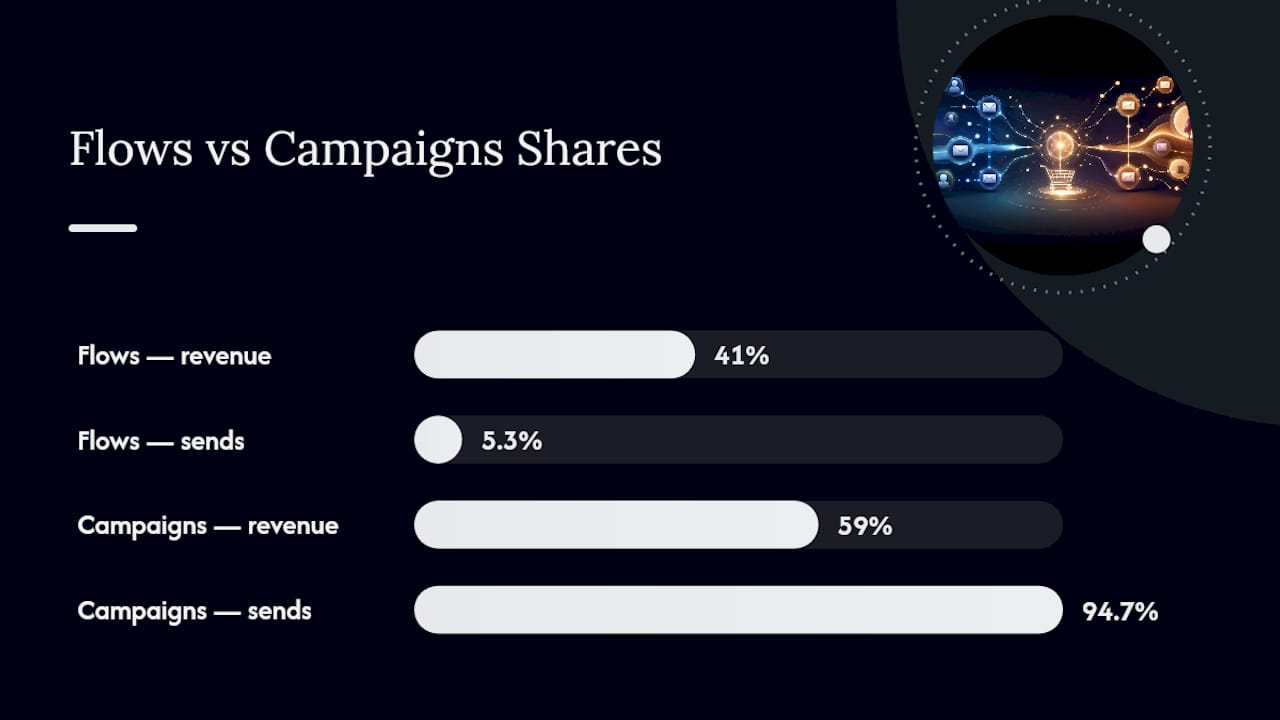
Build order matters because early flows compound. Welcome and abandoned checkout together often account for 40 to 60% of total flow revenue in the first few months, since they catch people at the exact moment of highest intent, someone who just signed up or someone who put a card number into your checkout form. Everything after that is important but less urgent.
Here’s the sequence we recommend building in, with what to expect from each:
| Flow | Trigger | Typical outcome to track |
|---|---|---|
| Welcome series | List signup | Early revenue-per-recipient, list warmup |
| Abandoned checkout | Checkout started, not completed | Cart recovery rate |
| Abandoned cart | Product added, no checkout | Cart recovery rate |
| Post-purchase | Order placed | Repeat purchase rate |
| Browse abandonment | Product viewed, no cart add | Revenue-per-recipient (lower volume) |
| Win-back / replenishment / VIP | Inactivity window or purchase cadence | List-attributed revenue, retention lift |
Rank each flow by revenue-per-recipient once it has enough volume to mean something, generally a few hundred triggers before you draw conclusions. Testing subject lines or send timing on a flow that fires ten times a week won’t produce a usable signal for months.
How Should You Segment an Email List for Revenue?
Open and click-based segments have gotten unreliable since Apple’s Mail Privacy Protection started inflating open rates across the board. A segment built on “opened in the last 90 days” tells you almost nothing about buying intent anymore. Purchase behavior is a far more honest signal, and it’s the foundation Klaviyo’s own segmentation framework recommends building on.
RFM (recency, frequency, monetary) analysis gives you a practical structure:
- Champions: recent, frequent, high spend. Protect these relationships; don’t over-discount them.
- Loyal actives: consistent purchasers who haven’t hit VIP spend thresholds yet.
- At-risk: past frequent buyers whose recency is slipping. This is where win-back messaging earns its keep.
- Win-back candidates: lapsed further than at-risk, worth one dedicated re-engagement push.
- Dormant: no purchase or engagement in a long window. Suppress or run a final, low-frequency attempt before dropping them.
Refresh these buckets monthly for most brands; weekly if you sell a fast-repeat consumable.
Zero-party data (a stated preference, like fragrance-free or a size range) earns its place only when it will change what you send. Collecting preference data nobody acts on is just friction at signup with no payoff.

Pro Tip: Before adding another survey field to your popup, ask what specific email content would change based on the answer. If nothing changes, drop the question.
For exclusions, hold three lines firm: exclude recent purchasers from acquisition-style campaigns for at least a week, honor every suppression instantly, and cap send frequency for your most-emailed segment so engagement doesn’t quietly erode.
Templates and Dynamic Content Without Building 20 Campaign Versions
Show/hide logic inside Klaviyo templates lets one email serve multiple audiences at once, which is how mature programs scale personalization without their campaign count exploding.
Practical patterns worth stealing:
- A rewards-member block that appears for enrolled customers and disappears for everyone else, in the same send.
- A “welcome back” section for lapsed purchasers versus a cross-sell section for someone who bought last week.
- Ordered-product insertions that pull in a customer’s actual purchase history to recommend a complementary item.
Reserve a separate campaign for genuinely different offers or audiences, like a region-specific promotion. Use dynamic blocks for everything else. Every template still needs mobile-first rendering (most email opens happen on a phone) and a CTA button large enough to tap without missing, not a text link buried in paragraph three.
What Metrics Actually Prove the Infrastructure Works?
Open rate tells you almost nothing anymore. Revenue-per-recipient (RPR) is the metric that separates flows and campaigns that pay for themselves from ones that don’t.
Track these on a recurring cadence:
- Revenue-per-recipient, aiming directionally for $0.18+ on campaigns and $0.35+ on flows as a maturity signal.
- Flow contribution percentage, the share of total email revenue coming from automated flows. Mature programs push this above 45%.
- List-attributed revenue, tracked with a 5-day click attribution window rather than a 30-day window that overstates email’s role.
Segment every one of these by AOV cohort. A brand with a $40 AOV and one with a $400 AOV should not be judged against the same RPR benchmark.
Building the Infrastructure: A Realistic Timeline
A properly scoped build follows a predictable rhythm. Rushing it produces flows that technically exist but don’t convert.
- Week 0: full data audit and event mapping validation, confirming Klaviyo receives clean order and browse data.
- Week 1: welcome and abandoned checkout flows live, since these capture the highest-intent moments first.
- Weeks 2 through 8: abandoned cart, post-purchase, and browse abandonment added and tested.
- Month 3 and beyond: win-back, replenishment, and VIP tracks layered in, followed by continuous optimization.
That pacing lines up with what practitioners consider a sensible rollout: two to three weeks for core flows, two to three months for the full suite. At each phase, your agency should hand over specific segments, tested templates, and a reporting dashboard, not a vague status update.
Pro Tip: If a proposal skips straight to “full automation suite in week one,” that’s a red flag. Nobody validates event mapping and ships six flows correctly in seven days.
Why Take Action Builds Infrastructure This Way
Take-action runs Klaviyo builds around the same priorities laid out above: welcome and checkout flows first, RFM-anchored segmentation, and reporting built on revenue-per-recipient instead of opens. That’s not incidental. It’s how the numbers actually move.
Our services cover the full stack a brand needs to stop guessing:
- Klaviyo setup and event mapping validation
- Lifecycle flow build in the priority order that produces revenue fastest
- RFM segmentation and dynamic template design
- AI-assisted testing and ongoing optimization through managed retainers
, and our engagements typically include alongside.
The Build Order Most Agencies Get Backward
Most infrastructure advice treats segmentation like a creative exercise, dozens of clever audience slices built for their own sake. That’s backward. A segment only earns a place in the program if it changes what gets sent or recovers revenue that would otherwise disappear. Champions and at-risk buyers matter because the message genuinely differs; a “people who clicked twice in March” segment usually doesn’t.
The bigger miss I see across brands evaluating their own setups: teams chase open rate improvements on flows that are already converting fine, while their win-back and browse abandonment flows sit unbuilt for months. Fix the flow that doesn’t exist before you tune the subject line on the one that does.
If you take one thing from this playbook, prioritize build order over polish. A rough welcome flow live this week outperforms a perfectly designed one launching next quarter. Revenue-per-recipient, not inbox aesthetics, is the number that should drive every decision in the segmentation strategy you build next.
Get a Scoped Audit of Your Email Infrastructure
Take-action is the alternative to guessing whether your current setup is actually working. We audit your Klaviyo account against the exact build order and RPR benchmarks covered above, then tell you plainly what’s missing, what’s underperforming, and what to fix first.
Whether you’re vetting a current agency’s work or starting from a blank Klaviyo account, a scoped audit gives you a prioritized list instead of a guess. For a look at automated efficiencies beyond email, DojoTrack’s take on communication automation is worth a read too. Ready to see where your infrastructure actually stands? Request a scoped audit from Take Action and get a build plan back, not a sales deck.
Frequently Asked Questions
What is email marketing infrastructure in simple terms? It’s the combination of your ESP configuration (typically Klaviyo for ecommerce), automated flows, segmentation rules, templates, and analytics that together turn customer data into automated, trackable revenue.
Why is Klaviyo the recommended ESP for ecommerce brands? Klaviyo’s native, deep sync with Shopify and other ecommerce platforms pulls order, browse, and profile data directly into segmentation and flow logic, which generic email tools handle far less precisely.
How long does it take to build a full email infrastructure? Core flows like welcome and abandoned checkout can launch within one to three weeks. A complete suite including win-back, replenishment, and VIP tracks typically takes two to three months.
What percentage of email revenue should come from flows? A mature program usually sees flows contribute a substantial portion of total email revenue, since flows run continuously off a small share of total sends.
How do I know if my current agency built this correctly? Ask for revenue-per-recipient by flow, confirm event mapping was validated (not just assumed), and check that segments are built on purchase behavior rather than opens or clicks.
Sources
- Klaviyo: Ecommerce segmentation framework
- How to build a high-ROI email marketing engine for ecommerce in 2026
- Klaviyo lifecycle email flows for ecommerce in 2026